
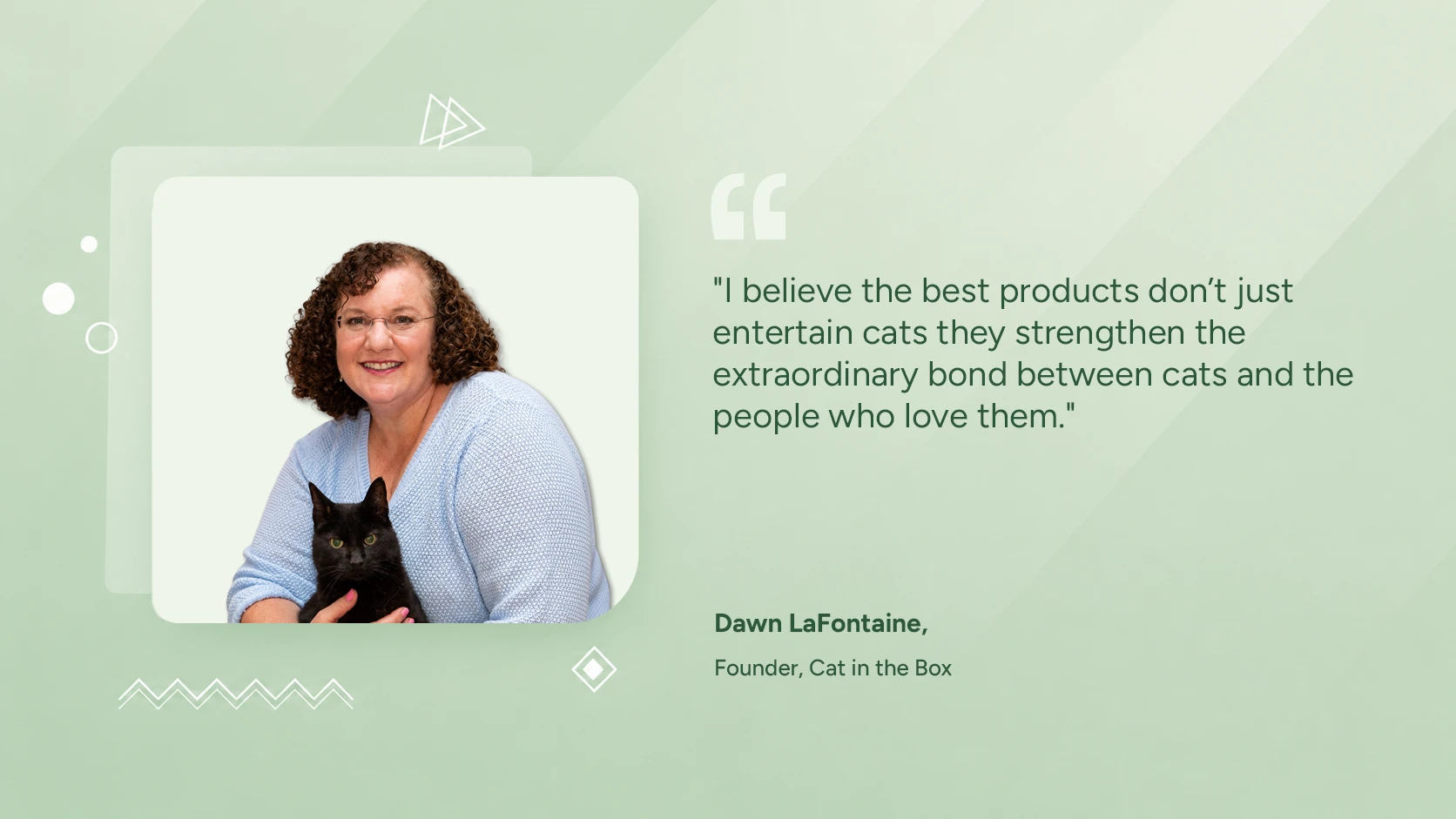
- Started Cat in the Box later in life, turning job losses and rejections into a successful business through persistence and lived experience.
- Built products solving a real, observed problem: attractive, safe cat toys that satisfy cats and appeal to guardians' home aesthetics.
- Learned by iterating: redesigning for shipping cost constraints, fixing packaging errors, and relying on a peer focus group for faster solutions.
Most founder stories begin with an advantage. A technical skill, an industry contact, a few years of runway. Dawn had none of those. She had 23 years out of the paid workforce, a husband who had just lost a job he held for 15 years, and a stack of rejections from employers who looked at applications for roles she was overqualified for and passed anyway. The conventional read on that situation is that the window has closed. Dawn read it differently. If no one was going to hire her, she was going to have to build the job herself.
The idea came from a cat sitter’s living room stacked with ordinary cardboard boxes. Every cat person on the internet knows cats love boxes. What Dawn saw was that nobody’s needs were actually being met. Some boxes were too small, some too big, some made of the wrong material, and all of them were an eyesore in a room where humans also live.
About Dawn LaFontaine
Dawn LaFontaine is the founder of Cat in the Box, a cat toy and enrichment brand built on one belief: products for cats should make both the cat and the human happy. She spent 23 years as a stay-at-home mother before starting the company, launching it after her last child left for college and her husband was laid off from a job he had held for 15 years.
Cat in the Box’s products, from its original cardboard box designs to its current line of wool toys handmade by a World Fair Trade-certified craft guild in Nepal, are built for cat guardians who want their homes to look as good as their cats feel. Dawn describes her mission simply: “I make cats happy.”
Key Takeaways
- Cat in the Box expanded its original cardboard box catalog with wool toys handmade by a Nepal-based Fair Trade guild, selling over 20,000 units in about two years.
- A quarter-inch packaging error cost thousands of dollars in Amazon fees, proving that shipping and packaging math can break a margin as fast as a bad product decision.
- A shipping rate spike forced Dawn to redesign one product multiple times, trading an assembled, ready-to-play format for a compact one customers could actually build.
- Dawn built a weekly focus group of women business owners specifically so she would not have to solve every problem alone.
- Dawn started the business the same year her last child left for college, and her husband lost a 15-year job, and credits this stage of life, not her 20s or 30s, with giving her the ability to persevere.
The Interview
You entered eCommerce without a traditional background in the industry. What did you have to learn the hard way during those first few years?
I feel like I had to learn everything the hard way at first. I’ve since joined a community of eCommerce sellers so I don’t have to keep reinventing the wheel. I also belong to a focus group of women business owners who meet weekly to discuss business problems and challenges. Chances are, if one of us is going through something, another one of us has already gone through it and can light the path.
You spent 23 years as a stay-at-home mother before starting Cat in the Box. What happened in your life that made you decide it was time to build a business of your own?
I found myself at a crossroads in my life.
My last child was heading off to college, and I was asking myself, “What’s next?” when my husband was laid off from a job he’d held for 15 years. I applied for traditional jobs I was overqualified for just to help make ends meet, but wasn’t offered any of them.
I realized that I was going to have to create my own working future if I was going to have one.
The idea for Cat in the Box came from seeing a cat sitter’s living room filled with ordinary cardboard boxes. What did you see in that moment that everyone else seemed to overlook?
If you’ve spent even 7 1/2 minutes on the Internet, you already know cats are crazy for cardboard boxes. There’s actually some serious science that explains why. In fact, if you have a cat, you should provide him with a cardboard box to give him the opportunity to perform some natural cat behaviors, even if it isn’t one of mine.
What I saw in that living room was an opportunity. The cats’ needs weren’t necessarily getting met (some of the boxes were too small, or too big, or weren’t made of the right material), and the guardians’ needs weren’t getting met either. Who wants an eyesore in their living room?
Cats already love cardboard boxes, so what made you believe people would actually pay for a better-looking version of something they could get for free?
What I’ve learned from my own experience, and from the experience of so many of my colleagues in ecommerce, is that you never know what people are going to buy. Just because you think something is a terrific idea doesn’t mean it’s going to sell. And vice versa. If someone had shown me a fidget spinner, I probably would have passed on that opportunity.
When I created my first box designs, there was literally nothing like them on the market. Now there are dozens of fancy cardboard boxes for cats on Amazon. None of them are made in the USA, the way mine are, and they’re imprinted with digital inks, which have an unknown safety profile, but that doesn’t stop cat people from buying them.
While I still sell my own box designs, I’ve pivoted to other cat products now.
What did the earliest version of Cat in the Box look like, and how different was it from the products you sell today?
When I started Cat in the Box, I had two products: a cardboard box shaped like a giant milk carton, and another shaped like a giant wedge of cheese. These products require expensive tooling for manufacture, and it was a big financial risk creating just these two products.
Today, I’m selling a line of wool toys of my own design, handmade for me by a World Fair Trade-certified craft guild in Nepal. They’re extremely popular – I’ve sold over 20,000 of them in about 2 years.
You’ve described the learning curve as steep and said that every day starts with a new problem to solve. What has been the hardest problem you’ve had to solve since launching Cat in the Box?
My biggest challenges came up right away in my business journey.
I’d designed my first products to come assembled and ready-to-play. Shipping rates at the time supported this approach. But shipping rates went up dramatically one year, and I was forced to rethink.
I designed a product that was very compact and more cost-effective to ship. It took almost a year to get it right, or what I thought was right. Customers liked the product, but some had trouble assembling it. Some felt that the roof was too flimsy.
So I went back to the drawing board a third time and came up with a terrific design that cat guardians really love. I’m really proud of this product.
Was there a particular mistake or failed experiment that ended up teaching you one of the most important lessons about running the business?
I think all the mistakes add up. When you hear about a successful business owner, what you don’t hear about are all the failed ideas and products that came before the big one that worked. It always sounds like they had a light-bulb moment, went straight to work, and sold a million units in their first month. But now that I have a little more behind-the-scenes look at my colleagues’ businesses, I know that is absolutely never true.
I’ve made a lot of mistakes – from the product design issues I described above, to packaging mistakes (a quarter of an inch too wide on a product cost me thousands in Amazon fees), and beyond. But every mistake has helped me refine my understanding of selling online.
What did your first customers teach you about why people buy Cat in the Box not just for their cats, but for themselves?
We live and play with our cats in the house. It’s not surprising that people want cat items that they can be proud to display in their homes.
We also tend to think of our pets as extensions of ourselves. I realized that people want toys that appeal to them as well as to their cats.
I like to make products that meet the psychological and biological needs of cats while also appealing to the aesthetic preferences of their guardians.
How do you differentiate Cat in the Box in a pet market filled with inexpensive mass-market products and increasingly sophisticated direct-to-consumer brands?
My audience is not all cat guardians. I can’t be everything to everyone. My customers are people who really care about making sure that their cats live interesting and fulfilled lives. They’re willing to pay more for cat toys and playhouses that meet those needs.
Was there a moment when you realized Cat in the Box was no longer simply an interesting product idea, but a real business with the potential to grow?
I’ve always thought that cats are an underserved market. If you go to any of the Big Box pet stores, there are aisles of toys for dogs. The cat aisle comprises a few small balls and some low-quality catnip-stuffed mice.
The key for me was to find products that cat guardians want that also make economic sense to produce.
What has surprised you most about building a company at this stage of your life compared with what you expected when you started?
I honestly thought it would be easier!! I had no idea what I was getting myself into, and I’m so glad that I didn’t. If I had, I might have been intimidated and not done it at all. I would have missed out on one of the most challenging, interesting, and fulfilling things I’ve ever undertaken.
This stage of life was the perfect time to undertake a project like this. I have learned a lot about myself and my ability to persevere by actually living a lot of years. I’m not sure how I would have handled the hard work, mental challenges, and frustration of running a business in my 20s or 30s.
What have you learned about entrepreneurship that you could only have learned by actually running the business?
Everything I have learned about entrepreneurship could have only been learned by actually doing it.
What would you tell someone who has a business idea but believes they don’t have the experience, background, or “right” time in life to pursue it?
I would say that the idea is rarely the thing. The implementation is. And there’s a good chance that your first idea isn’t the one you’re going to ultimately pursue anyway. Maybe not the second or third idea either.
As for experience or background – I’m living proof that you can develop the skills you will need to be a successful business owner. You only have to have the drive to learn.
Finally, the “right time in life” is something to really consider. There is no way that I personally could have built this business while I was raising kids, but there are people who do it. On the other hand, if you’re one of those people who never seem to “have the time” in their life to pursue a project like a new business, it’s possible that this isn’t the kind of thing that’s right for you. It’s not for everyone, and there’s nothing wrong with that.
Lessons for Founders
- Start from a real problem you have personally witnessed rather than a market gap you only read about. Dawn built her first box designs after noticing unmet needs in a cat sitter’s living room, not from competitive research.
- Treat rising costs as a redesign signal, not a reason to quit. A shipping rate hike forced Dawn to rebuild one product three times before it worked.
- Build a recurring peer group before you need one. Dawn’s weekly focus group of women business owners exists so she is not reinventing solutions alone.
- Design for both ends of the purchase: the buyer and the user. Dawn’s toys are built to satisfy a cat’s instincts and a cat guardian’s taste for their own home.
- Question the “right time in life” honestly instead of assuming earlier is always better. Dawn says the perseverance she needed came from years lived, not youth.
For more founder stories and growth strategies from operators who have built from the ground up, read more at eFounder.club.