
- Left consulting to launch Portraits de Famille, proving aesthetic with three internal capsules before securing LikeLewis and building credibility for artist collaborations.
- Built Collector's Club, a raffle-based access system to replace first-come-first-served drops, improving fairness, transparency, and community engagement.
- Prioritize consistency, transparency, and product quality over discounts; retention, community and credible storytelling make scarcity meaningful and sustainable.
Most founders leave stable career for idea they can’t stop thinking bout. Gon left consulting for garment. Not garment itself, but what it could carry: artist’s story, documented narrative, piece of culture someone actually wear and live in rather than hang on wall. That bet became Portraits de Famille…
What makes Gon’s story worth reading isn’t just pivot from consulting to fashion. It’s what happen after brand found footing. To fix fairness problem he saw in own product drops, he built internal raffle-based system called Collector’s Club. It worked so well, other founders start asking to buy it.
About Gon
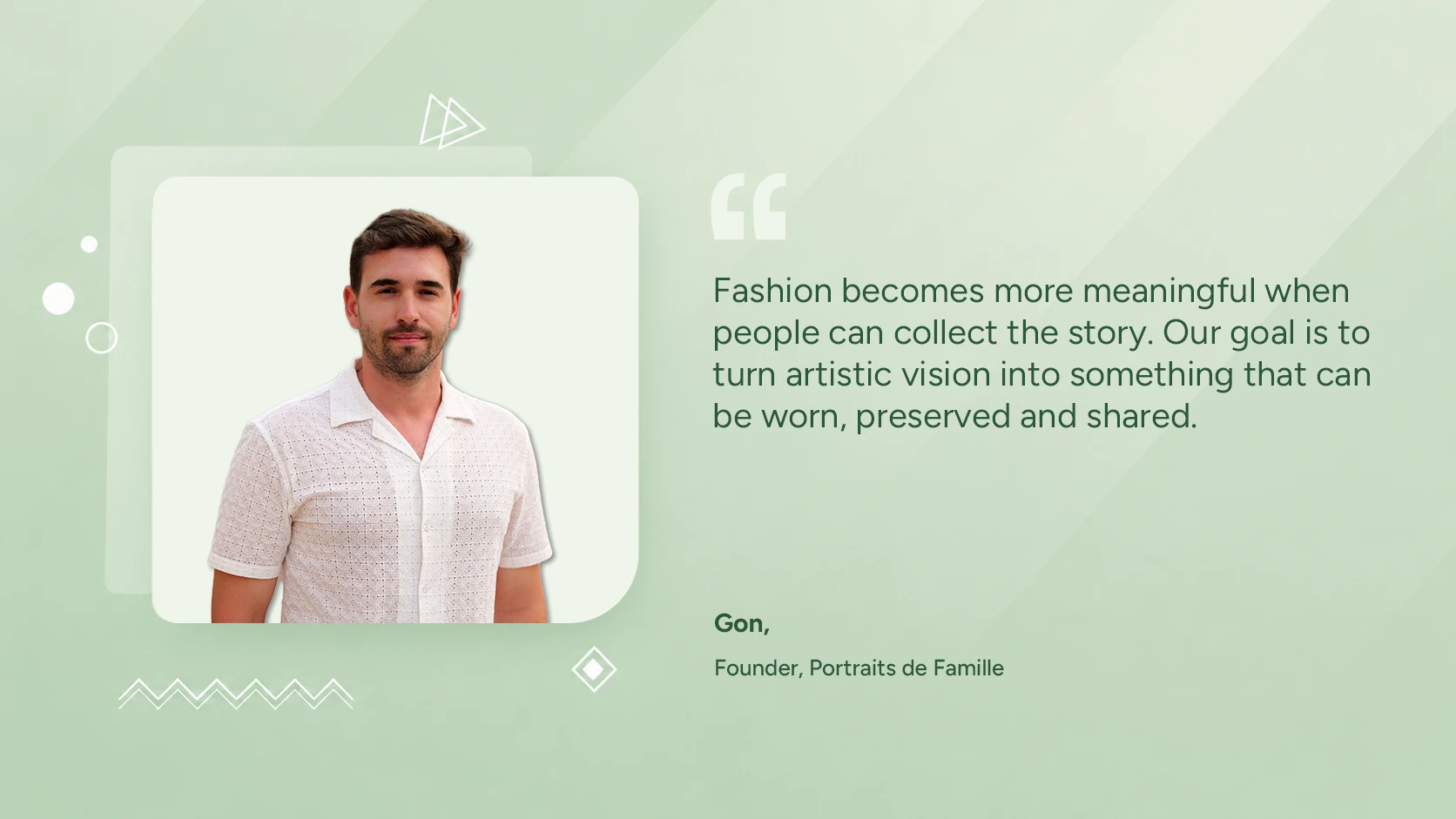
Gon is the founder of Portraits de Famille, an art-driven fashion brand built on a simple premise: a garment can be a living canvas for an artist’s story, not just a decorated piece of clothing. Before founding the company in 2024, he spent years in consulting, where new projects, changing teams, and tight deadlines taught him how to structure ambiguous problems and manage several priorities under pressure.
Portraits de Famille launched with three internal, brand-led capsules: modern casual chic, contemporary minimalism and Mediterranean elegance, before bringing on its first outside collaborator, the artist LikeLewis. Each capsule since has paired a distinct artist’s visual language with the brand’s Mediterranean identity, turning the resulting garments into wearable pieces connected to a documented narrative.
To fix the fairness problems built into conventional first-come-first-served product drops, Gon also created the Collector’s Club, a raffle-based access platform that started as an internal tool and is now being explored as a standalone SaaS product for other brands.
Key Takeaways
- Portraits de Famille didn’t approach artists until it had proof of its own identity: three internal capsules, modern casual chic, contemporary minimalism, and Mediterranean elegance.
- LikeLewis agreeing to collaborate with an unproven brand created the credibility that made every later artist partnership possible.
- The Collector’s Club uses raffle-inspired mechanics instead of first-come-first-served checkout, so connection speed and bots no longer decide who gets access to rare pieces.
- A system built to fix Portraits de Famille’s own launch problems is now being adapted into a SaaS platform, after other founders recognized the same friction, opaque scarcity, and short-lived hype in their own drops.
- Portraits de Famille has never discounted its products. It uses a free-shipping threshold to encourage larger orders instead, protecting the perceived value of artist-led, limited-edition pieces.
The Interview
When you entered the market in 2024, what was the biggest challenge you faced as an unknown brand competing for attention in an already crowded fashion industry?
The greatest challenge was earning attention without already having an audience, celebrity founder or established reputation. Fashion is full of new brands and even a strong product can disappear into a vast sea of visual sameness. Having a clear identity and a differentiated proposition is essential, but that is only the beginning. You must then make enough people notice and care.
This affected both sides of the business. We needed customers to trust an unfamiliar brand enough to purchase a premium garment, but we also needed artists to invest their creative work in a collaboration with a company that had not yet proven itself. The first “yes” therefore mattered enormously. LikeLewis was the first artist to believe in the project, and that collaboration created credibility for the partnerships that followed.
The experience taught me that consistency is an underrated form of brand building. There was no single viral moment that solved the problem. We had to keep producing, communicating, improving, and showing up. Over time, that consistency became evidence that the brand was serious and that the vision was not temporary.
What were you doing before starting Portraits de Famille, and what made you decide to leave consulting and build a business in fashion?
Before Portraits de Famille, I worked in consulting. It was a demanding environment defined by new projects, changing teams, tight deadlines, and the expectation that you would learn unfamiliar subjects quickly while consistently delivering high-quality work.
It taught me how to structure ambiguous problems, manage several priorities under pressure and become someone others could depend on.
Those lessons remain central to how I operate today, but I eventually wanted to build something more personal.
Something that combined creativity, culture and storytelling with the analytical and operational skills I had developed.
I had always been drawn to art, fashion and the visual atmosphere of Southern Europe, particularly the effortless elegance of the Mediterranean and French Riviera.
Leaving consulting was a decision to apply what it had taught me to an idea that felt closer to my identity.
I wanted to build a brand with its own cultural world, empower artists through meaningful collaborations, and explore how technology could improve the experience of collecting limited-edition fashion.
How did the original idea for Portraits de Famille come about, and what made you believe there was an opportunity to combine fashion with collectible art?
The original idea began with the belief that clothing could serve as a living canvas. Art is usually experienced on a wall, in a gallery or through a screen, whereas a garment allows an artwork and its story to move through everyday life. It can travel, spark conversations, and become connected to the memories of the person wearing it.
I saw an opportunity to create capsule collections in which artists would not simply license an image or provide decorative input. Instead, each artist could help shape a complete creative chapter through their personal story, visual language and interpretation of a wider theme. This would give collectors something more meaningful than a graphic garment: a wearable piece connected to a real creator and a documented narrative.
We initially launched three internal, brand-led capsules to establish our visual canvas: modern casual chic, contemporary minimalism and Mediterranean elegance. That gave us a foundation before introducing our first artist collaboration with LikeLewis.
The response confirmed that people were interested not only in the individual designs, but also in the stories, artists and broader world surrounding them.
How did you approach finding and convincing your first artists to collaborate with the brand, and what did those early partnerships teach you about building creative collaborations?
I looked for artists with an immediately recognizable visual language, but aesthetic compatibility was only part of the decision. I also wanted people with stories, perspectives, and working styles that could contribute something genuinely new to Portraits de Famille. A successful collaboration should retain the artist’s signature while entering into a meaningful dialogue with the brand’s Mediterranean identity.
Convincing the first artists required being very clear about the vision and equally honest about where the brand was at that moment. I could not offer the reputation of an established fashion house, so I focused on what we could offer: creative freedom, a thoughtful platform for the artist’s work, a serious production process and a commitment to presenting the person behind the designs.
Those early partnerships taught me that reliability is as important as creative ambition. Artists need to know that deadlines, agreements, approvals, production and storytelling will be handled professionally. I learned to establish expectations early while leaving room for experimentation. Creative freedom works best when it is supported by trust, structure, and clear communication.
Your products are released as limited-edition collections. How did you arrive at this model, and what have you learned about creating demand for products that aren’t available indefinitely?
Limited editions felt like the natural expression of the brand because we were building capsule collections around individual artists and defined creative stories. Producing an endless volume of the same design would weaken the sense that each capsule collection represents a particular moment in the artist’s and brand’s journey. Limited production also allows us to be more intentional about what we release rather than following a constant cycle of disposable newness.
I have learned, however, that scarcity cannot create lasting demand by itself. A limited product that lacks a compelling design, quality or story is still an unconvincing product. The customer first needs to want the piece; scarcity then gives the decision context and urgency.
Transparency is equally important. If a brand calls something limited, customers should understand what that means. Our Collector’s Club makes the availability of its rarest designs visible rather than treating scarcity as a vague marketing claim. Genuine limitation can build collectibility, but artificial or ambiguous scarcity eventually erodes trust.
How do you balance the creative side of working with artists with the commercial realities of deciding what to produce, how much to produce, and how to sell it?
We begin with the concept and the artist’s creative perspective rather than starting from sales data and asking the artist to decorate a predetermined product. That freedom is essential because the collaboration loses its value if the artist’s contribution feels overly controlled.
At the same time, creative freedom does not mean ignoring practical constraints. I bring considerations such as garment placement, production techniques, legibility, color reproduction, pricing and customer behavior into the conversation early. This helps us solve commercial and technical questions collaboratively rather than forcing compromises at the end.
Our capsule collections structure also provides a useful framework. Designs intended for the main Shop can be more broadly accessible, while the most distinctive or technically ambitious ideas can be developed for the Collector’s Club through smaller editions, additional details or combinations of techniques such as printing and embroidery. The commercial structure supports different forms of creativity without asking every design to perform the same role.
What have you learned from running product launches on Shopify about customer behavior, demand, and what actually makes people decide to purchase a limited-edition piece?
One of the clearest lessons is that people may discover a piece because of its design, but they need additional reasons to justify a premium purchase from a young brand. The artist’s story, the meaning of the capsule, the garment’s quality, the fit, and trust in the shopping experience all contribute to conversion.
We have therefore invested in showing rather than merely claiming value. Our product pages include detailed material and construction information, fit guidance, model details and an AI-powered size recommender. Artist interviews and behind-the-scenes content explain how a design moved from an initial idea to a finished garment. This reduces uncertainty while giving the piece more emotional and cultural context.
I have also learned that not all attention is equally valuable. A particular motif can attract people who like the subject but do not necessarily value artist collaboration or collectible fashion. Strong campaigns need to communicate the entire proposition and not only the most immediately recognizable image, so they attract customers who understand why the piece costs what it does and why the wider capsule collection matters.
What led you to develop the Collector’s Club, and what problem with traditional first-come-first-served drops were you trying to solve?
I had long been fascinated by exclusivity and limited-edition drop culture, but I also saw significant weaknesses in the conventional model. First-come-first-served launches reward speed, internet connection, bots and sometimes insider access. Scarcity may generate a moment of hype, but it often leaves the majority of customers frustrated and gives them little reason to remain engaged afterward.
The Collector’s Club was developed to make the experience fairer, more transparent and more participatory. It uses raffle-inspired mechanics rather than making checkout speed the deciding factor. Collectors receive access, participate in draws connected to specific editions and winners unlock the opportunity to purchase the corresponding physical pieces.
The aim is not simply to make purchasing harder. It is to turn the launch into an experience with clear rules, visible rarity and a meaningful connection between the digital design and physical garment. It transforms exclusivity from an opaque barrier into a transparent community event.
How does the Collector’s Club change the relationship between Portraits de Famille and its customers, and what have you learned about retention and community through building it?
A conventional ecommerce relationship can easily end at checkout. The Collector’s Club creates reasons for people to return, participate, and follow what happens across multiple releases. The customer is no longer only browsing a product catalog, they are engaging with a system built around anticipation, access, collectibility, and shared moments.
It has reinforced my belief that retention is one of the most important foundations of a sustainable ecommerce business. If a company continually needs to pay to replace every customer after one transaction, customer acquisition costs become increasingly difficult to absorb. When customers return across capsules, lifetime value grows, and the economics of acquisition become much healthier.
The broader lesson is that loyalty cannot be reduced to points or discounts. We do not want to train people to wait for lower prices. We want to give them better reasons to return: new artist stories, transparent access to rare pieces, recognition as collectors and the feeling that they belong to an evolving cultural project.
At what point did you realize that the system you created for your own brand could potentially become a platform that other brands could use?
The realization came when I stopped viewing the problems we were solving as unique to Portraits de Famille. Many brands run drops, produce limited quantities, or keep products continuously available but underuse their potential for retention and community. They face the same fundamental issues: short-lived hype, opaque scarcity, first-come-first-served frustration, and limited engagement between launches.
The Collector’s Club had begun as an internal solution, which was valuable because it was developed inside a real operating brand rather than as an abstract software concept. We could test the mechanics through our own releases, observe where users experienced friction, and improve the platform through successive versions.
Once other founders began showing interest in the model, its wider potential became clearer. The proposition could be adapted for brands already running drops, brands selling limited runs without making them feel collectible, or brands seeking a retention mechanism that does not depend on discounting. That was when I started thinking of it as a SaaS product rather than only a Portraits de Famille feature.
You’ve been closely involved in everything from paid acquisition and ecommerce strategy to storytelling and retention. How do you make sure the creative vision of the brand and the commercial side of the business continue to work together?
I do not see creativity and commercial discipline as opposing forces. The commercial side makes it possible to fund more ambitious collaborations, improve product quality, compensate artists and continue building the brand. The challenge is ensuring that commercial decisions strengthen the creative proposition rather than gradually hollowing it out.
Every major initiative therefore has to pass two tests. First, does it make strategic and economic sense? Second, does it feel unmistakably like Portraits de Famille? A campaign may perform well in the short term, but if it attracts the wrong audience or reduces the brand to a generic design, it can create a longer-term positioning problem.
The same principle applies to pricing and promotions. We avoid discounting because it would contradict the enduring value we assign to premium, artist-led pieces and could make previous buyers feel they received a poor deal. Instead, we use mechanisms such as a free-shipping threshold to encourage larger orders without reducing the perceived value of the work. Commercial growth should finance the creative vision, not require us to abandon it.
Looking back at the journey so far, what has building Portraits de Famille taught you about launching a new ecommerce brand, and what would you do differently if you were starting again today?
The biggest lesson is that a clear idea only becomes valuable once it encounters the market. Founders can spend months perfecting a website, product, or campaign without learning whether anyone outside their immediate circle actually cares. Friends and family may encourage you; the market gives you a much more honest answer.
Our first three internal capsules helped us test the aesthetic and establish the brand before beginning artist collaborations. The first version of the Collector’s Club was also a beta rather than the final platform I imagined. Each release generated feedback that informed the next one. Building publicly was occasionally uncomfortable, but it produced learning and momentum that private perfectionism never could.
If I were starting again, I would launch earlier, speak with customers sooner and focus on fewer priorities. I would also begin building the artist and collector community from the first day rather than treating community as something that emerges after the product. Most importantly, I would remind myself that progress often feels slower than expected. The objective is to remain in the game long enough to improve, because consistency compounds into expertise, trust, and eventually opportunity.
Lessons for Founders
- Prove your aesthetic before you ask anyone to trust it. Gon launched three internal capsules before approaching a single outside artist, giving the brand a defined visual identity to offer instead of just an idea.
- The first “yes” is worth more than it looks. LikeLewis was the first artist willing to collaborate with an unproven label, and that single partnership became the credibility every later collaboration was built on.
- Consistency beats a single viral moment. Gon says no breakthrough campaign solved the trust problem of being a new brand, only repeated delivery over time.
- Solve your own problem before you try to sell the solution. The Collector’s Club started as an internal fix for Portraits de Famille’s launch mechanics, and only became a SaaS idea once other founders recognized the same friction.
- Scarcity only works if the product already earns the want. Gon is direct about this: a limited release without a compelling design, quality or story is still an unconvincing product. Scarcity adds urgency; it doesn’t create desire.
For more founder stories and growth strategies from operators who have built from the ground up, read more at eFounder.club.