
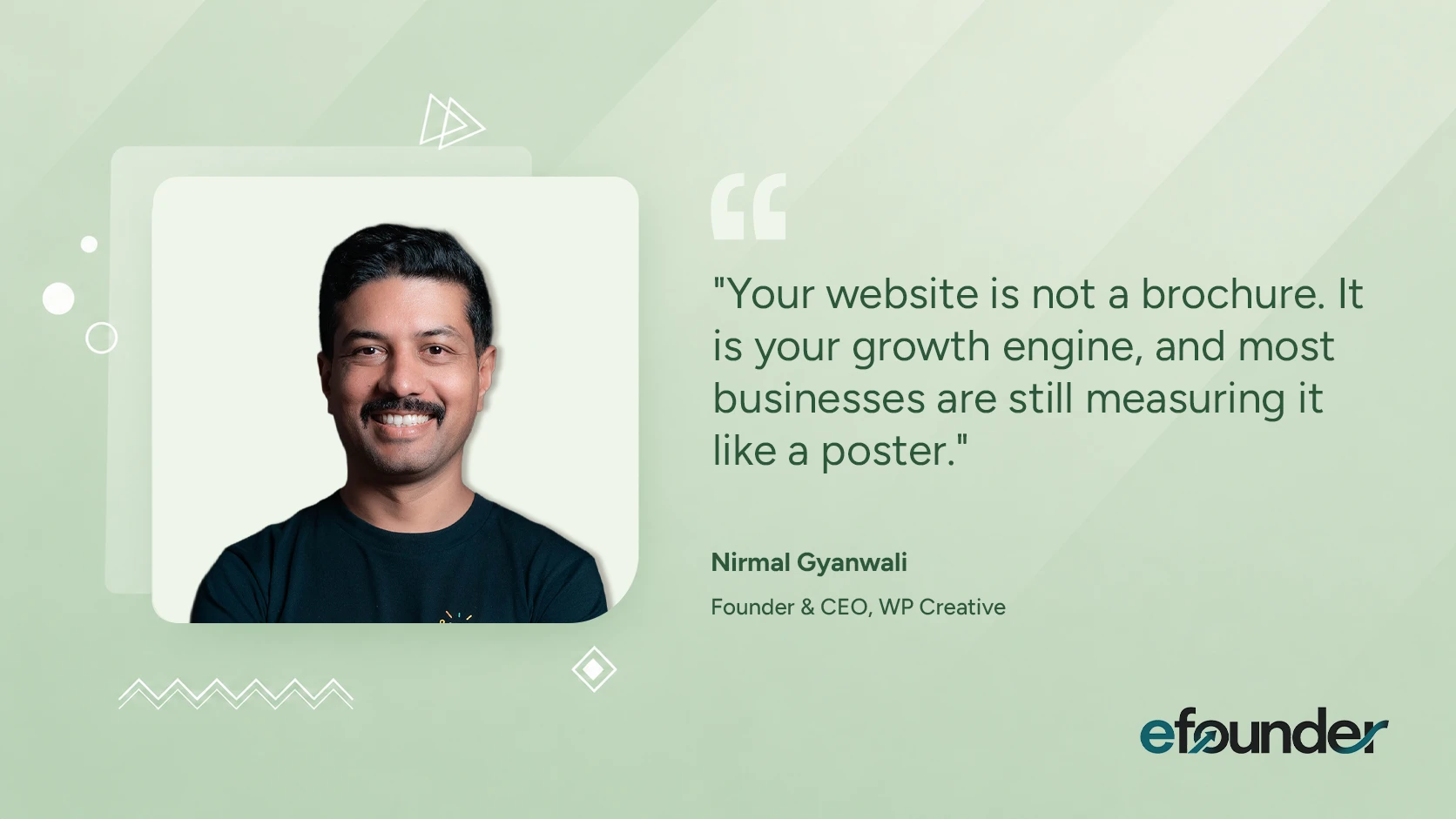
- Diagnose a store by exit points, not appearance: three-second bounce, ten-minute browse with no order, checkout drop mean different problems.
- Answer buying questions on product pages: shipping, returns, stock, sizing must be visible, not buried in tabs or footers.
- Treat the store as owned after launch, offer monthly care plans to maintain performance, security, tracking, and integrations.
- Protect migrations: map every URL one-to-one, preserve tracking, test rollback and checkout, reconcile product data before launch.
- Do not replatform to fix conversion issues; choose platforms by catalog complexity, integrations, in-house technical capacity, and peak international needs.
Meet Your Interviewee
| Founder | Nirmal Gyanwali |
|---|---|
| Company | WP Creative |
| Category | Web performance agency for ecommerce brands |
| Started after | 20 years in web development |
| Who he serves | Ecommerce brands with an in-house marketer and a long-term relationship in mind |
| Breakout product | Monthly care plans in place of one-off builds |
| Traction | 1,200+ projects delivered and 100+ five-star reviews |
| Big lesson | Honesty is the fastest way to earn trust. Clients come back to the people who tell them the truth. |
Key Numbers
|
1,200+ Projects delivered, with 100+ five-star reviews |
47,000 Product views on a luxury accessories store that produced fewer than 50 orders |
144% Mobile speed improvement on the Gregory Jewelers site, from 27 to 66 |
~70% Approximate rise in quote requests for one retailer inside six months |
The Interview
Agencies usually sell online store owners a redesign. Nirmal starts by asking where shoppers leave, because a store that is not converting rarely needs to look better. After 20 years in web development, he started WP Creative in January 2016 around one observation: brilliant marketers were held back by websites nobody owned. Everything before the click had an owner. Everything after it did not.
WP Creative is 100% in-house and senior-only, split between Sydney and Kathmandu, with 1,200+ projects delivered and 100+ five-star reviews. Its diagnosis starts with exit points, not with how the site looks. On a luxury accessories store with around 47,000 product views and fewer than 50 orders, that approach found dead clicks on product images, buried shipping answers, and ads pointing at the wrong pages. Part of the fault sat with the site. Part did not, and Nirmal’s team said so.
1Your pitch is that brands spend the budget getting people to the site, and you make sure it converts when they land. When an eCommerce brand comes to you convinced their website is the problem, how do you work out whether it actually is the site, or whether it is their traffic quality, pricing, or product?
We look at where people leave, not at how the site looks. The exit point tells you who is to blame. If people land and bounce in three seconds, that is a traffic or a message-match problem. If they browse for ten minutes and buy nothing, the traffic is fine, and the site is failing them. If they add to cart and vanish at checkout, that is friction or a payment issue. If every channel converts except paid, the ads are pointing at the wrong pages.
We picked up a luxury accessories brand with around 47,000 product views and fewer than 50 orders. Average sessions were over eight minutes. That is not a traffic problem. Nobody browses a high-end jewelry site for eight minutes if they are in the wrong place.
We installed heatmaps and found dead clicks on product images, and no answers to the questions that actually stop a purchase. Shipping. Insurance. Aftercare. All buried.
We also found their social ads were landing on the wrong pages. So part of it was the site and part of it was not, and we said so.
We are happy to tell a client it is not the website. It costs us a project and saves them one.
| The Decision | A brand arrives convinced its website is the problem. A luxury accessories store had around 47,000 product views, fewer than 50 orders, and sessions averaging over eight minutes. |
|---|---|
| Choice | Take the redesign brief, or read where shoppers leave and report which part is not the site. |
| What he did | Installed heatmaps and found dead clicks on product images, buried answers on shipping, insurance and aftercare, and social ads landing on the wrong pages. |
| What happened | Part of the problem sat with the site and part did not, and his team told the client so. |
| Lesson | Diagnose by exit point, even when the honest answer costs you the project. |
2You have delivered over 1,200 projects in more than 10 years. What is the single most common conversion mistake you see on eCommerce stores that owners consistently believe is a design problem when it is really something else?
The product page does not answer the buying questions.
Owners look at a page that is not converting and decide it needs to look better. It almost never needs to look better. It needs to tell the truth sooner.
What does shipping cost? When does it arrive? Can I return it? Is it in stock? What size am I? What happens after I pay? Most stores bury all of that in a tab, a footer link, or an accordion nobody opens. Then they wonder why people who clearly wanted to buy did not.
The second version of the same mistake is navigation built around how the business is organized instead of how people shop. Categories by product type when the customer is thinking by occasion, recipient, or problem. That is an information architecture issue wearing a design costume.
You do not lose the skeptics. You lose the people who had already decided to buy and could not find the door.
A redesign resets all of this without fixing any of it. Which is exactly why so many rebuilds land and nothing changes.
3You build across eCommerce platforms. What are the specific signals in a store’s revenue, catalog size, or team that tell you which platform is the right call, and at what point do you advise a client to leave it?
Four signals decide it for us.
1/Catalog and variant complexity. A thousand SKUs with real variant logic behave nothing like two hundred.
2/ How many systems the store has to talk to. ERP, inventory, CRM, accounting. That is usually the deciding factor, not the storefront.
3/ Who runs it on a Tuesday. If there is no technical person in-house, do not hand them a platform that needs one. That is how stores rot.
4/ Peak load and international. Multi-currency, duties, landed cost. Some platforms make that a config change and some make it a six-week project.
We moved a fashion label off open-source WooCommerce onto a hosted platform because the inventory and B2B side had outgrown it, and they needed proper stock synchronization. The same year we kept a homewares retailer with a catalog over a thousand SKUs exactly where they were, because their ERP integration and content depth mattered more than checkout elegance.
The signal to leave is simple. When you are paying developers every month to force the platform to do something it was never built for, the platform has already lost.
What we will not do is replatform to fix a conversion problem. That is a different disease.
4Replatforming or redesigning a live store means risking rankings, tracking, and revenue during the switch. Walk us through what you protect first on an eCommerce migration, and what have you seen go wrong on migrations that were handled by someone else?
In this order.
1/ The URL map. Every indexed URL, every product, every category, every old article, mapped one to one before a single line ships. This is the thing that kills stores.
2/ Tracking. Analytics, tag manager, pixels, transaction values, all tested on staging. If tracking breaks, you go blind in the exact week you need eyes.
3/ A tested rollback. Not a backup sitting in a folder. A rollback somebody has actually run.
4/ Checkout end-to-end on staging with real test transactions. Tax, shipping, duties, the lot.
5/ Data integrity. Products, prices and images reconciled against a master source, not against hope. We inherited one store where the catalog had duplicates and prices that did not match the client’s own master sheet.
What we have seen go wrong on other people’s migrations. Redirects done as a blanket rule to the homepage, which wipes out every product ranking overnight. Tracking that carried across but lost transaction value, so a whole quarter of return-on-ad-spend data was fiction. Plugin auto-updates left running in production. And launching mid-sale.
One of our retail clients freezes their site from late December to mid-January. Nothing ships in peak. Ever. That rule has saved more revenue than any optimization we have done for them.
5Gregory Jewelers saw a 144% mobile speed improvement and Crown Furniture a 145% lift in user engagement. How do you connect a speed or engagement number like that to actual revenue for the client, and which metrics have you learned to stop reporting because they do not correlate with sales?
Carefully, and without overclaiming.
Mobile speed going from 27 to 66 on that jewelry site is not revenue. It is the condition for revenue. So we do not report it as a win on its own. We tie it to the chain underneath it. Mobile bounce on category and product pages. Add-to-cart rate on mobile. What happened to paid traffic that used to leave before the page finished painting? Then the client’s own sales numbers close the loop.
With the furniture brand, the engagement lift only counted because it moved the next step. The number the business actually felt was inquiries. On another retailer, quote requests rose by around 70 percent inside six months. That is the metric the sales team notices on a Monday morning.
We own the asset. We influence the return. We will not pretend a speed score created a sale.
What we stopped reporting. Raw pageviews. Average session duration, because long sessions usually mean confusion, not interest. Bounce rate on its own. And speed scores as a headline. Those are diagnostic. They belong in our reports internally, not at the top of a client’s.
6You run monthly care plans rather than one-off builds. What made you move eCommerce clients to an ongoing model, and what breaks in a store when it is launched and then left alone for a year?
Because a store is never finished, and pretending otherwise was dishonest.
We would hand over a fast, clean build; everybody would be delighted, and twelve months later we would open the same site and barely recognize it. Forty plugins. Half of them abandoned. Speed back where it started.
Here is what actually rots in a year.
Plugins, themes, and PHP drift out of date. Security posture slides. One store we took over was scoring in the fifties on security when we inherited it, and we got it into the high eighties. Admin accounts pile up, and every one is a door. Payment integrations break silently after an update, so a buy-now-pay-later option or a digital wallet just stops working and nobody knows until a customer bothers to email.
Tracking breaks and the data quietly goes wrong, which is worse than no data. Image weight creeps as the marketing team uploads full-resolution hero shots. And bot and AI crawler traffic now hits hard enough to slow a store down on its own.
The expensive one is always checkout. It fails without an error message. People just leave.
Commercially, it changed us too. One-off builds mean you start every month at zero. But the real reason is the first one. Nobody owned performance after launch, so nobody fixed it.
| The Decision | Clients loved a fast, clean build. Twelve months later, the same site carried forty plugins, half of them abandoned, with speed back where it started. |
|---|---|
| Choice | Keep handing over one-off builds, or keep owning the store through monthly care plans. |
| What he did | Moved clients to monthly care plans, because nobody owned performance after launch. |
| What happened | One store inherited in the fifties on security reached the high eighties under his team. The commercial model changed too, because one-off builds meant starting every month at zero. |
| Lesson | A store is never finished, so someone has to own it after launch. |
7Store owners often want design decisions that hurt conversion, whether that is a hero video, a clever navigation or a checkout with extra brand steps. How do you handle that disagreement, and can you describe a case where the client was right and you were wrong?
We do not argue taste. Taste is unwinnable. We argue evidence.
The first question is always what this element is supposed to do. Then we look at heatmaps and session recordings. A recording of ten real people missing your clever navigation ends the debate faster than our opinion ever will. One retailer had flashing promotional banners across the homepage. We did not call them ugly. We showed what they were doing to perception and offered a smooth scrolling version instead. Approved in a day.
Where we were wrong, I used to push hard to strip luxury sites back. Cut the video, compress everything, fewer images, faster load. On one high-end brand, I pushed to drop a campaign film because of page weight. The client pushed back and said the film was the sale.
They were right. In luxury, the thing I was calling friction is the actual product experience. We moved the video to external hosting so it did not drag the page, and kept it.
That changed our default question. Not what does this cost in milliseconds, but what does this do for the buyer. Speed is not free. Neither is stripping the emotion out of a five-figure purchase.
8Your team is 100% in-house, senior-only, split between Sydney and Kathmandu. What does that structure let you do for eCommerce clients that an outsourced or junior-heavy agency cannot, and what has it cost you to maintain?
It means the person who built the site is the person who fixes it when a payment gateway falls over. No handoff. No relearning the codebase during an outage.
It also means memory. We have some eCommerce clients we have now worked with for close to a decade, dozens of projects each. Somebody on our team knows why a strange bit of code exists on those sites and what breaks if you touch it. You cannot buy that from a marketplace.
Senior-only matters for one reason. A junior builds what you asked for. A senior asks why you asked for it. On eCommerce, that question is worth more than the build.
What it has cost us. Margin, and patience. Senior hiring across two countries takes months, not weeks, and we have walked away from strong technical candidates who could not hold a client conversation. In quiet months, we turn work down rather than stack juniors on it. That is a real cost and we feel it.
It also forced us to build systems early, because you cannot lean over someone’s desk. Version control on every client site. Documented process. Code review before anything merges. We became disciplined sooner than a single-office agency would have.
The time zone split is the accidental gift. Kathmandu is still working while Sydney has already finished for the day.
9How do eCommerce brands actually find and choose WP Creative, and what have you learned about which client size or revenue stage is worth taking on versus which projects you now turn down?
Three ways. Referrals from marketing agencies who do not build in-house and want a partner who will not steal the client. Search, because we rank for the queries marketing managers type when they are fed up. And proof, which for us is 1,200+ projects and 100+ five-star reviews doing the talking before we get on a call.
The person who finds us is almost always a marketing manager who has been frustrated for months. They bring us in. Someone above them signs.
What we have learned. We set a floor. We turn down one-off projects with no ongoing relationship, because the site will decay and both of us will be embarrassed by it within a year. We turn down businesses with no internal marketing person, because nobody drives the work and it stalls. And we turn down anyone who opens with what is your cheapest price.
| The Decision | Brands find WP Creative through agency referrals, search, and 1,200+ projects of proof, and not every inquiry is a fit. |
|---|---|
| Choice | Take every project that arrives, or set a floor and turn work away. |
| What he did | Set a floor: no one-off projects without an ongoing relationship, no businesses without an internal marketing person, and no one who opens with the cheapest price. |
| Why it holds | One-off sites decay and embarrass both sides within a year, and without an internal marketer nobody drives the work and it stalls. |
| Lesson | Turn down the projects both sides will be embarrassed by within a year. |
10AI search, agentic checkout, and AI-generated product content are changing how shoppers reach a store. What are you changing in how you build eCommerce sites right now because of it, and what would you tell a store owner deciding between hiring an agency and doing it in-house?
Four things have changed in how we build.
Product data has to be machine-readable. Real product schema. Price, availability, shipping, and returns in structured data, not buried in a tab or baked into an image. If a model cannot parse it, your product does not exist in that answer.
Clean HTML that renders without JavaScript. A lot of AI crawlers do not execute JavaScript properly. Beautiful stores are going invisible for exactly this reason, and nobody has told them.
We now treat the crawler as a user with a server bill attached. One of our retail clients had AI and bot traffic heavy enough to slow the site down for real customers. You have to decide who you let in and give them a fast, cheap path.
And content that answers the buying question plainly. Sizing, shipping, returns, care. That is what gets quoted back to shoppers.
We also run prompt tests. Ask the major AI tools the questions your buyers ask and see who gets named. Most brands have never checked once.
On agency versus in-house. If the site is a real revenue channel, someone has to be accountable for it weekly, not every three years. In-house works if you can hire a senior who does performance, not just updates. Most stores cannot justify that salary. So the honest question is not agency or in-house. It is who picks up the phone when revenue drops on a Tuesday and nobody knows why.
What Changed
| Then | Now | |
|---|---|---|
| What gets reported | Raw pageviews, average session duration, bounce rate on its own, and speed scores as a headline | Mobile bounce, add-to-cart rate on mobile, and the client’s own sales numbers, with speed scores kept as internal diagnostics |
| How stores are delivered | A fast, clean one-off build handed over at launch | Monthly care plans that keep an owner on performance |
| Approach to luxury design | Cut the video, compress everything, fewer images, faster load | Ask what each element does for the buyer, and keep the campaign film on external hosting |
Lessons for Founders
- Start with the gap you can already see. After 20 years in the industry, Nirmal noticed something most people overlooked. Talented marketers were doing great work, and nobody was looking after what happened next. He didn’t wait for a perfect moment. He started WP Creative in 2016 to own that gap, and it has since grown to more than 1,200 projects and over 100 five-star reviews. The opportunity you keep noticing could be your company.
- Make honesty your edge. Nirmal built his reputation by telling clients the truth, even when that meant a smaller job. That trust has kept some clients with him for close to a decade. “We are happy to tell a client it is not the website.”
- Build relationships, not one-off jobs. Instead of finishing a project and moving on, Nirmal stays with his clients and keeps improving their stores. Those ongoing partnerships gave his agency a steady foundation, and some clients have now worked with him on dozens of projects.
- Surround yourself with people who ask why. Nirmal built a team that is curious first and quick second. That curiosity is what clients value most. “A junior builds what you asked for. A senior asks why you asked for it.”
- Turn your constraints into strengths. Running a team across two countries could have felt like a challenge. Nirmal sees it as a gift. “The time zone split is the accidental gift. Kathmandu is still working while Sydney has already finished for the day.”