
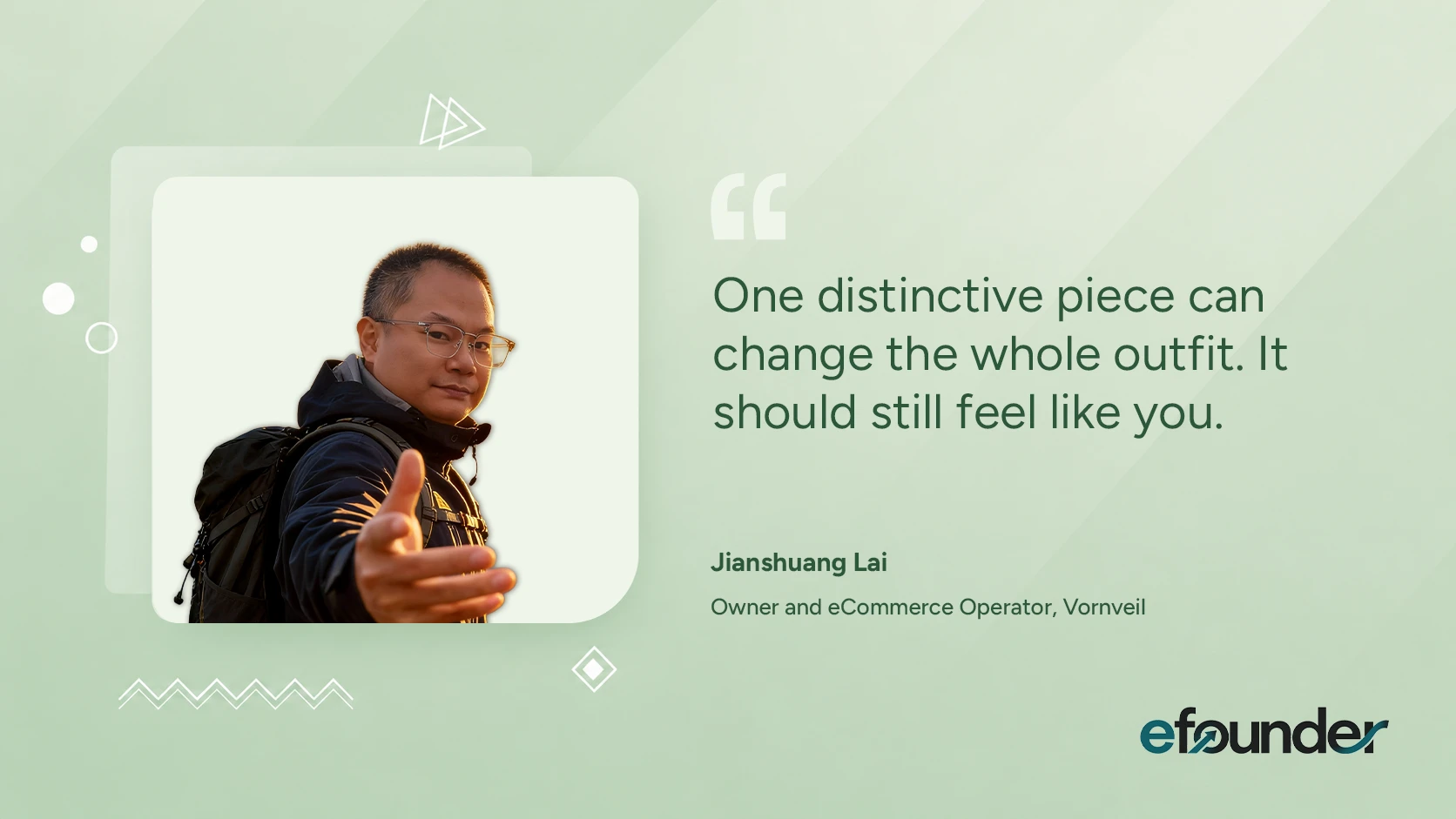
Meet Your Interviewee
| Founder | Jianshuang Lai |
|---|---|
| Company | Vornveil |
| Category | Curated punk, gothic, and streetwear-inspired jewelry |
| Role | Owner and eCommerce Operator |
| Ships to | United States |
| Who he serves | Shoppers looking for jewelry chosen for its visual character rather than a gender label |
| Store focus | Clear product images, honest descriptions, and ring-sizing and measurement guides |
| Channels | Meta paid social (tested), search-focused website content, organic social |
| Key insight | Clicks, add-to-cart events, and reported conversions are not interchangeable with verified paid orders |
The Interview
Many jewelry stores sort their catalog by who a piece is for. Jianshuang Lai chooses pieces for Vornveil by their visual character instead of a gender label. The store curates punk, gothic, and streetwear-inspired jewelry, built on one observation: a single accessory can change the feeling of an otherwise simple outfit.
Most of his time goes into product selection and presentation: images, descriptions, sizing information, and checking that the website and the ads communicate the same thing. AI tools help with research, drafts, and technical work, and he makes the final decisions.
He is also open about the part many store owners leave out: some paid tests did not work financially, so his focus now is on stronger pieces, sample checks, and better presentation before committing to another paid test. Vornveil is a business in progress, and this interview looks at that work as it stands.
1Punk, gothic, and streetwear-inspired jewelry is a focused niche to build a store around. What drew you to it over something broader, and what have you learned about your buyers since you started?
Vornveil is not exclusively a men’s jewelry store. Its direction is rooted in punk, gothic, and streetwear influences, with pieces chosen for their visual character rather than a strict gender label.
What drew me to this space was how one accessory can change the feeling of an otherwise simple outfit. I am still learning about our buyers, so I would not claim to have a complete customer profile yet. The question I keep exploring is what makes a piece interesting enough to wear, not just interesting enough to click on.
2As owner and eCommerce operator, you cover a lot of ground across the store. Which part of running Vornveil takes most of your time today, and how are you managing it?
Most of my time goes into product selection and improving how the store presents each piece. That includes images, descriptions, sizing information, and checking that the website and advertising communicate the same thing.
I use AI tools to help with research, drafts, and technical work, but I still make the final decisions. For a small business, the challenge is not just doing more work; it is deciding which work actually matters.
3Jewelry depends heavily on presentation. How do you approach product photography and descriptions, and what have you learned about what helps shoppers decide?
I want the images to answer two different questions: what does the product actually look like, and what does it look like when worn? A clear product image shows the details, while a wearing image helps communicate scale and styling.
Descriptions should support that rather than replace it with exaggerated language. I have learned to pay attention to clarity, especially when creating advertising assets: repeated image generation can soften details or change the product, which defeats the purpose.
4You publish ring-sizing and measurement guides rather than only listing dimensions. What prompted you to create them, and which customer questions or concerns are they meant to address?
A measurement alone does not always help someone imagine the fit. A buyer may know a ring’s dimensions but still wonder whether it will feel too large, touch nearby fingers, or suit everyday wear.
The guides are meant to turn those practical questions into clearer buying decisions. I would rather help someone choose a suitable piece before ordering than leave them to guess.
5A first-time visitor to an independent jewelry store is often deciding whether the brand is trustworthy. What have you put on your product pages to help with that, and which element do you consider most important?
I focus on making the essential information easy to find: product details, sizing, shipping, returns, and ways to contact us.
The most important element is consistency. An attractive advertisement is not enough if the product page tells a different story or leaves basic questions unanswered. Building trust is ongoing work, not something I consider solved by adding a badge or a slogan.
6Sizing on rings and chains can be tricky for online buyers. How do you handle a customer who orders the wrong size, and how did you settle on that approach?
If a customer chooses the wrong size, we ask them to contact us before returning the item. Our policy allows return requests within 30 days after delivery, provided the item is unused, unworn, and in its original condition and packaging.
For sizing mistakes not caused by a product issue, the customer is responsible for return shipping. We also provide measurement guides to help buyers check the fit before ordering.
7Vornveil currently ships to customers in the United States. How do you keep customers informed between checkout and delivery, and what do they ask about most often after ordering?
Vornveil currently ships to the United States. We use order emails and tracking information to keep customers informed after purchase, and we check address details when something needs clarification. I also distinguish between creating a shipping label and physically handing a parcel to the carrier.
I do not yet have enough customer-service data to confidently name the most common post-order question.
8Punk and streetwear buyers have strong opinions about what feels authentic. How do you make sure Vornveil’s pieces and brand come across as credible to that audience?
For me, credibility starts with having a clear point of view without pretending to represent an entire subculture. Punk, gothic, and streetwear influences overlap, but people interpret them in their own ways.
Vornveil is a curated store. I do not want to describe sourced products as original designs. The work is in selecting pieces, presenting them honestly, and showing how they can fit into someone’s personal style.
| The Decision | |
|---|---|
| Question | How to present a store built on sourced pieces to an audience that cares about authenticity. |
| What he did | Positioned Vornveil openly as a curated store, with the work focused on selecting pieces, presenting them honestly, and showing how they can fit into someone’s personal style. |
| Why it holds | Punk, gothic, and streetwear influences overlap, and people interpret them in their own ways, so he aims for a clear point of view without claiming to represent an entire subculture. |
| Editor’s take | Honest curation is a position in its own right. |
9Which channels are you focusing on to reach new customers right now, and what led you to choose them?
I have tested paid social, particularly Meta, while also working on search-focused website content and organic social channels.
Paid advertising gives relatively quick feedback, but it can become expensive before the business has found a reliable approach. I am now spending more time evaluating products and building useful content rather than assuming that a larger advertising budget will solve the problem.
10What is one growth effort that taught you something useful, whether or not it went the way you expected?
Paid advertising has been an important lesson, including the tests that did not work financially.
It taught me to separate attention from business results. Clicks, add-to-cart events, and reported conversions are not interchangeable with verified paid orders.
I also learned that a product can generate sales at one price without leaving enough margin to support customer acquisition. Those experiences have made me more careful about product selection, measurement, and testing limits.
| The Decision | |
|---|---|
| Question | What to take from paid tests that did not work financially. |
| What he learned | To separate attention from business results: clicks, add-to-cart events, and reported conversions are not interchangeable with verified paid orders. A product can also generate sales at one price without leaving enough margin to support customer acquisition. |
| What followed | He became more careful about product selection, measurement, and testing limits. |
| Editor’s take | A sale that cannot cover its own acquisition cost is not yet a sustainable result. |
11Many jewelry buyers purchase one piece and move on. How do you stay connected with customers after their first order?
My priority is the experience after the first order: clear communication, accurate tracking information, and being available if something needs attention.
I prefer a natural follow-up and an invitation to leave an honest review rather than pressuring customers to buy again. I am still developing this part of the business, so I would not describe it as an established retention system yet.
12Where would you like to take Vornveil next: deeper into this niche, into new product lines, or growing the brand in other ways?
I want to sharpen the product selection rather than expand simply to have more products. The direction remains punk, gothic, and streetwear-inspired jewelry, without limiting the brand to men. My next focus is finding stronger pieces, checking samples, and creating more convincing product presentation before committing to another paid test. I also want the website’s guides and content to become useful assets over time, rather than relying entirely on paid traffic.
| The Decision | |
|---|---|
| Question | Where to take Vornveil next. |
| Direction | Sharpen the product selection rather than expand simply to have more products, keeping the punk, gothic, and streetwear-inspired direction without limiting the brand to men. |
| Next steps | Find stronger pieces, check samples, and create more convincing product presentation before committing to another paid test. |
| Why | He wants the website’s guides and content to become useful assets over time, rather than relying entirely on paid traffic. |
| Editor’s take | Better products and pages come before a bigger catalog. |
Lessons Learned
The takeaways below are the eFounder editorial team’s interpretation of this interview. They are not quotations from Jianshuang.
1Answer Sizing Questions Before Checkout
Measurement guides that translate dimensions into fit decisions address a buyer’s practical doubts before they order, which is where much of the hesitation in online jewelry starts.
2Count Verified Orders Over Attention
The interview draws a clear line between attention metrics and verified paid orders, and between a sale and a sale that leaves enough margin to fund customer acquisition.
3Keep Every Touchpoint Consistent
When the ad and the product page tell the same story and answer the same basic questions, trust has something to stand on. A badge or slogan cannot do that work alone.
4Curate Honestly
Presenting sourced pieces as a curated selection, rather than as original designs, keeps the brand credible with an audience that is quick to judge authenticity.
5Invite Customers Back, Never Push
Clear communication, accurate tracking, and a natural invitation to leave an honest review make up the post-order experience Vornveil is working toward.