
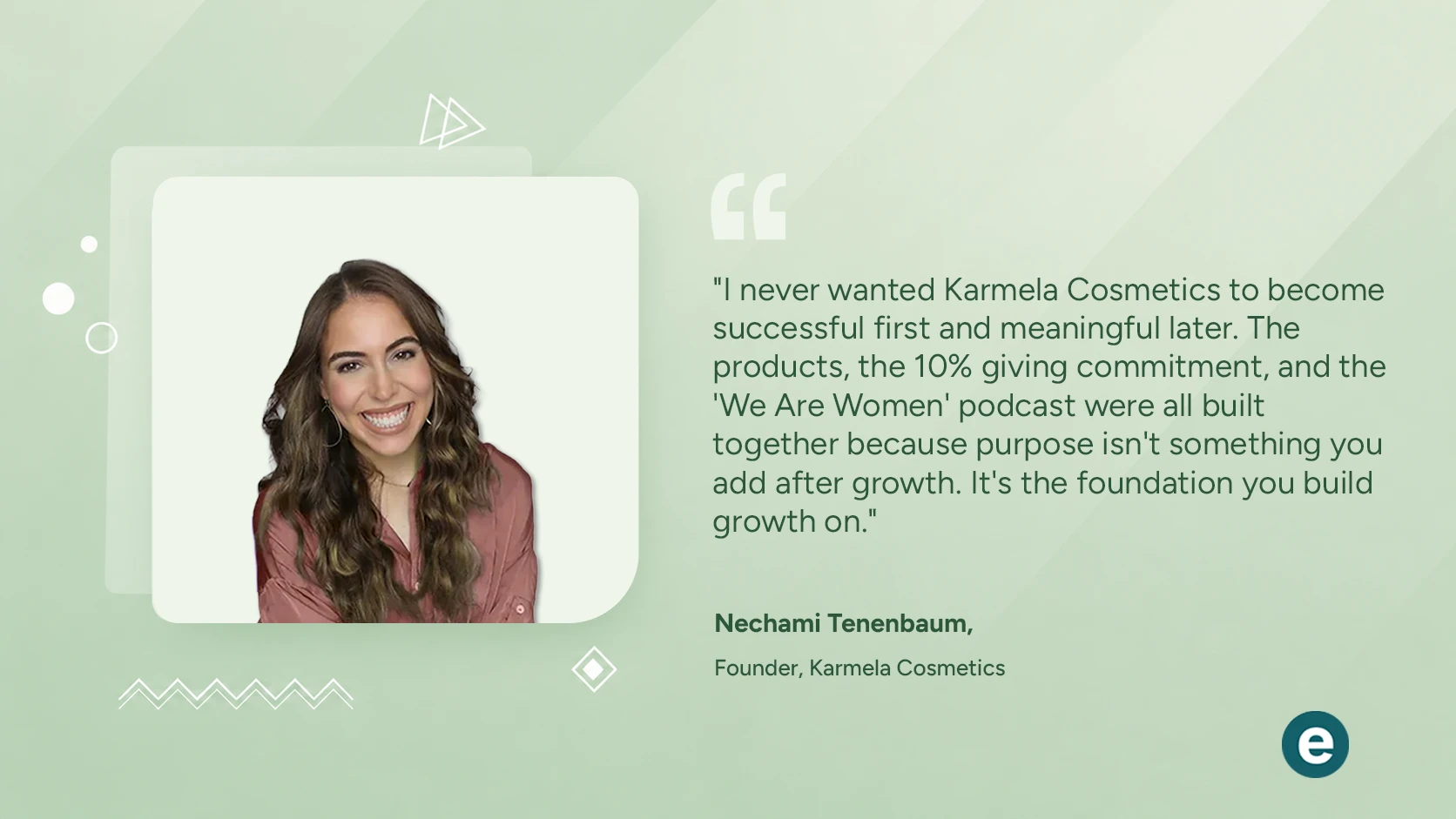
The beauty industry is not short on lipstick brands. It is short on lipstick brands with a formulation standard, a social mission, and a founder who completed an MBA and connected her brand’s commercial decisions to causes she had personally investigated rather than causes she had selected for marketing alignment.
Nechami grew up in Michigan as the only girl among three brothers, in a family that emphasized inclusivity across appearance, religion, and ethnicity. That upbringing shaped the brand’s values before the brand existed. Her grandparents, both artists, cultivated her appreciation for aesthetic craft. During her MBA program, her student group independently reached the same market positioning conclusion she had arrived at through personal conviction. That convergence confirmed the opportunity.
About Nechami Tenenbaum
Nechami Tenenbaum is the founder of Karmela Cosmetics, a luxury natural beauty brand built around lipsticks formulated without harsh chemicals and loaded with vitamins and moisturizing ingredients. She completed an MBA, ran a podcast, and connected her brand to causes including endometriosis, eating disorders, and breast cancer before she had significant revenue to give.
Karmela donates 10% of profits from each color collection to a different nonprofit dedicated to women’s healing initiatives. The “W
Key Takeaways
- Karmela Cosmetics lipsticks are formulated without harsh chemicals and loaded with vitamins and moisturizing ingredients, meeting a formulation standard the conventional beauty category rarely applies.
- 10% of profits from each color collection go to a different nonprofit dedicated to women’s healing initiatives, with causes personally investigated by Nechami rather than selected for marketing alignment.
- An MBA student group independently reached the same market positioning conclusion Nechami had already arrived at through personal conviction, confirming the commercial opportunity.
- The “We Are Women” podcast extends the brand’s mission beyond products by interviewing women who have overcome significant challenges.
- One manufacturer was eliminated mid-process when Nechami discovered dishonesty and quality issues, demonstrating that formulation standards take precedence over supply chain convenience.
You built a giving program and a podcast before you had significant revenue. Why make those commitments so early?
Because those commitments were not dependent on revenue scale to be genuine. The 10% donation and the podcast are expressions of what Karmela Cosmetics is, not what it aspires to be when it is larger. Starting them early meant building the brand around those values from the beginning rather than adding them later when they would feel like positioning decisions rather than genuine ones. Most people see the finished result, but not the nitty-gritty, unglamorous aspects of business building.
You eliminated a manufacturer mid-process after discovering quality and honesty issues. How did you make that decision when supply chain continuity matters so much?
The formulation standard is the product. If a manufacturer cannot meet it honestly, there is no version of continuing with them that produces what Karmela Cosmetics is supposed to be. The short-term disruption of finding a new supplier is preferable to the long-term damage of selling a product that does not meet the standard I built the brand around. That decision took time and cost money. It was the only available decision.
Your MBA student group independently reached the same market positioning you had already identified. What did that convergence tell you?
That the opportunity was real and visible to people with business training who had no personal stake in my conviction being right. My colleagues reached the same conclusion I had through entirely different reasoning. That is the strongest kind of confirmation: independent verification from people who had no reason to tell me what I wanted to hear.
Before partnering with the Endometriosis Foundation, you had never heard of the condition. How did that partnership develop?
Through the process of genuinely investigating the causes I wanted to support rather than selecting causes based on brand fit. When I learned that one in ten women are diagnosed with endometriosis, and when I understood what that experience involves, the partnership became obvious. The podcast became a way to build awareness around conditions that affect enormous numbers of women but that most people have not heard of. The causes inform the brand rather than the brand selecting causes that serve it.
What would you tell a founder building in the beauty category about formulation versus marketing?
That the formulation is the marketing if it genuinely meets the standard you claim. Consumers in natural beauty have been disappointed enough times by products that claim clean formulation and deliver conventional chemistry that they are paying attention to ingredients now in a way they were not five years ago. Build to the standard first. The marketing follows credibly from a formulation that actually delivers what it promises.
Lessons for Founders
- Social mission commitments made before commercial scale are more credible than those added after success because they reflect values rather than positioning.
- Independent confirmation of a market opportunity from people with no stake in your conviction being right is more valuable than any market research report.
- Cause selection through genuine personal investigation produces partnerships that are defensible and authentic rather than selected for brand alignment.
- Formulation standards that precede marketing claims build credibility in ingredient-conscious categories where consumers have learned to be skeptical.
For more founder stories and growth strategies from operators who have built from the ground up, read more at eFounder.club.