
Building From Scratch
Many founders believe the timing has to be perfect before they start. Adam completely disrupts that narrative. His entrepreneurial instincts actually appeared around age 12 when he started running informal feasibility exercises on vacant Manhattan real estate using Google Earth. When a ninth-grade business class project required him to create a company, that builder instinct finally found an accessible outlet.
He submitted his project and then decided to actually build the company in the real world. For founders waiting for ideal market signals, Adam proves that constraints can serve as powerful launch conditions. He launched an eCommerce brand during a global pandemic with zero network and zero funding, treating his limitations as a roadmap rather than an excuse.
About Adam Schnell
Most jewelry brand founders come from retail backgrounds, design schools, or family businesses with existing supplier networks. Adam Schnell came from the ninth grade. When he launched Windsor Diamonds in late 2020, he did not have startup capital, a manufacturing contact, or a mentor walking him through the process. He simply had a business class deadline, a last-minute idea, and enough stubbornness to turn a school assignment into a direct-to-consumer brand.
He was 15 years old and attending high school full-time. Neither fact slowed him down in any meaningful way. Today, he runs a growing eCommerce brand that outmaneuvers legacy competitors through structural intimacy and relentless operational consistency.
Key Takeaways
- Adam launched Windsor Diamonds as a ninth-grade business class project and converted it into a live eCommerce brand within months.
- Every initial attempt to outsource web design, copywriting, and SEO failed. Adam learned each skill himself to build complete operational fluency.
- Windsor Diamonds competes on structural intimacy. Personalized packaging and handwritten notes are things large jewelry brands simply cannot replicate at scale.
- Adam runs the business entirely during after-school hours. He treats entrepreneurship as a daily discipline rather than a passing phase.
- He is already building his next venture while keeping Windsor Diamonds active. He treats his first brand as a proof of concept rather than a final destination.
The Interview
Q: You launched Windsor Diamonds at 15 years old. How did a high school business class project turn into a real eCommerce company?
Adam Schnell: The assignment required us to create a company with an executive summary, a marketing plan, and financial projections. I left it until the last minute. The idea of a jewelry brand just clicked, connecting back to a family interest in diamonds. The name and logo came together almost instinctively. After I submitted the project, I realized there was no reason to stop there. I decided to actually build the business and see what happened.
Q: You initially tried to outsource the technical work but quickly changed course. What went wrong with those early contractor hires?
Adam: My first instinct was to hire people for the functions I did not understand. I hired contractors for web design, product descriptions, and SEO. The results were consistently unusable. The contractors did not read the briefs carefully or understand what the brand required. I learned very quickly that if you want something done right, you have to do it yourself. I learned web design from scratch, taught myself Photoshop, and mastered SEO fundamentals.
Q: That sounds incredibly time-consuming. Do you think learning all those granular skills was worth the effort?
Adam: Absolutely. Spending hours on tasks that adult founders usually delegate gave me a complete, firsthand understanding of every operational layer. That knowledge changes how you manage vendors and evaluate work quality. You cannot catch bad work in a function you do not understand. You cannot set a standard you have never tried to meet yourself. I built that operational fluency out of necessity, and it became a massive advantage.
Q: The jewelry category is dominated by well-funded incumbents. How does a bootstrapped brand compete against decades of brand recognition?
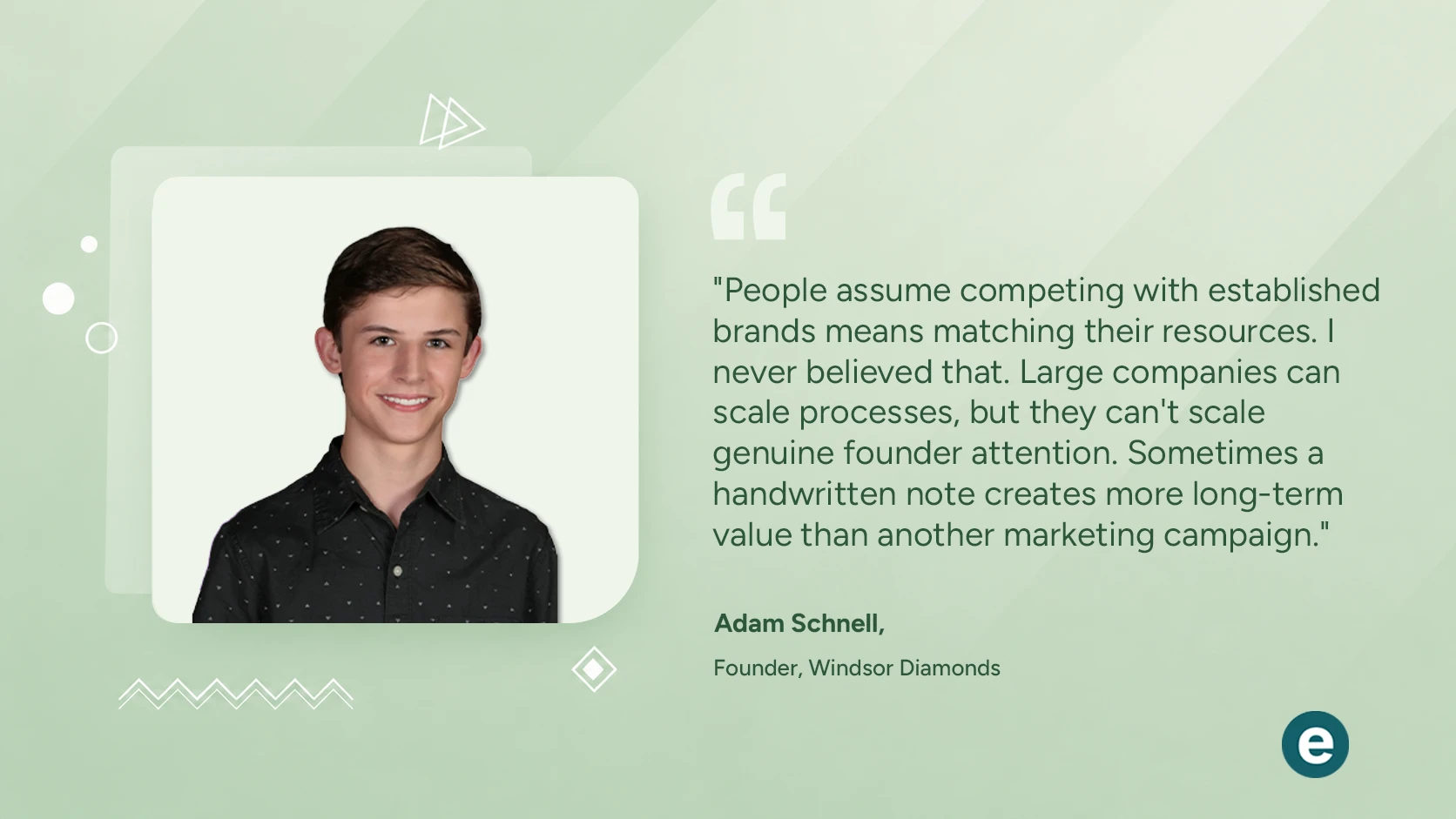
Adam: I never tried to out-resource them. I built directly into the gap they structurally cannot close. Large jewelry brands cannot handwrite notes for individual orders. They cannot have a founder personally respond to every customer message. The operational scale that makes those big brands efficient makes intimacy completely impossible for them. I built our entire customer experience around personalized packaging and direct founder interaction. That emotional connection drives repeat purchases and word-of-mouth marketing.
Q: Running a growing brand while attending high school full time requires serious time management. What does your daily routine look like?
Adam: I treat the business as a daily discipline. My routine is highly consistent. I come home from school, respond to customer emails and direct messages, place orders with our manufacturers, and work on marketing campaigns. The early excitement of launching a brand always fades. The daily operational work that keeps it alive is much less glamorous than the founding story, but that consistency is exactly why the business is still growing.
Q: You learned a lot of hard lessons during your launch phase. What is your biggest piece of advice for a founder preparing to launch a new product?
Adam: You must double or even triple your original timeframe and cost estimates. Every experienced operator eventually discovers that launches take longer than planned and cost more than expected. My pre-launch checklist kept expanding. Decisions that looked minor, like choosing packaging colors, consumed far more time and research than I allocated. Tripling your estimates is not pessimism. It is the only accurate way to plan a product launch.
Lessons for Founders
- Constraints produce clarity. Adam had no capital, no network, and no time outside of school hours. He converted those limitations into launch conditions rather than excuses to delay.
- Learning the fundamentals is infrastructure. Learning web design, copywriting, and SEO gave Adam the ability to evaluate future vendors effectively. You cannot manage a function you do not fundamentally understand.
- Triple your launch estimates. Original time and cost estimates are almost always optimistic. Build a massive buffer into your plan before you start to avoid eroding product quality under pressure.
- Personal touch is a defensible moat. Intimacy is structurally impossible for massive legacy brands. Direct founder engagement and handwritten notes serve as a powerful competitive advantage in categories dominated by scale.
If you are looking for more actionable insights from founders building real businesses without waiting for the perfect moment, explore more stories at eFounder.club.