
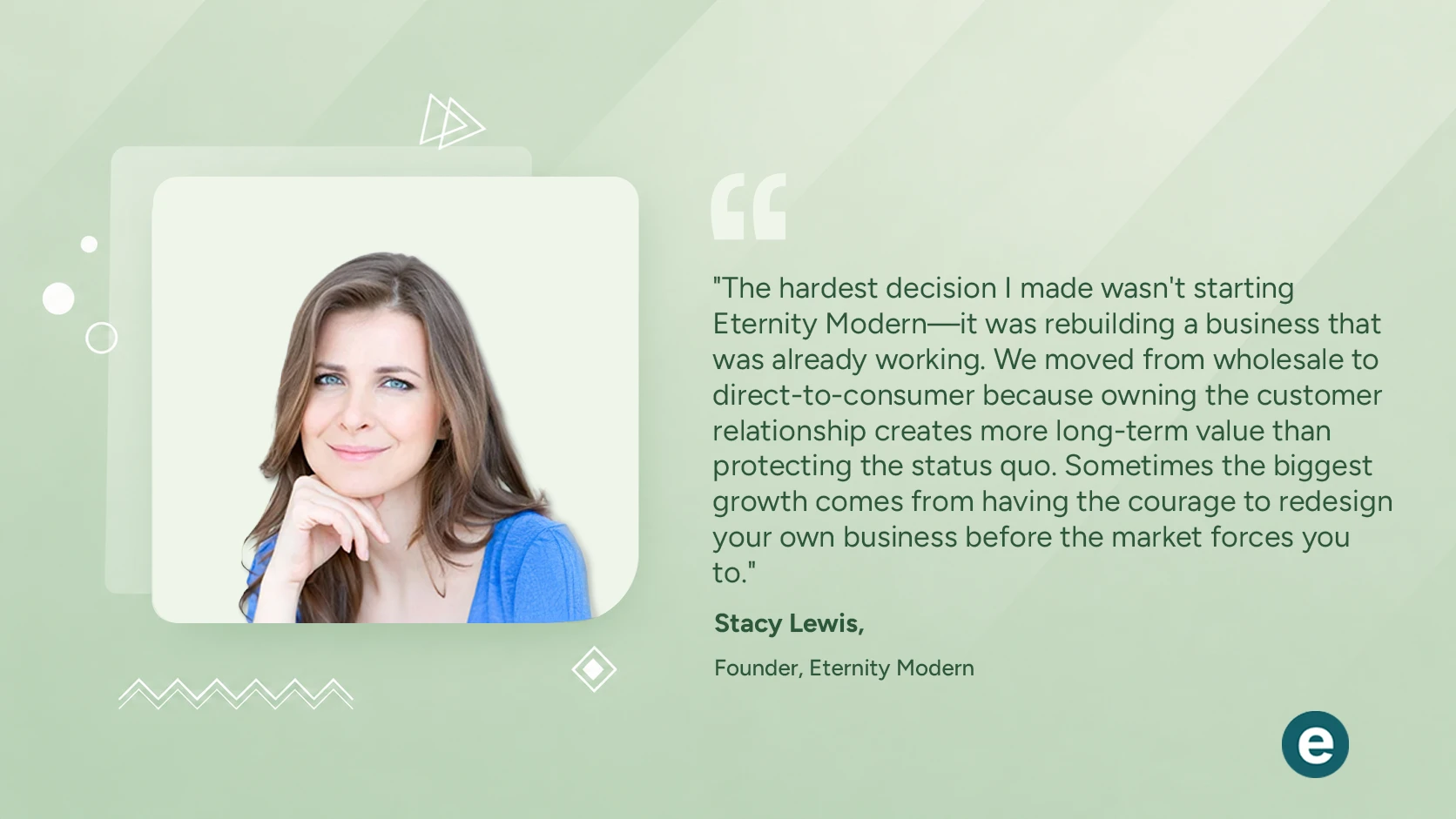
Most furniture businesses that survive for fifteen years do so by staying the same. Stacy did the opposite. When e-commerce had matured to the point where a furniture brand with strong aesthetics and credible product quality could reach consumers directly, she recognized the disruption to existing wholesale relationships was worth the reset.
The 2015 restructure eliminated the middlemen entirely. Eternity Modern moved to direct partnerships with international manufacturers and began selling directly to consumers. That change compressed pricing to the consumer’s benefit and gave the brand direct ownership of the customer relationship. It also required rebuilding the business. Existing wholesale relationships ended. The sales motion changed completely.
About Stacy Lewis
Stacy Lewis is the founder of Eternity Modern, a mid-century modern furniture brand she launched in 2005 as a traditional wholesale interior design business and restructured entirely in 2015 to sell directly to consumers online. That restructure eliminated middlemen, compressed margins to the consumer’s benefit, and required rebuilding every commercial relationship the business had.
Eternity Modern has been featured in Vogue, Refinery 29, and L’Officiel. The brand offers product customization, allowing customers to configure pieces to their specifications rather than choosing from a fixed catalog. Fundraising was resolved through a VC network that provided both capital and relevant operational connections.
Key Takeaways
- Eternity Modern launched in 2005 as a wholesale interior design business and restructured in 2015 to a direct-to-consumer online business, a deliberate reset that eliminated ten years of existing wholesale relationships.
- The 2015 restructure compressed pricing to the consumer’s benefit by eliminating middlemen and establishing direct international manufacturer partnerships.
- Mid-century modern specialization within a durable aesthetic gave the brand a specific identity that customization offers reinforced rather than diluted.
- Vogue, Refinery 29, and L’Officiel coverage validated the design judgment behind the product selection to audiences who make lifestyle purchasing decisions.
- A VC network resolved initial fundraising and provided the connective tissue to people with relevant operational experience beyond capital alone.
You ran Eternity Modern as a wholesale business for ten years and then restructured it entirely. What made that the right moment to disrupt what was working?
eCommerce had matured to the point where the path to the consumer was open in a way it had not been when I launched in 2005. The question was whether the disruption to existing relationships was worth what the direct model would provide. It was.
Direct-to-consumer means I own the customer relationship, I control the experience, and I can pass the margin compression from eliminating middlemen to the consumer. That is a fundamentally better business than wholesale, even if the transition is painful.
Eliminating your wholesale relationships meant rebuilding the entire commercial structure of the business. How did you manage that transition?
Carefully and deliberately. I did not eliminate everything simultaneously. I identified the new manufacturer partnerships first, established the direct sales infrastructure, and then let the wholesale relationships wind down rather than cutting them abruptly.
The transition took time. It required accepting a period of reduced revenue while the new model came online. But restructuring from a position of some stability is better than restructuring in a crisis.
Eternity Modern offers product customization. In a category with significant supply chain complexity, how do you make that work operationally?
By building the manufacturing relationships specifically to support it. Customization requires partners who can execute to specification rather than from a fixed production run. I built those relationships directly with international manufacturers over years. The customization offer is only possible because of the partnership infrastructure underneath it. It is not a feature you add to an existing supply chain. It is a supply chain you build to support a specific product promise.
Vogue, Refinery 29, and L’Officiel have all featured Eternity Modern. What drove that press attention?
The aesthetic is specific and credible, and it holds up to scrutiny from editors whose professional reputation depends on getting those calls right. Lifestyle publications are not covering furniture brands because they have interesting founder stories.
They are covering them because the product resonates aesthetically and stands up to the quality standards those publications apply. The press reflects design judgment that is defensible, not PR relationships.
What would you tell a founder considering a major restructure of a business that is already profitable?
That’s the time to restructure, when you have the stability to do it deliberately, not when the disruption forces you to. I restructured Eternity Modern when the wholesale model was still working because I could see that the direct model was structurally superior and the window to make the transition on my own terms was open.
Waiting until the wholesale model broke would have meant restructuring under pressure. Do it when you choose to.
Lessons for Founders
- The time to restructure a working business model is when you have the stability to do it deliberately, not when disruption forces it under pressure.
- Direct-to-consumer restructuring that eliminates middlemen is a commercial reset worth executing even when it requires rebuilding every existing relationship.
- Customization offers require supply chain infrastructure built specifically to support them rather than being layered onto existing production arrangements.
- Press in consumer lifestyle publications reflects design credibility that holds up to editorial scrutiny, not PR relationships or advertising spend.
For more founder stories and growth strategies from operators who have built from the ground up, read more at eFounder.club.