
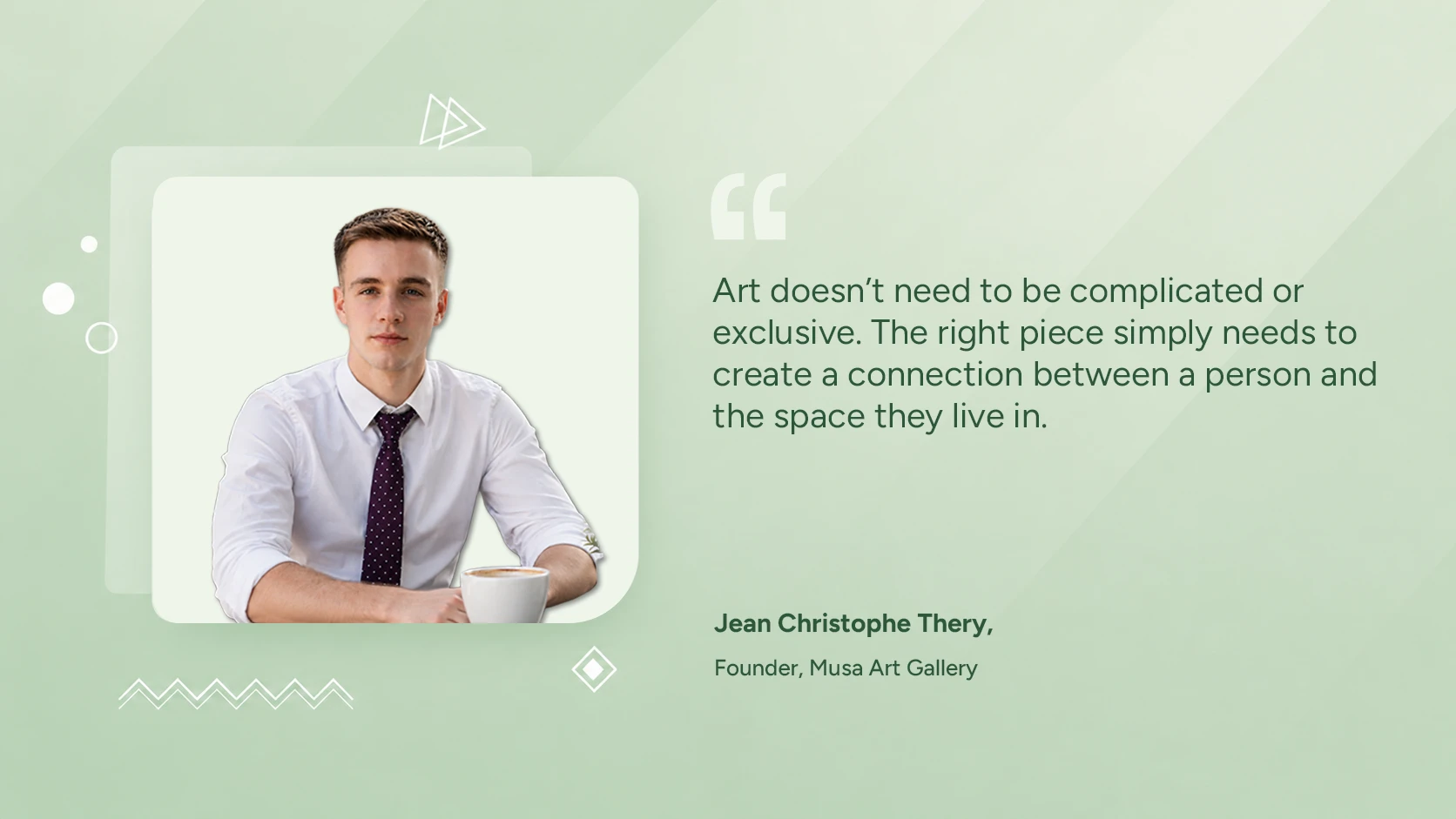
Most people who leave banking take the spreadsheet with them. Jean Christophe had to put his down. After a degree in International Finance and years inside banks, he built a business around the one variable a model cannot price: whether a stranger will want an image on their wall. That bet became MusaArtGallery.
The story is not the career switch. It is what the catalog taught him on the way past 9,000 designs, and where a wall-art business defends itself now that AI can generate a design for free.
About Jean Christophe
Jean Christophe Thery is the founder and CEO of MusaArtGallery, an international online art and wall décor company built on a simple premise: finding the right artwork for a space should be easier and more accessible, not more exclusive. His finance background still runs the margins, cash flow, and acquisition costs.
The creative starting point is his mother’s ceramics work in the Japanese Raku technique, a process built around accepting imperfection.
What began as an online art project became an international business, registered as Canvasbase OÜ in Tallinn, now listing more than 9,000 designs priced roughly between 93 and 434 dollars, with most shown at about 27 percent off. The United States became the primary market because demand for large-format wall art is strongest there.
The second build is the operation. Orders move through a made-to-order process: printed, prepared, stretched, packaged, handed to a logistics partner chosen by destination and product. Nothing waits in a warehouse, which is what lets a catalog that size exist.
Key Takeaways
- Registered as Canvasbase OU in Tallinn, selling primarily into the United States, where demand for large-format wall art is strongest.
- Visibility across the 9,000-plus catalog is set by customer behavior: sales history, search interest, engagement, seasonality, interior trends. A small share of it carries most revenue.
- Prices run roughly 93 to 434 dollars, most shown at about 27 percent off. No permanent formula; structures tested over time.
- Fulfillment is made-to-order, partners chosen by destination. Failures cluster in shipping, not printing.
- Conversion improved through lifestyle imagery, clearer sizing and simpler checkout, shipped together, so no single percentage is claimed.
The Interview
What did you spend money on in year one that you would now call a complete write-off, and roughly what did it cost you?
Like many early-stage businesses, we tested a lot of marketing channels and tools before understanding what actually worked for our audience. Some advertising experiments and software investments produced very little return. I would consider those costs part of the learning process rather than a single major mistake, and fortunately they were manageable relative to the overall development of the business.
You have a degree in International Finance and spent years in banking before starting MusaArtGallery. Banking rewards models and predictability. Selling art rewards taste. What did you have to unlearn from finance before this business started working?
The biggest thing I had to unlearn was the idea that everything important could be predicted in a spreadsheet.
In finance, you are trained to look for historical data, patterns, and measurable risk before making a decision. In e-commerce, especially with something emotional like art, sometimes the customer reacts to things you cannot fully quantify in advance.
Some designs I personally thought would perform extremely well did almost nothing, while others I initially considered quite niche became consistent sellers.
I had to become much more comfortable testing before understanding. Instead of spending weeks trying to prove that an idea should work, we learned to put it in front of customers, measure the response and adapt quickly.
Finance is still extremely useful for margins, cash flow, and acquisition costs. But I learned that data should validate creativity, not replace it.
The origin story traces back to watching your mother work in ceramics using the Japanese Raku technique, a process built around accepting cracks and imperfection. How much of that idea actually survived into running a made-to-order canvas business at scale?
Quite a lot, although in a different form. The idea that beauty does not always come from perfection influenced the way I think about art and interiors. At scale, the operational side obviously has to be much more structured, but creatively we still try to keep variety, individuality and emotion at the center of the product rather than making everything feel overly standardized.
MusaArtGallery is registered as Canvasbase OU in Tallinn, but the marketing speaks directly to American buyers. Walk us through that decision. What did Estonia give you operationally that another base wouldn’t?
Estonia offered a very practical environment for running an international digital business. The company could be managed efficiently while selling across multiple markets. The United States became an important market simply because there is strong demand for home décor and large-format wall art there, so the marketing naturally evolved around the customers we were serving.
Wall art is one of the hardest things to sell online. Buyers can’t judge scale, texture, or how it sits on their own wall. What was the first change you made to the product page that measurably moved conversion, and by how much?
The biggest improvements generally came from helping customers visualize the artwork in a real environment. Better lifestyle imagery, clearer size information and simplifying the buying process all had a meaningful impact. I prefer not to isolate one exact percentage because conversion improvements usually came from several changes made together rather than one single modification.
You now list more than 9,000 designs. Most stores that scale a catalog that fast lose the ability to merchandise it. How do you decide what gets promoted, and what share of that catalog actually produces the revenue?
We look primarily at customer behavior. Sales history, search interest, engagement, seasonality and broader interior-design trends all influence what receives more visibility. Like most large catalogs, a relatively small portion of the collection naturally generates a disproportionate amount of revenue, while the long tail is important because it gives customers a much wider range of styles and subjects to discover.
Your prices sit between roughly $93 and $434, with most products shown at about 27 percent off. Talk us through how you arrived at that anchor, and whether you have ever tested running the store without discounting at all.
Pricing is based on a combination of production costs, size, logistics, customer expectations and positioning within the wall-art market. Promotions are also common in e-commerce and can help customers make a decision, particularly for larger purchases. We have experimented with different pricing and promotional structures over time rather than relying on one permanent formula.
Walk us through what happens between checkout and the customer’s wall. Who prints, who stretches, who ships, and where do the failures cluster?
Once an order is placed, it moves through a made-to-order production process. The artwork is printed, prepared, and stretched before being packaged and handed to a logistics partner for delivery. We work with production and shipping partners depending on the destination and product. Most issues in this type of business tend to happen around shipping delays, handling or occasional damage rather than during the printing process itself.
What is one growth initiative that surprised you, either by working far better or far worse than you expected?
One recurring lesson has been that some of the simplest initiatives can outperform more complicated strategies. Improving merchandising, content or the customer experience can sometimes create more sustainable growth than aggressively increasing advertising spend. On the other hand, some marketing channels that look very promising on paper can take much longer to become profitable than expected.
What is a lesson that took you far longer to learn than it should have, and what did learning it late cost you in money or months?
Probably the importance of focus. In eCommerce, it is very easy to test too many products, markets, platforms, and marketing ideas at the same time. Learning to concentrate resources on what is already showing clear signs of working would have saved both time and money. It is difficult to put an exact figure on it because the cost was spread across many small experiments.
Where did your instincts as a finance person actively hurt this business?
A finance background naturally encourages you to look for measurable returns and efficiency. That is useful, but creative businesses do not always respond immediately to that kind of logic. Branding, content, and customer trust can take time to compound. Earlier on, I probably expected certain decisions to produce measurable results too quickly rather than allowing enough time for brand value to develop.
AI image generation has made producing a wall-art design close to free. If the design itself is no longer scarce, where does the defensibility in this category move to?
The competitive advantage moves away from simply producing an image. It becomes much more about curation, brand, distribution, customer experience, product quality, and understanding what people actually want to put in their homes.
AI can generate an enormous number of images, but abundance creates a new problem: customers need someone to filter that abundance. In that environment, knowing what to select, how to present it, how to manufacture it well and how to build trust around the product becomes increasingly important.
Lessons for Founders
- Test before you understand. Jean Christophe is direct about it: “data should validate creativity, not replace it.” The designs he backed hardest did almost nothing, while the niche ones sold steadily.
- Give brand the time a returns model will not. He names this as where finance instincts hurt him, expecting branding, content, and trust to show measurable results faster than they compound.
- Fix visualization before you touch price. MusaArtGallery’s conversion gains came from showing the artwork in a real room, not from arguing its value.
- Concentrate on what is already working. Focus took him the longest to learn, and the cost hid inside many small simultaneous experiments across products, markets, and channels.
- When supply becomes free, value moves to the filter. With AI generating unlimited images, he argues curation, brand, distribution, quality, and trust become the defensible parts.
For more founder stories and growth strategies from operators who have built from the ground up, read more at eFounder.club.