
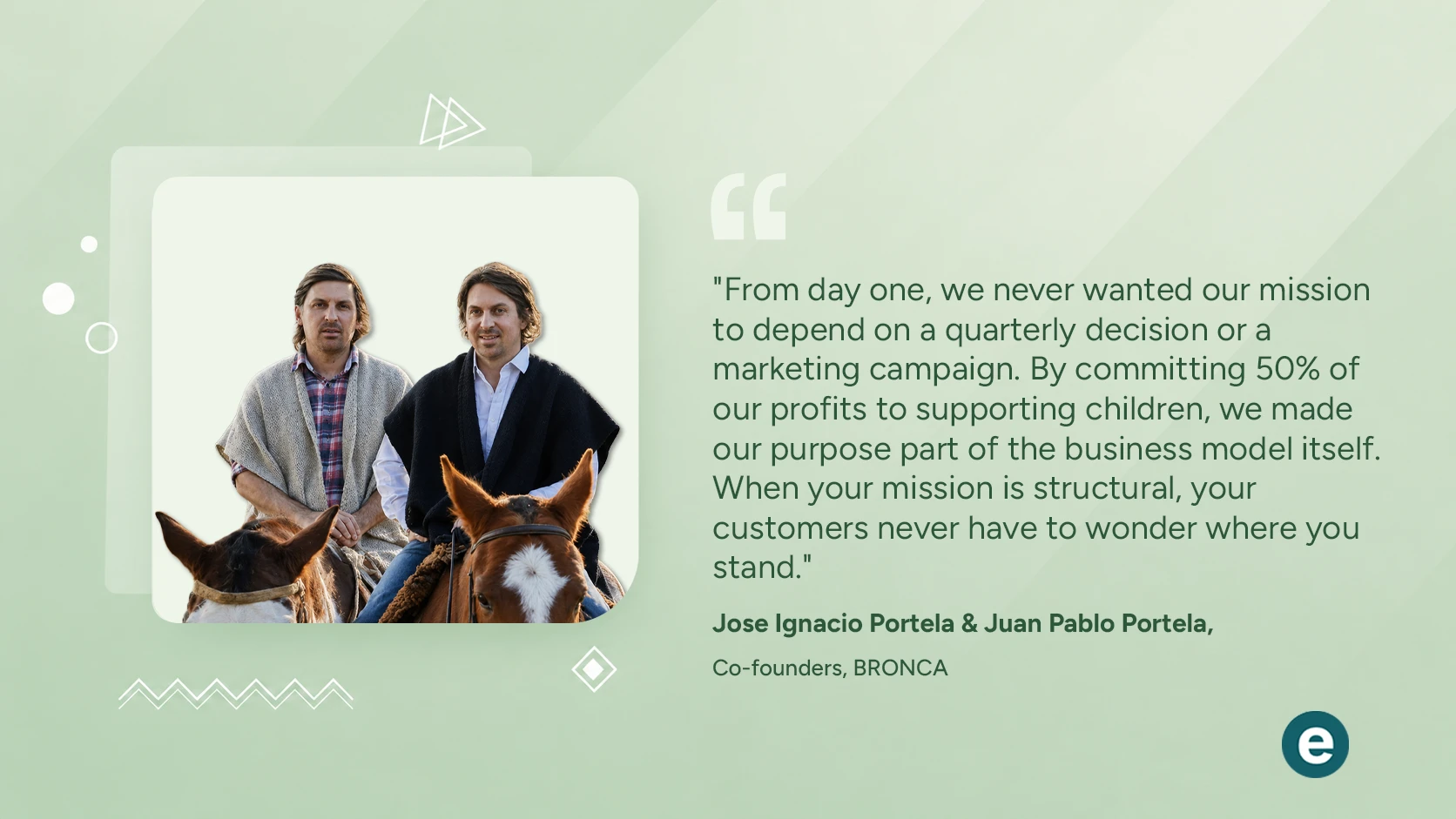
Fifty percent of profits is an unusually direct commitment compared to the typical CSR model. The beneficiaries are specific. The use of funds is specific. The brothers talk about impact, not in aggregate statistics but in terms of what individual sales produce for individual children. That specificity is what makes the social commitment credible rather than decorative.
That customer is a different kind of buyer. She is not switching to a competitor when the price drops by ten percent. The mission is part of what she bought. That loyalty dynamic is structurally different from the loyalty produced by product quality or brand aesthetics alone.
About Jose Ignacio and Juan Pablo Portela
Jose Ignacio and Juan Pablo Portela are twin brothers from Uruguay who founded BRONCA, an apparel brand that donates 50% of profits toward feeding underprivileged children. Jose Ignacio studied hotel management. Juan Pablo studied business administration. Together, they built a fashion brand organized around a social mission direct enough to be verified in a single line: half of every profit goes to a child who needs food.
The programs funded by BRONCA extend beyond the immediate meal: vegetable gardens, cooking lessons, and horse riding for the children the brand supports. The brothers designed the mission to be developmental, not transactional.
Key Takeaways
- BRONCA donates 50% of profits to feeding underprivileged children, a commitment specific enough to be verified and direct enough to be the brand’s primary differentiator.
- The social mission extends beyond meal provision to vegetable gardens, cooking lessons, and horse riding, reflecting a developmental rather than transactional approach.
- Hotel management and business administration backgrounds provide complementary service excellence and operational disciplines.
- Mission-driven customer loyalty is structurally different from product-quality loyalty and more resistant to competitive price pressure.
- Embedding the giving at the business model level rather than adding it as a marketing program makes the commitment structurally verifiable.
You built the 50% profit donation into the business model from the start rather than adding it later as a CSR program. Why that sequence?
Because a mission that lives in a marketing program can be removed when conditions change. A mission embedded in the profit structure cannot. We wanted the commitment to be structural, not optional. If BRONCA has a profitable month, half of that profit goes where it was always going to go. There is no quarterly decision about whether we can afford the commitment this period. It is the model, not a feature of the model.
Your charitable goals extend beyond feeding children to vegetable gardens and cooking lessons. What is the reasoning behind that scope?
Feeding a child today matters. Building a child’s relationship with food production and physical activity matters for the rest of her life. We are not trying to intervene episodically. We are trying to build something durable. The meal is the entry point. The garden and the cooking lessons, and the horse riding are the investment in what follows.
The fashion category has constant price pressure. How does BRONCA hold its position against cheaper alternatives?
There is no better motivation than the feeling that your actions and sales have a direct impact on children in need. The customer who chooses BRONCA is not choosing primarily on price. She is choosing because the purchase does something beyond dressing her. A competitor who drops their price ten percent is not offering her what BRONCA offers.
How do you maintain the specificity of the social commitment as the business scales?
By being specific in our reporting rather than retreating to aggregate statistics. We talk about specific children, specific programs, specific outcomes. As we scale, the programs scale with us. The commitment percentage stays constant. We do not let the social mission become a line item managed for minimum viable compliance.
What would you tell a founder who wants to build social mission into a business but worries about commercial trade-offs?
The trade-off assumption is usually wrong. The customers who choose you for the mission are more loyal, more likely to refer, and more resistant to competitive price pressure than customers you attract through price alone. Building the mission in structurally rather than adding it rhetorically is the key distinction.
Lessons for Founders
- Structural mission embedding is more credible and more durable than mission as a marketing program, and more commercially valuable over time.
- Mission specificity, named beneficiaries, specific programs, verifiable outcomes, converts social commitment from claim to credential.
- Mission-driven customer loyalty is more resistant to price competition because the purchase serves a motivation that price alone cannot satisfy.
- Developmental impact ambitions require program design that serves long-term outcomes, not just immediate intervention metrics.
For more founder stories and growth strategies from operators who have built from the ground up, read more at eFounder.club.