
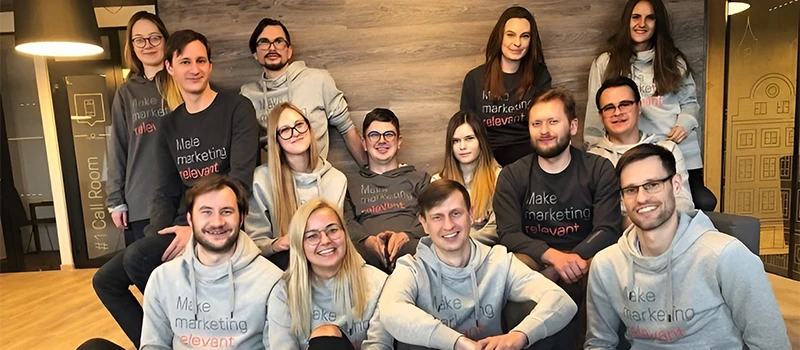
About Rytis Lauris
Most SaaS founders spend their first two years pitching investors. Rytis Lauris spent his first two years pitching customers. When he built Omnisend, he made a deliberate architectural decision. He knew that a product built around investor timelines and return targets would always serve a different master than the one that actually mattered.
Today, Omnisend is a category-defining eCommerce marketing automation platform. It reached that milestone without a single dollar of investor capital. That bootstrapping choice structurally shaped the product, the company culture, and every strategic call the team has made since day one.
The Bootstrap Filter
Many founders view bootstrapping as a financial constraint. Rytis viewed it as a filter. Staying funded entirely by customers kept every product and strategy decision pointed at one central question. They only asked if a new feature actually helped the customer. Growth requires scale, and scale costs money. The temptation to take a venture capital check is completely rational. However, founders who successfully bootstrap understand exactly what they are trading away if they take that money.
Key Takeaways
- Omnisend was Rytis’s third startup attempt. His prior ventures gave him the operational scar tissue necessary to build a sustainable SaaS product.
- The decision to bootstrap ensured that every feature update prioritized customer needs over investor return timelines.
- A massive 2017 pivot from an email-only tool to a full omnichannel platform fundamentally transformed Omnisend’s market position.
- When a major competitor dropped their Shopify integration, thousands of displaced merchants switched to Omnisend because the core product simply worked better.
- Automated messages drive 41% of all email orders while accounting for only 2% of total sends. Omnisend was built to close this exact behavior gap for small merchants.
The Interview
Q: You built Omnisend into a massive success without venture capital. Why did you choose to bootstrap when so many SaaS founders prioritize raising money?
Rytis Lauris: Taking outside money usually comes with a specific priority stack. Investors have return timelines, growth targets, and board dynamics. Those pressures shape decisions in ways that slowly pull a product away from what the paying users actually need. Once we proved we could sustain ourselves, it became clear that keeping the customer at the center of our purpose was our ultimate competitive advantage. If a feature was not going to help our customers, we simply did not build it.
Q: Omnisend was your third startup. How did your previous failures shape your approach to building this company?
Rytis: My prior ventures were the real curriculum. I ran an eco-friendly postcard business and later an audience polling tool similar to Slido. Those experiences taught me the difference between a product people find interesting and a product they will actually pay for. Later, I ran a marketing agency working directly with eCommerce merchants. That agency became my laboratory. I saw exactly how much revenue brands were leaving on the table because they had not automated the right sequences. By the time I launched Omnisend, I was not guessing at customer problems.
Q: You launched as an email marketing tool but pivoted to omnichannel in 2017. What drove that massive shift?
Rytis: We realized that eCommerce merchants needed to reach their buyers wherever they were. We added SMS, web push notifications, and other channels to our core email offering. It was not just a feature addition. It was a complete repositioning. We stopped competing purely on email and started competing on a much more important question. We wanted to help merchants send relevant messages at the right moment without forcing them to build an expensive enterprise tech stack.
Q: Your biggest growth inflection happened when a major competitor dropped their Shopify integration. What did that moment teach you about product strategy?
Rytis: It proved that building product credibility is everything. Market disruptions create windows of opportunity, but they do not create retention. Thousands of merchants suddenly needed a replacement and looked at their options. They chose us and stayed because our platform actually worked. You cannot out-market a competitor with ten times your budget. But if you out-build them on the things that matter to the customer, you will be ready when the market finally gives people a reason to switch.
Q: You frequently cite a specific statistic about automation. Why is the gap between email sends and actual orders so important?
Rytis: Automated messages account for 41% of all email orders but represent only 2% of total sends. That gap highlights a massive missed opportunity for merchants. We built our value proposition around closing that behavior gap rather than just closing a feature gap. We give smaller merchants access to the exact same automation workflows that enterprise brands take for granted.
Q: What is the most important piece of advice you can give to a founder launching a SaaS product today?
Rytis: Move first and optimize later. Do not overthink every single aspect of the business before you launch. Start acting, evaluate the real data, and pivot if you need to. The founders who scale are rarely the ones with the most detailed business plans. They are the ones who move fast enough to collect actual feedback before their assumptions calcify. Also, if early users are willing to pay for an imperfect MVP, that is your clearest green light to keep going.
Lessons for SaaS Founders
- Bootstrapping is a strategy. Staying customer-funded means every growth decision is grounded in real value creation rather than runway pressure.
- Paying customers validate your MVP. Do not wait for a polished product before committing. If people pay and renew, build from that signal rather than internal conviction.
- Omnichannel is the baseline. Automated SMS makes up a massive portion of orders. Merchants treating email as their only retention channel are actively falling behind customer expectations.
- Market disruptions require readiness. When a competitor makes a mistake, you capture the fallout only if your product is already robust enough to retain the influx of new users.
If you want to read more insights from founders who scaled their businesses without taking shortcuts, explore more stories at eFounder.club.