
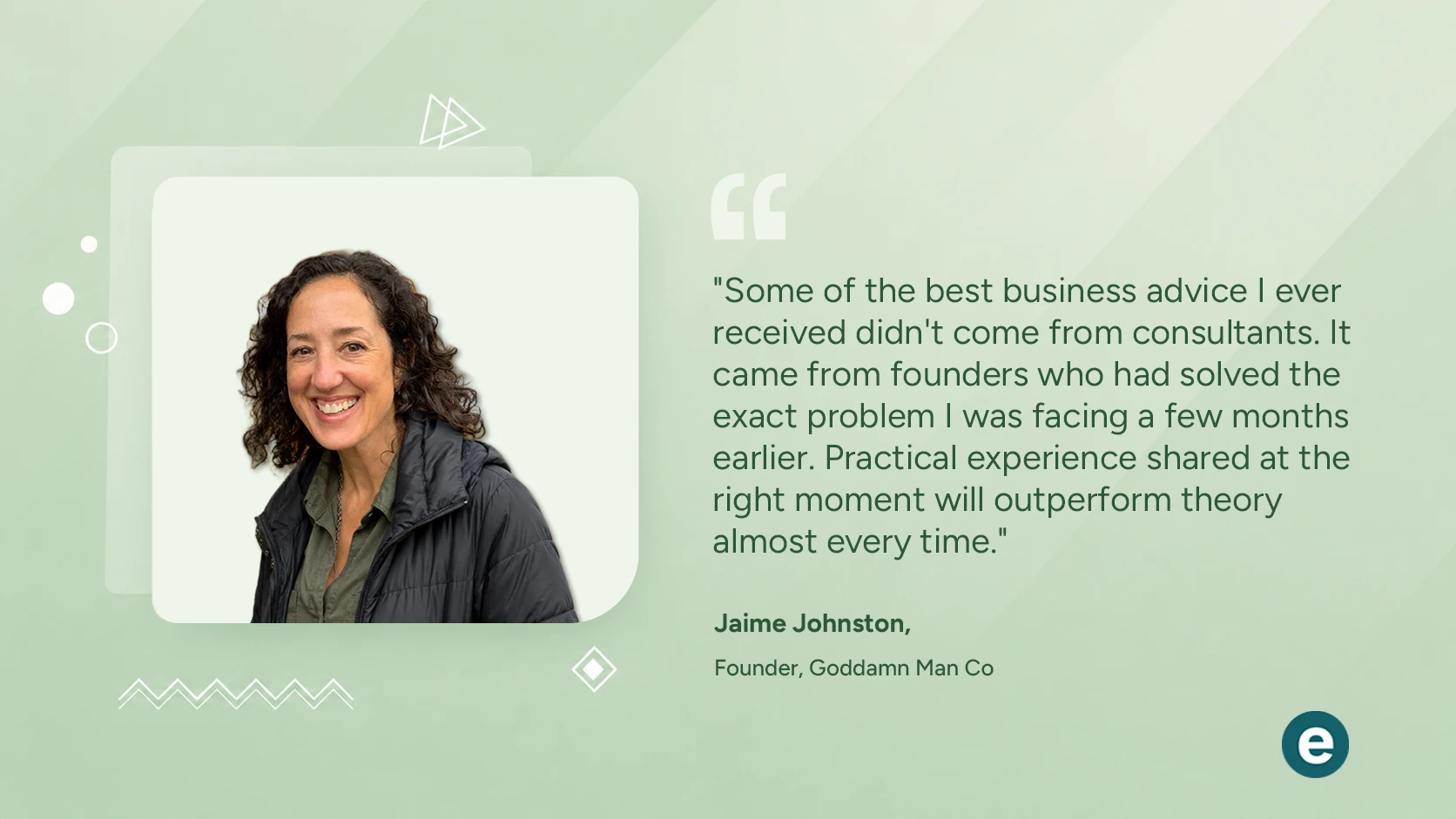
The grooming industry assumes its best founders are insiders: former brand chemists, retail buyers, beauty school graduates. Jaime entered with none of those credentials and built from a different foundation: two decades of watching bureaucratic systems fail the people they serve, and the rural disposition to build the solution rather than write a report about the gap.
Every beard oil in the Goddamn Man Co. line is named after a motorcycle. That decision is not a random aesthetic choice. It connects the product to a subculture with its own codes of craft, maintenance, and self-sufficiency, the same values Jaime brings to formulation.
About Jaime Johnston
Jaime Johnston is the founder of Goddamn Man Co., a men’s beard grooming brand built on eco-friendly formulations and motorcycle-themed packaging. Jaime spent 20 years in disability policy before burnout at the executive director level in Oregon pushed her toward launching something new.
She built from scratch in a category where she was a genuine consumer but not a credential-holder. Two decades of policy work, a rural background, and a community of female business owners produced a beard grooming brand that does not look or feel like anything else in the category.
Key Takeaways
- Twenty years in disability policy built the analytical discipline and systems thinking Jaime applied to brand operations.
- Motorcycle-themed packaging connects Goddamn Man Co. to a subculture whose values align directly with the brand’s formulation philosophy.
- Eco-friendly formulations were a founding decision rather than a marketing response to consumer demand.
- A community of female business owners provided real-time tactical intelligence that formal advisory structures rarely deliver.
- Platform migrations (WordPress to Wix to Shopify) were deliberate operational maturity investments, not reactive fixes.
You spent 20 years in disability policy before launching a beard grooming brand. What carried across?
Systems thinking. In policy work, you spend years understanding why well-intentioned programs produce outcomes nobody wanted. You learn to trace failure back to structural causes. When I built Goddamn Man Co., I applied that same diagnostic habit to product decisions, supply chain choices, and platform strategy. The industry was different. The mode of thinking was identical.
Why motorcycle themes specifically?
Because the values are the same. People who name their motorcycles understand something about maintenance, craft, and the relationship between care and performance that most grooming brands never connect to theirproducts. Naming each beard oil after a motorcycle is not decoration. It is a signal to the specific consumer who will immediately understand what kind of brand this is.
You migrated platforms three times. How did you decide when a migration was worth the disruption?
The question I always asked was whether I was making the move because the destination was genuinely better or because I was avoiding solving a harder problem on the current platform. Both times I could articulate exactly what the new platform would allow me to do that the previous one prevented. If you cannot answer that specifically, the migration is probably avoidance, not strategy.
What did the community of female business owners give you that formal advisors could not?
Honest, recent, specific intelligence from people who had just solved the exact problem I was facing. Formal advisory structures tend toward abstraction. The woman in my network who had dealt with the same fulfillment issue six months ago could tell me exactly what she tried, what failed, and what finally worked.
What do you think the grooming industry consistently underestimates?
The consumer’s ability to detect inauthenticity. A brand built around craft and values by someone who actually holds those values reads differently from a brand that assembled the same aesthetic from a mood board. Consumers in this category have seen enough generic motorcycle imagery to know the difference between a brand that means it and one that is performing it.
Lessons for Founders
- Expertise from outside a category is not a deficit to overcome but a source of differentiation when applied with genuine rigor.
- Brand identity decisions that connect to a subculture’s actual values create recognition that generic aesthetics cannot replicate.
- Platform migrations earn their disruption cost only when the founder can articulate specific capabilities the move unlocks.
- Peer networks with recent, specific, tactical experience outperform formal advisory structures for operational problem-solving.
For more founder stories and growth strategies from operators who have built from the ground up, read more at eFounder.club.