
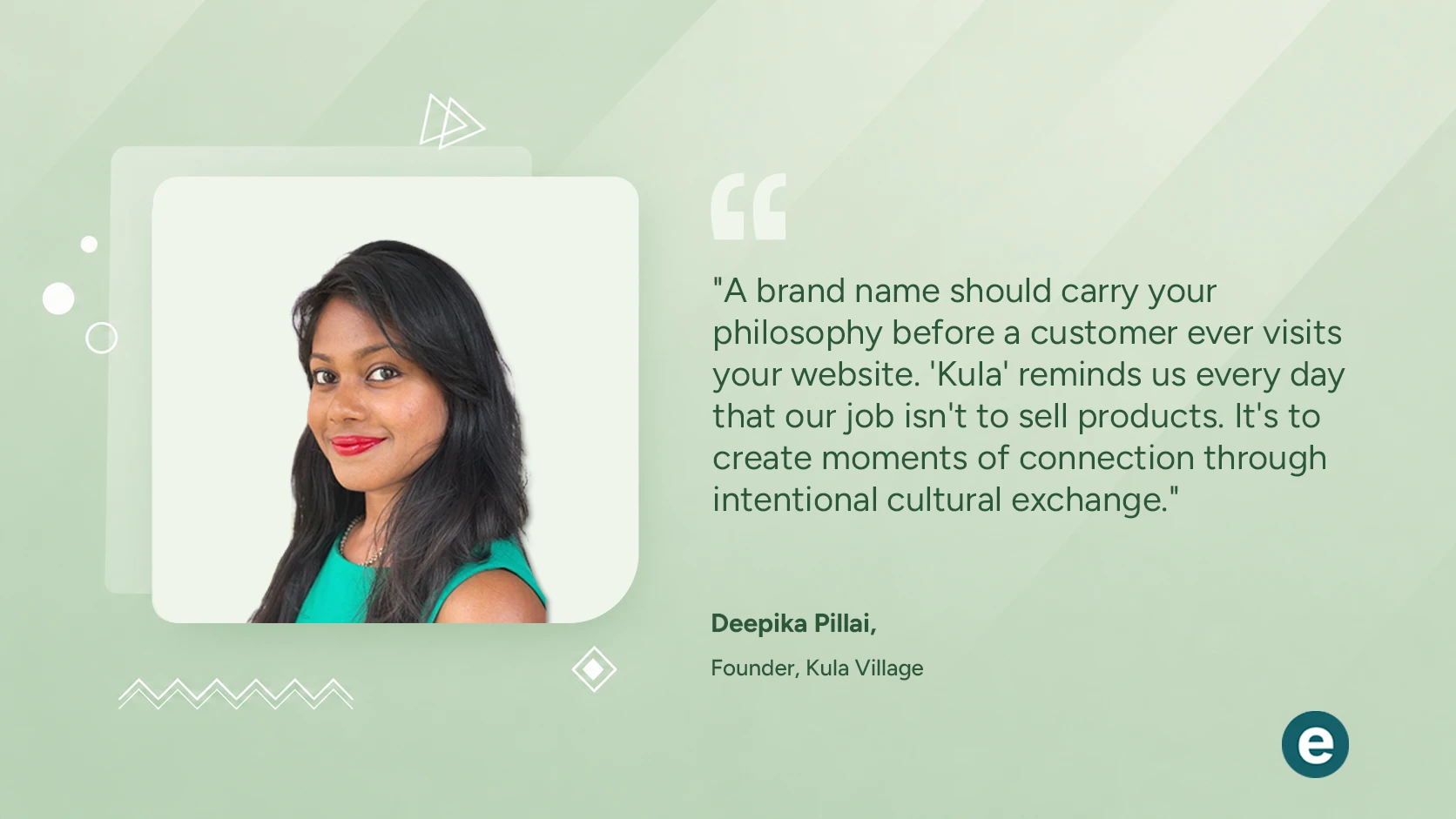
Most gift brands treat culture as aesthetic. Kula Village was built from the inside out by someone who genuinely understands cultural nuance because she has navigated it across languages, geographies, and professional contexts for over a decade.
Deepika’s career in hospitality sales within a global Dubai conglomerate gave her two things: a precise understanding of how meaning travels across cultures, and professional fluency in communicating across differences. She brought both into the product design, the sourcing, and the brand’s voice.
About Deepika Pillai
Deepika Pillai is the founder of Kula Village, a brand curating cultural gift boxes and children’s books to bring cultural exchange directly to families. Fluent in five languages and shaped by an MBA in Germany and a career in hospitality sales across global markets, Deepika was living the thesis behind Kula Village long before she named it.
“Kula” means community and the exchanging of gifts in certain cultural traditions. She launched in mid-2020, drawing on years of navigating cultural contexts professionally and personally. The name is not decorative. It is the brand’s entire operating logic distilled to one word.
Key Takeaways
- Deepika built Kula Village from genuine lived experience navigating cultural contexts across five languages and multiple global markets.
- The brand name “Kula” carries the core thesis: community and the exchanging of gifts as meaningful acts rather than transactions.
- Cultural gift boxes and children’s books serve the same mission from different angles, building toward the same long-term outcome.
- Launching mid-2020 required building consumer trust around international sourcing during maximum supply chain uncertainty.
- Family support was structurally essential to the founding, a resource Deepika names directly rather than treating as incidental.
You were already living the Kula Village thesis before you launched. When did you recognize it as a business?
There was not a single moment. It accumulated. Years of crossing cultures professionally, of watching how much meaning gets lost in gift-giving that is culturally misaligned, of noticing that families who wanted to introduce their children to a wider world had very few genuinely thoughtful options. When the pandemic created space and clarity, the decision to formalize what I had been observing became obvious.
Why anchor the brand in the name “Kula” specifically?
Because the name says everything the brand needs to say before a customer reads a single line of copy. Kula means community. It means the intentional exchange of gifts as a way of building connection across difference. That is precisely what every Kula Village product is designed to facilitate.
Why children’s books alongside the gift boxes? That is a significant product category expansion.
It does not feel like an expansion to me. It feels like completing the sentence. The gift boxes introduce families to cultural traditions in tangible form. The books do the same work at an earlier developmental stage, before the child has formed fixed assumptions that make cultural openness harder to cultivate.
What role did your family play in making Kula Village possible?
I could not be here without the unconditional support of my family. That is not a formal acknowledgment. It is accurate accounting. Building a brand from scratch while managing international cultural sourcing and a launch in the middle of global disruption requires a support structure. Mine gave me the space to focus entirely on building something real.
What does a founder from outside a product category need that industry veterans sometimes overlook?
Permission to trust the thing that makes you different. Industry veterans know the category. I know the cultural context the category is supposed to serve. Those are not equivalent. Brands that default to industry convention over genuine cultural understanding produce products that look right and feel hollow.
Lessons for Founders
- A brand name that accurately carries the brand’s thesis does more work than any tagline can replicate.
- Authentic cultural expertise is structurally different from cultural aesthetics, and consumers who care about the distinction will find the difference.
- Multi-format product strategies are most coherent when both formats genuinely serve the same mission from different angles.
- Name your support structure explicitly rather than treating it as incidental. It shapes what you can build.
For more founder stories and growth strategies from operators who have built from the ground up, read more at eFounder.club.