
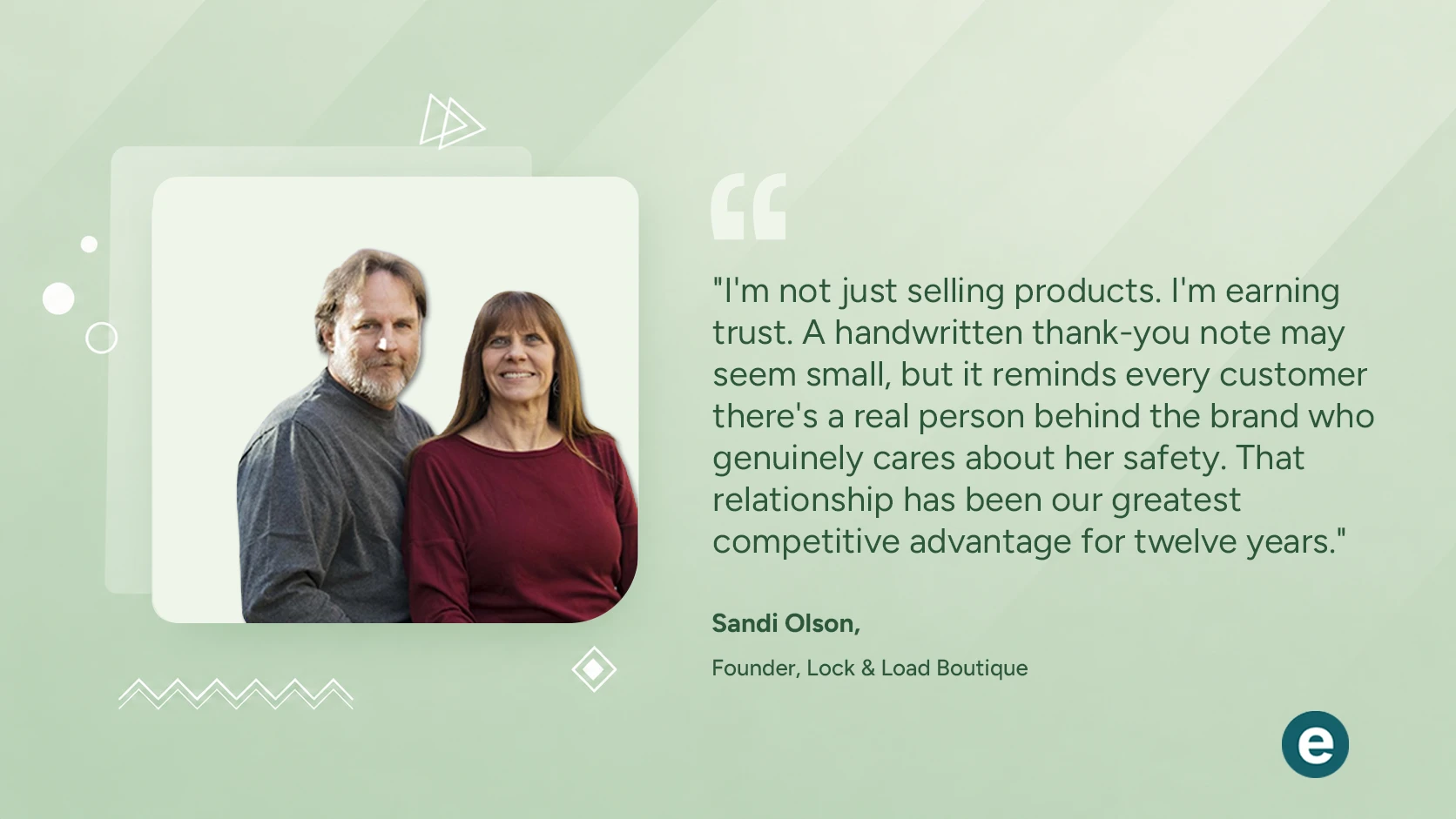
Most self-defense retail leads with product specifications: lumen counts, range distances, voltage ratings. Sandi leads with relationship. That is not a soft substitute for a product strategy. It is a product strategy built on an accurate read of what drives repeat purchase and referral in a category where the customer’s underlying motivation is personal safety.
A handwritten thank-you note is evidence of character. In an era of automated customer communications, it signals that a real person is paying attention to you as an individual. For a customer thinking about personal safety, that signal carries weight no automated sequence can replicate. It is also not scalable in the conventional sense, which is exactly why it works as a competitive moat.
About Sandi Olson
Sandi Olson is the founder of Lock & Load Boutique, a women-centric self-defense gadget brand she has run for twelve years. She built the brand around one premise the self-defense retail category consistently undervalues: the customer relationship is the product. Twelve years of handwritten thank-you notes and genuinely personalized service have produced a loyal customer base no advertising budget could manufacture.
The self-defense category carries inherent emotional weight. Every purchase implicitly acknowledges a threat. Sandi understood from the beginning that how a brand shows up in that transaction matters as much as what the product does.
Key Takeaways
- Lock & Load Boutique has operated for twelve years by prioritizing customer relationship quality over customer acquisition volume.
- Handwritten thank-you notes function as evidence of brand character rather than marketing tactics, building trust that automation cannot produce.
- Women-centric positioning in self-defense reflects a specific product curation philosophy, not just a demographic targeting decision.
- Personalized service is a competitive moat precisely because it is not scalable in the way large competitors would need it to be.
- Twelve years of consistent customer engagement has created accumulated trust that represents a different kind of asset than product or distribution advantages.
You have been running Lock & Load Boutique for twelve years. What has sustained the business through changing market conditions?
The relationships. Every customer who has stayed with us for years, who refers people to us, who comes back when she has another need in the category, she did not do that because of our search ranking alone. She did that because she felt genuinely seen and served when she bought from us the first time. Replicating that at scale is what most e-commerce brands cannot do, and it is precisely what I have spent twelve years building.
Handwritten thank-you notes seem like a very analog strategy for an online business. Why that specifically?
I believe in the power of personalized experiences. A handwritten note proves that a real person, not a system, is paying attention to you specifically. In a category where the customer is making a purchase connected to her personal safety, that proof of individual attention is not a nice gesture. It is a fundamental part of the trust I am trying to build.
Self-defense is a category with significant emotional weight for the buyer. How does that shape how you curate products?
Every product I carry had to pass my own evaluation: would this genuinely serve a woman trying to feel safer? I do not curate for aesthetics or margin alone. I curate for actual utility in the situations my customers are likely to encounter. My customers are making real decisions about their safety. They deserve accurate information, not sales enthusiasm.
Twelve years is a long time to maintain the same service standard. How have you kept the personalization genuine?
By staying small enough to actually know my customers. Growth that requires you to automate the relationship is growth that destroys the thing that made you worth choosing. I have made conscious decisions about scale that prioritize the quality of the customer experience over the volume of customers I serve. That is a deliberate business philosophy, not a failure to grow.
What do you think the self-defense category consistently misunderstands about its female customer?
That she wants to feel capable, not just armed. The category tends to lead with product specifications and threat scenarios. What the customer actually wants is confidence: the knowledge that she has thought through her safety, made informed choices, and has access to someone she trusts if her needs change.
Lessons for Founders
- Relationship quality is a competitive moat that accumulates over time and resists the replication attempts of larger competitors.
- Personalized service is most powerful in categories where the purchase carries emotional or safety significance for the buyer.
- Deliberate growth constraints that protect service quality are a business philosophy, not an operational limitation.
- Category expertise that serves genuine need, rather than product enthusiasm, builds the trust required for repeat purchase in high-stakes buying contexts.
For more founder stories and growth strategies from operators who have built from the ground up, read more at eFounder.club.