
The engagement ring industry operates on structural information asymmetry. Buyers arrive underprepared. The only expert in the room is the jeweler, who has a direct financial interest in the outcome. The average buyer visits 26 rings across 3.5 months and still overspends by 35%. Those figures are not anomalies. They are the expected result of a system not designed to serve the buyer.
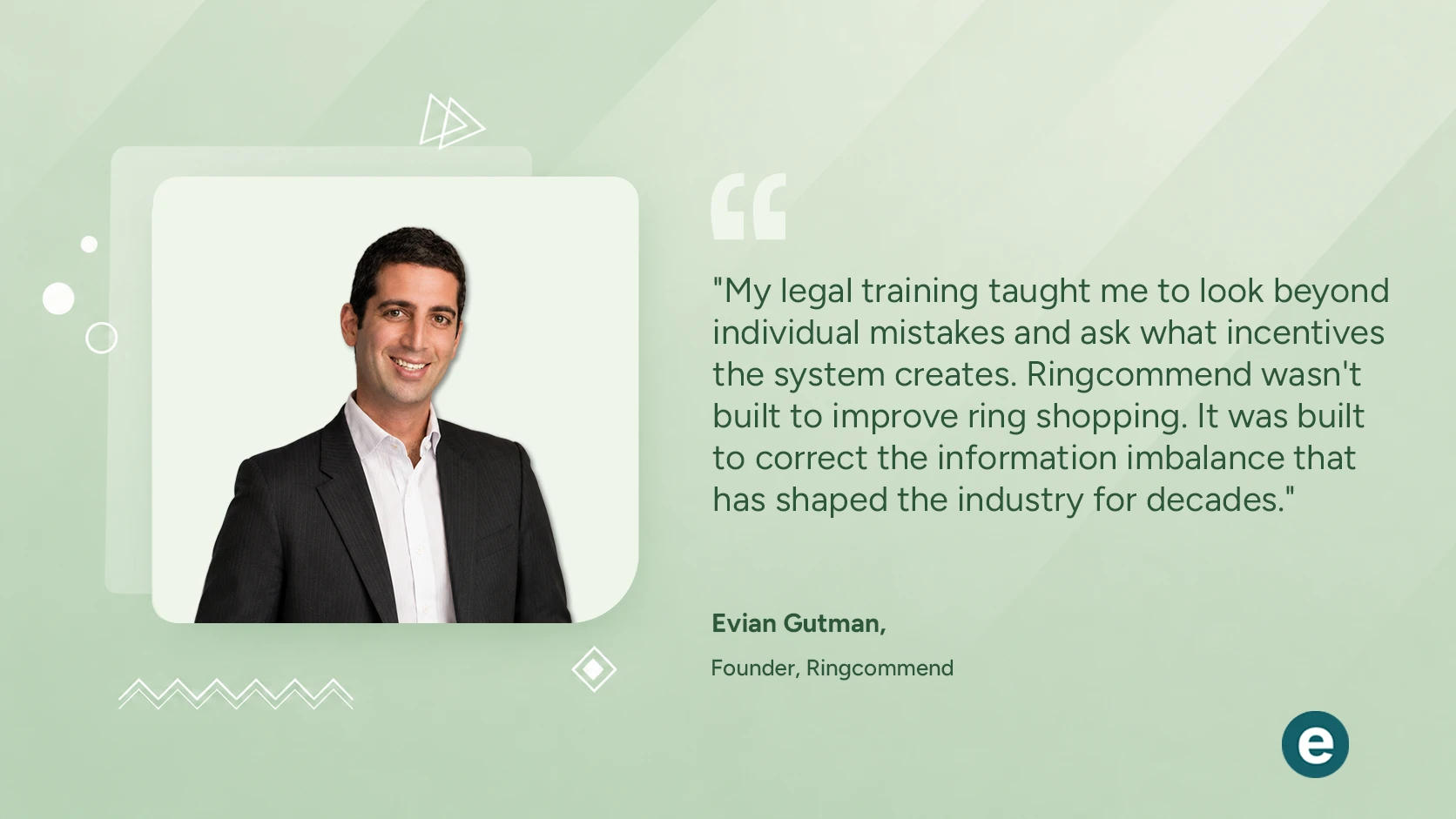
Ringcommend was built to dismantle that asymmetry. Evian’s law training developed his instinct for where information imbalances create unfair outcomes. His marketplace experience taught him the operational mechanics of trust-building between buyers and sellers.
About Evian Gutman
Evian Gutman is the founder of Ringcommend, a platform giving engagement ring buyers the independent guidance the industry has never prioritized. He arrived through personal experience: he proposed in 2018, spoke to 14 jewelers, and still overspent his budget by $2,500. The overspend was the predictable outcome of a purchase process built to produce it.
Before Ringcommend, Evian completed a law degree and ran Padlifter, a short-term rental marketplace in Sydney. His co-founder is Waldo Perez, a veteran jeweler with over 500 engagement rings in his portfolio.
Key Takeaways
- The average engagement ring buyer visits 26 rings over 3.5 months and still overspends by 35%, revealing a structural guidance failure rather than individual buyer error.
- Evian’s law background developed the analytical instinct for information asymmetry that made Ringcommend’s founding insight clear.
- Co-founder Waldo Perez brings 500+ engagement ring conversations, making lived buyer intelligence the product’s foundation.
- Five operating values (value, simplicity, expertise, trustworthiness, transparency) map directly to the five ways traditional ring buying fails buyers.
- Trust is the purchase barrier in this category, and Ringcommend’s positioning as independent guidance addresses it structurally rather than rhetorically.
You overspent on your own engagement ring by $2,500 after speaking to 14 jewelers. What did that reveal about the industry?
I did the research. I visited multiple stores. I came in with a budget. I still overspent significantly, and I was not alone. When I started measuring the category, I found the average buyer visits 26 rings over more than three months and still overshoots their budget by 35%. That pattern does not happen because buyers are careless. It happens because the process is designed by people whose interests are not aligned with the buyer’s.
How did a law degree and a rental marketplace prepare you to address a jewelry industry problem?
Law trains you to locate the structural source of unfair outcomes. Marketplace operations teach you how to build trust between strangers making significant decisions. Both capabilities are exactly what the engagement ring category needs. The problem is not that there are bad jewelers. It is that the buyer has no independent source of expertise. Building that source required both the analytical framework from law and the trust mechanics from marketplace experience.
What does Waldo Perez’s experience of 500+ engagement rings give Ringcommend that research cannot?
Lived pattern recognition from real conversations at real stakes. Five hundred engagement ring decisions means 500 instances of watching how buyers make choices under emotional pressure, where their estimates break down, what they are afraid to ask out loud. You cannot get that from studying the market. You acquire it from being in the room for that many consequential decisions.
Trust is the central purchase barrier. How do you build it when asking buyers to rely on an unfamiliar platform?
Honesty about who we are and what we are not. We are a small team of dedicated and honest jewelers. That is the description I use because it is accurate. That specificity about identity is more credible than a brand positioning statement.
What does the engagement ring market look like from a founder’s perspective today?
The information asymmetry has not been resolved. The industry has added digital tools and virtual consultations, but those tools are still operated by jewelers whose incentives are unchanged. The buyer still arrives without independent expertise. The fundamental structural gap Ringcommend was built to address is still there.
Lessons for Founders
- Structural analysis of industry failure points is more productive than searching for unmet consumer demand at the surface level.
- Co-founder selection based on lived operational intelligence fills gaps that no advisory board or industry research can substitute.
- Trust-building in high-stakes categories requires honest specificity about who you are and what you are not.
- Information asymmetry as a business problem is rarely resolved by the industry that benefits from it, which is where the founding opportunity lives.
For more founder stories and growth strategies from operators who have built from the ground up, read more at eFounder.club.