
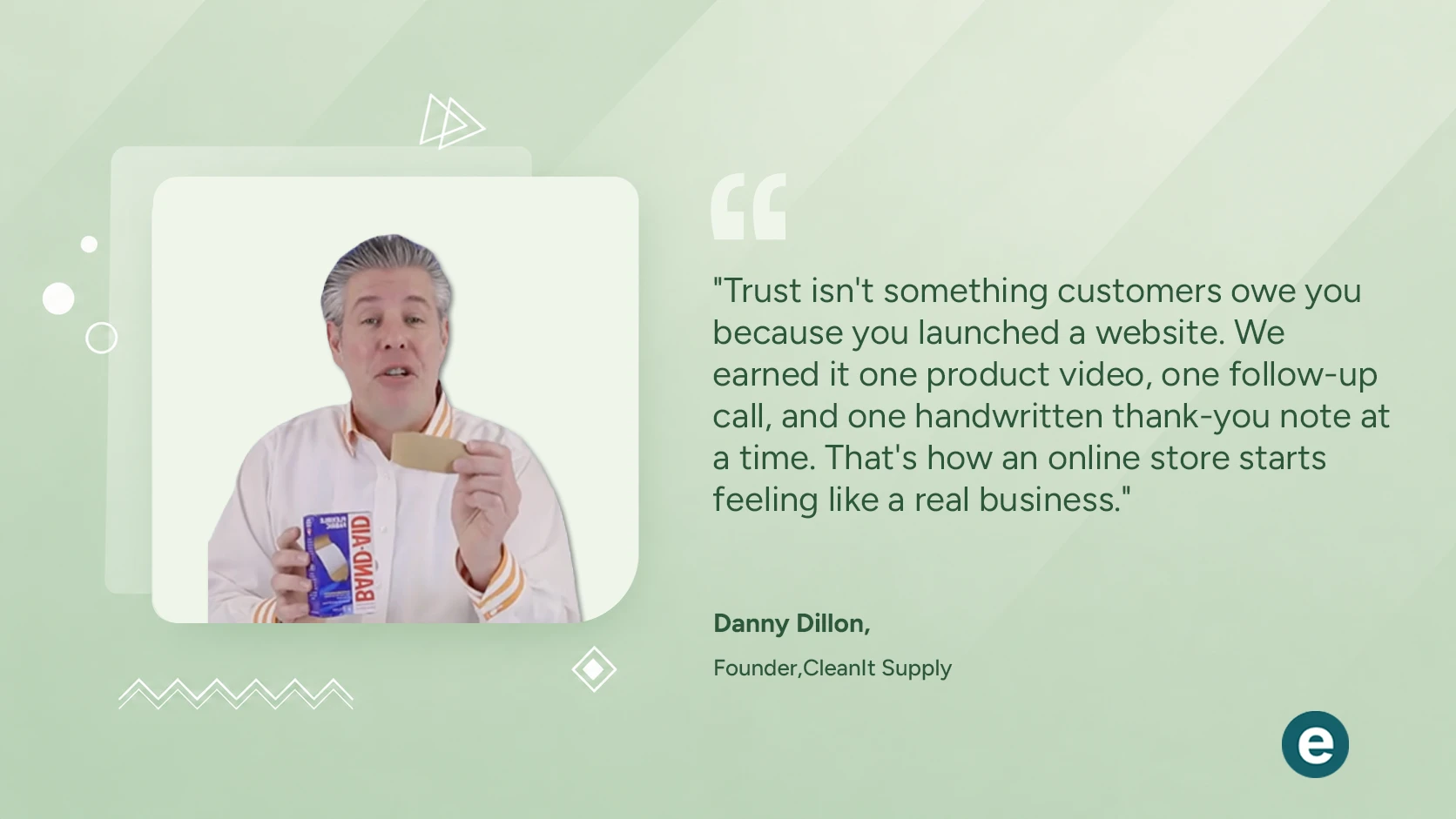
About Danny Dillon
Most eCommerce founders chase categories with cultural cachet like fashion, beauty, or wellness. Danny Dillon chose janitorial supplies. When he launched CleanItSupply.com in 2005, eCommerce was still fighting for legitimacy in mainstream retail. In the industrial cleaning space, buyers traditionally wanted to talk to a sales rep and shake hands before committing. Skepticism was incredibly high.
Danny launched anyway. Nineteen years later, CleanItSupply is still operating, still growing, and still proving that boring categories with sharp execution consistently outlast exciting ideas with sloppy follow-through.
The Founding Insight
Many founders identify a market gap by looking from the outside in. Danny grew up watching his industry from the inside. His family had a background in cleaning services, which gave him a firsthand understanding of how procurement actually worked. He saw that large institutional buyers negotiated wholesale pricing, while small businesses paid full retail for the exact same products.
Danny recognized the early internet as a distribution channel that could remove intermediaries. He built CleanItSupply around a single principle of providing wholesale prices to everyone. The market insisted that selling unglamorous industrial supplies online would never work. Instead of arguing with the skepticism, Danny simply built a business that made it irrelevant.
Key Takeaways
- Danny leveraged his family background in cleaning services to identify a massive pricing gap between institutional buyers and small businesses.
- The company was built on a single uncompromising principle of offering wholesale prices for everyone.
- To overcome early eCommerce skepticism, Danny recorded over 6,000 product videos to put a human face on an otherwise anonymous digital storefront.
- Scale was achieved by methodically expanding the catalog and upgrading logistics without sacrificing personalized customer touchpoints.
- After 19 years, the company continues to grow by expanding geographically and aggressively adding eco-friendly product lines.
The Interview
Q: You launched an eCommerce business in 2005 selling janitorial supplies. Why did you choose such an unglamorous category when the internet was still so unproven?
Danny Dillon: I grew up in the cleaning services industry. That proximity showed me exactly where the friction lived and who was paying the price for it. Large buyers like hospitals and school systems got great wholesale rates. Small businesses bought the exact same supplies but paid massive retail markups. I realized the internet could act as a direct distribution channel to remove the middlemen. I wanted to give smaller buyers access to the exact same economics that large institutions always enjoyed.
Q: In a category built entirely on handshakes and in-person sales reps, how did you get buyers to trust a website?
Danny: Customers were applying reasonable skepticism to an unfamiliar buying experience. I knew I could not replicate the traditional sales relationship online, so I rebuilt it in a format the channel could actually support. I filmed over 6,000 product videos featuring myself as “Danny D.” I walked customers through specifications and use cases in plain language. Those videos put a human face on the transaction. Customers could see the product and hear an honest explanation without needing to schedule a meeting with a sales rep.
Q: How did you scale the business over nearly two decades without losing that initial personal connection?
Danny: Growth requires solving multiple problems at once without letting any single solution degrade the others. We diversified our product catalog through partnerships with established brands and completely rebuilt our logistics to handle higher volume. However, I absolutely refused to compromise on direct customer contact. We kept doing follow up calls after purchases and writing personalized thank you notes. Those things are not scalable in a traditional sense, but they are the exact mechanisms that built and protected our reputation.
Q: Most companies have a mission statement, but you describe “wholesale prices for everyone” as an operational filter. What is the difference?
Danny: A mission statement is something you put on an About Us page. An operational filter dictates your daily choices. It was the lens through which we evaluated every single product decision and pricing call for nineteen years. If a new product did not fit our wholesale pricing model, it did not make the catalog. When a pricing decision conflicted with the principle, the principle won every single time. That consistency builds a kind of loyalty that promotional discounts simply cannot manufacture.
Q: What is the most important lesson you learned about navigating market skepticism in the early days?
Danny: Early market skepticism is just noise. People told me that buyers wanted relationships and demonstrations, and that a website could never provide that. But the underlying logic of the business was sound. There was a real gap, a real customer pain point, and a real distribution advantage. If your business fundamentals are right, external skepticism should be your cue to move faster.
Q: What does the roadmap look like for CleanItSupply today?
Danny: We are focusing heavily on geographic expansion into new markets and broadening our product categories. We are also making a massive push into eco-friendly and sustainable supply options because that is where buyer preferences are heading. Our founding principle stays exactly the same, but our execution just keeps getting more precise.
Lessons for Founders
- Skepticism is not data. If your business fundamentals solve a real pain point, treat industry skepticism as an opportunity rather than a roadblock.
- Trust is infrastructure. Customers do not trust online storefronts by default. You have to earn it through transparency and by putting a human face on your brand.
- Principles must drive decisions. A founding principle that bends under growth pressure is just decoration. Apply your core values as a strict filter for every operational choice.
- Personalization survives scale if you prioritize it. Things like handwritten notes and follow up calls defy traditional scaling logic, but they are often the exact reason customers remain loyal for decades.
If you want to read more about builders who put in the work for longer than anyone expected, explore more stories at eFounder.club.