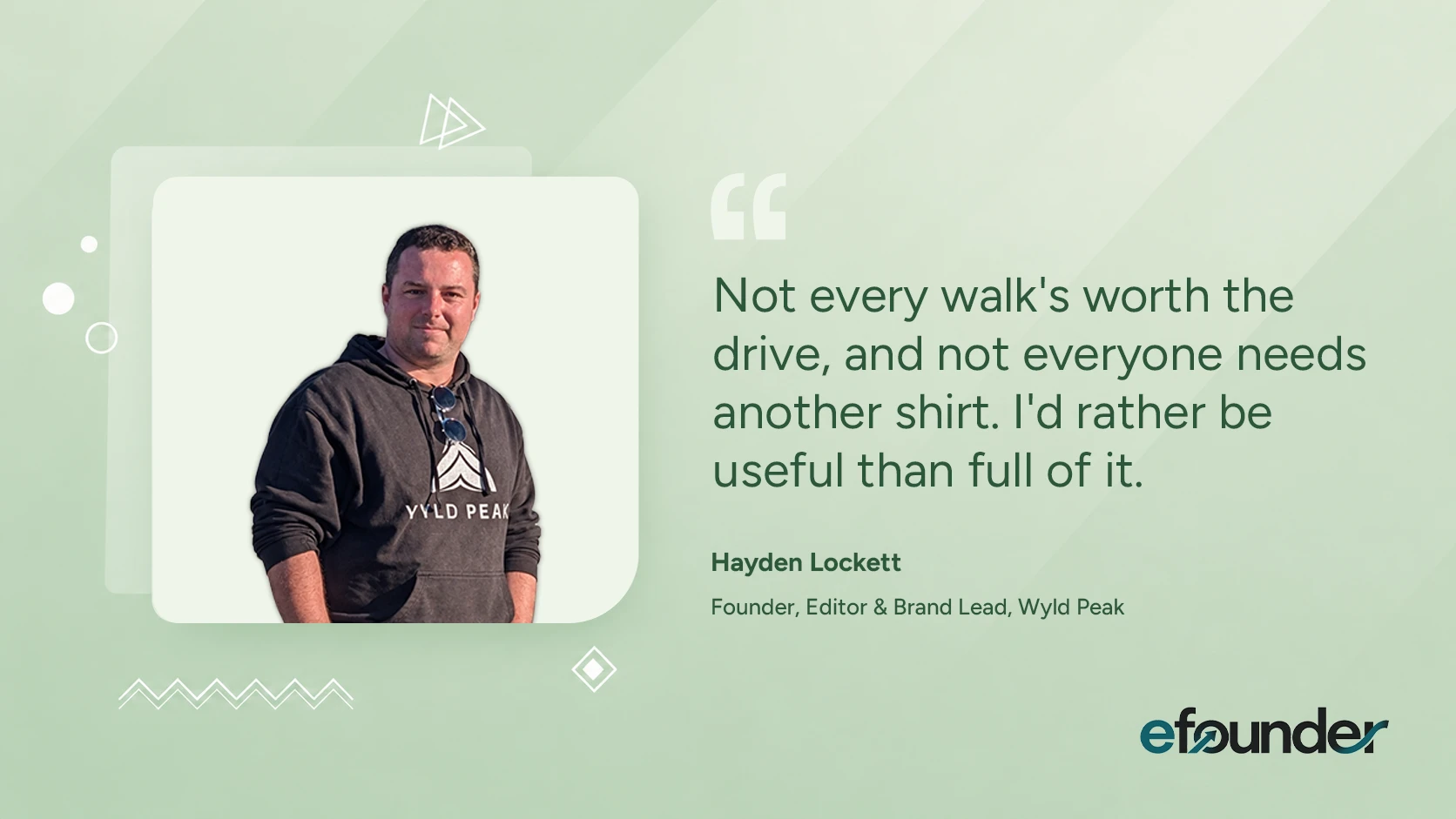
- Pushback against staged outdoor culture, telling readers when a walk is not worth the drive and valuing honest trail information.
- Growth is welcome but not at the cost of integrity; no fake environmental claims, misleading product descriptions, or forced urgency.
- Mixes practical guides, real stories, and playful cryptid gear while acknowledging impact with made to order production and a tree planted per sale.
| Founder | Hayden Lockett |
|---|---|
| Company | Wyld Peak |
| Category | Independent outdoor clothing, accessories and hiking guides |
| Started after | Years of hiking, diving and travelling |
| Who he serves | Walkers and hikers in New Zealand and the US who want honest information |
| Breakout product | National park designs and cryptid gear |
| Traction | The US has become a big part of WYLD PEAK |
| Big lesson | People don’t need you to love every trail; they need to know what they’re getting into |
Key Numbers
|
2022 Year WYLD PEAK started in New Zealand |
1 tree Planting funded with every completed order |
2 countries Hiking guides written across New Zealand and the US |
4 cryptid gifts Bigfoot, Mothman, Dogman and the Fresno Nightcrawler |
The Interview
Outdoor brands usually sell the summit: perfect light, perfect gear and a planet saved with every purchase. Hayden Lockett sells the honest version. He got fed up with how staged outdoor culture had become, and in 2022 he started WYLD PEAK in New Zealand as the pushback.
In practice, that means outdoor clothing and accessories, hiking guides across New Zealand and the US, and Stories from the Trail about people going through hard times. A Bigfoot hoodie sits next to an accessibility guide, and nobody at WYLD PEAK sees a problem with that.
Hayden also does what most of the category skips: he tells readers when a walk isn’t worth the drive, and he admits a tree planted per order doesn’t undo the cost of making and shipping a product.
1WYLD PEAK started as a pushback against fake outdoor culture. How has your idea of the brand changed since 2022, and what did you have to let go of along the way?
Back in 2022, I was pretty fed up with how staged outdoor culture had become. Everything looked perfect, everyone was climbing mountains, and every brand had something to say about saving the planet.
WYLD PEAK started with clothing, but I realized we could do more than just sell things. That’s where the guides, real stories and wider community started taking shape. I’ve had to drop designs I liked, ideas that went nowhere, and that pressure to make us look bigger than we are.
These days I’m more interested in building something people actually use and want to come back to.
2You spent years walking, diving, and traveling before starting WYLD PEAK. What did that time outside teach you about people, and how has it shaped the way you run the brand?
You meet all sorts of people out there, and everyone’s got their own reasons for going. Some want to push themselves; others just need a break from whatever life’s throwing at them. I’ve also learned not to judge people by their gear, fitness, or experience. You can be incredibly well prepared and still get humbled by the weather.
That’s carried into how I run WYLD PEAK. I try to listen, keep an open mind, and remember that what works for me won’t necessarily work for someone else. We don’t all need the same version of adventure.
3You’ve said many outdoor brands say the right words but don’t really mean them. What made you notice this, and how do you make sure WYLD PEAK never becomes one of them?
I kept seeing the same claims everywhere. Sustainable, adventure-ready, built for explorers. Sometimes you’d look at the actual product and wonder what any of it meant. There are some genuinely good brands out there, but plenty of marketing fluff too.
With WYLD PEAK, I try to keep things accurate. We check product details, question claims, and don’t call a regular cotton tee technical hiking gear just because it’d sound better. I’m not going to pretend we’re perfect either. If we get something wrong, I’d rather we fix it than make excuses.
4Your guides sometimes tell readers a walk isn’t worth the drive. Why share the honest answer even when it isn’t flattering, and what has it taught you about trust?
Because I’ve driven across the country and even taken flights for disappointing walks myself. It’s annoying, especially when you’ve planned your day or week around it.
Our Puketutu Island review is a good example. Nice enough if you’re nearby, but we wouldn’t cross the city for it. There was rubbish, barely any shade, and a pretty awful smell around the wastewater side when we went.
We could’ve made it sound amazing and used the standard hidden gem language and picked only the flattering photos, but that’s not much use to anyone and straight-up dishonest for the purpose of clicks.
5Your Stories from the Trail are about real people going through hard times. Which story stayed with you the most, and what did it teach you about why WYLD PEAK exists?
Shane Kidby’s Walking With Wings story really stuck with me. He’d lost his younger brother and his mum, then set out to walk New Zealand’s coastline. On his second night at Ninety Mile Beach, he found himself crying outside his tent, wondering what he was doing.
That moment stayed with me more than any distance he walked.
He didn’t finish his original goal, but that wasn’t really what made his story worth telling. It reminded me why I want WYLD PEAK to share these experiences. People are dealing with things we often know nothing about. Getting outside doesn’t fix everything, but it can help them through some pretty rough times.
6You’ve spoken up for public land, even when staying quiet would have been safer. Why did you decide to speak up, and how do you choose which causes to stand behind?
It’d feel pretty hypocritical to build an outdoor brand around national parks and wild places, then go quiet when those places need protecting.
I know speaking up can put some people off, and we’re a small business. But staying quiet just to avoid upsetting potential customers doesn’t sit right with me.
That doesn’t mean jumping into every argument. I look at whether something genuinely affects conservation, wildlife or public access, and whether we’ve actually got the facts straight.
Sometimes protecting land means limiting access too. I’m not interested in blindly taking sides just because one sounds better or for social credit.
| The Decision | Public land kept coming up as an issue, and speaking out as a small business could put customers off. |
|---|---|
| Choice | Stay quiet to avoid upsetting potential customers, or speak up for the places the brand is built around. |
| What he did | Spoke up, but only on issues that genuinely affect conservation, wildlife or public access, and only once the facts were straight. |
| Why it holds | Building a brand around national parks and wild places, then going quiet when they need protecting, would be hypocritical. |
| Lesson | Back the causes your brand stands on, check the facts first, and skip the arguments that only earn social credit. |
7You’ve said growth is fine, but losing the plot is not. What does losing the plot look like to you, and what would you never do, even if it helped the brand grow?
Selling stuff we don’t believe in, making claims we can’t back up, and treating customers like walking wallets.
I want WYLD PEAK to grow. Of course I do. But I wouldn’t knowingly mislead someone about a product, invent environmental claims, or fake urgency to squeeze out another sale.
I also don’t want us becoming one of those brands that makes people feel they need expensive gear just to enjoy a walk.
Making money matters. It keeps the business going. I just don’t want to make it by becoming the very thing I was fed up with in the first place.
| The Decision | Growth tactics that would squeeze out extra sales while contradicting why the brand exists. |
|---|---|
| Choice | Mislead, invent environmental claims and fake urgency, or grow only on claims he can back up. |
| What he did | Ruled out selling products he doesn’t believe in, unbacked claims, invented green claims, fake urgency and pushing expensive gear. |
| Why it holds | Hayden wants growth and knows money keeps the business going, but not by becoming the thing he was fed up with. |
| Lesson | Write down the tactics you will never use before you need the sale. |
8WYLD PEAK has a public list of things it won’t pretend, like calling every trail incredible. Which of those promises is hardest to keep, and why does it matter to you?
Probably not assuming everyone experiences a trail the same way. I might find a walk easy, but someone with an injury, disability, or less experience could have a very different time.
Working on our accessibility guides has made me much more aware of how easily you can overlook things when they don’t affect you personally.
It matters because someone could be relying on that information to decide whether they can safely do a walk.
9You plant a tree with every order but say it doesn’t cancel out every impact. How do you balance selling products with caring for the outdoors, and has that ever changed a decision you made?
We sell physical products, so there’s always going to be an environmental impact. Pretending otherwise would be ridiculous. We fund a tree planting with every completed order, but that doesn’t magically undo the cost of manufacturing and shipping something.
It’s part of why we’ve gone with made-to-order production for some of our clothing. It can take longer, but we’re not producing piles of stock that might never sell.
We also offer selected products using organic or recycled materials.
There’s plenty more we could improve. I just want us making sensible decisions and being upfront about what we’re actually doing, rather than slapping a green label on everything.
10WYLD PEAK mixes useful trail advice with cryptids and strange stories. When did you decide to let the brand be a bit weird, and how did people react?
I don’t think there was some big decision. I’ve always liked strange stories, folklore and things that don’t quite make sense.
Bigfoot, Mothman, Dogman, even the Fresno Nightcrawler, which honestly looks like a pair of trousers that’s wandered off without its owner.
Some people love that side of WYLD PEAK. Others are more interested in the hiking guides and practical gear. I’m happy with both.
I never really saw why the two couldn’t go together. The outdoors is already full of weird and interesting things.
Besides, there’s only so many serious mountain graphics the world needs.
11Your roots are in New Zealand, but many of your customers are in the US. What is it like building a brand across that distance, and what has it taught you?
It’s pretty cool knowing something we’re building here in New Zealand can reach people halfway around the world.
The US has become a big part of WYLD PEAK, particularly with our national park designs and cryptid gear.
But it’s also been a learning curve. Different landscapes, different conditions, different customers and a whole lot of things you can’t just assume are the same.
Hiking in Auckland is nothing like hiking in Arizona. We have to research properly and be clear about where we’ve actually been.
It’s taught me to think beyond our own backyard without forgetting where we started.
12You’ve said a brand built around the outdoors should never feel finished. Where do you hope WYLD PEAK goes from here, and do you want it to grow bigger or stay close to its size today?
Bigger, definitely. I’d love to see how far we can take it. I want to keep improving our guides, making better products and sharing stories from people who don’t always get much attention.
There’s also plenty we’ve tried that hasn’t worked, and a lot we still want to figure out.
I don’t want WYLD PEAK to stay small just for the sake of it, but I don’t want growth turning us into something bland either.
If we can reach more people, build a solid business, and still have the freedom to make weird stuff and call out rubbish when we see it, that’s a pretty good direction to head in.
| The Decision | Whether WYLD PEAK should grow or stay close to its current size. |
|---|---|
| Choice | Stay small for its own sake, or grow and risk turning bland. |
| What he did | Chose growth: better guides, better products and more stories from people who don’t always get much attention. |
| Why it holds | Growth works as long as the brand keeps the freedom to make weird stuff and call out rubbish. |
| Lesson | Decide what growth must never cost you, then chase as much of it as you can. |
What Changed
| 2022 | Now | |
|---|---|---|
| Brand focus | Clothing | Clothing plus guides, real stories and a wider community |
| Priority | Pressure to make the brand look bigger than it is | Building something people actually use and come back to |
| Ideas kept | Designs he liked and ideas that went nowhere | Dropped in favour of what the brand actually needs |
Lessons for Founders
- Honesty is a form of respect, not a marketing tactic. Hayden’s Puketutu Island review tells readers the walk isn’t worth crossing the city for, and he has found that people return to a voice they can trust, not one that loves every trail.
- A claim is a promise, so only make the ones you can keep. WYLD PEAK won’t call a regular cotton tee technical hiking gear just because it sounds better, and when the brand gets something wrong, Hayden would rather fix it than make excuses.
- Every product leaves a mark; the honest work is admitting it. A tree planted with every completed order doesn’t undo manufacturing and shipping, so Hayden pairs it with made-to-order production and refuses to slap a green label on everything.
- The same trail is a different trail for every person who walks it. Working on accessibility guides taught Hayden that a walk he finds easy can be a very different walk for someone with an injury or disability, so he checks the details and says when he doesn’t know.
- A brand, like the outdoors, is better when it leaves room for the strange. Bigfoot hoodies sit beside practical trail guides at WYLD PEAK, because Hayden sees the outdoors as already full of weird and interesting things.