
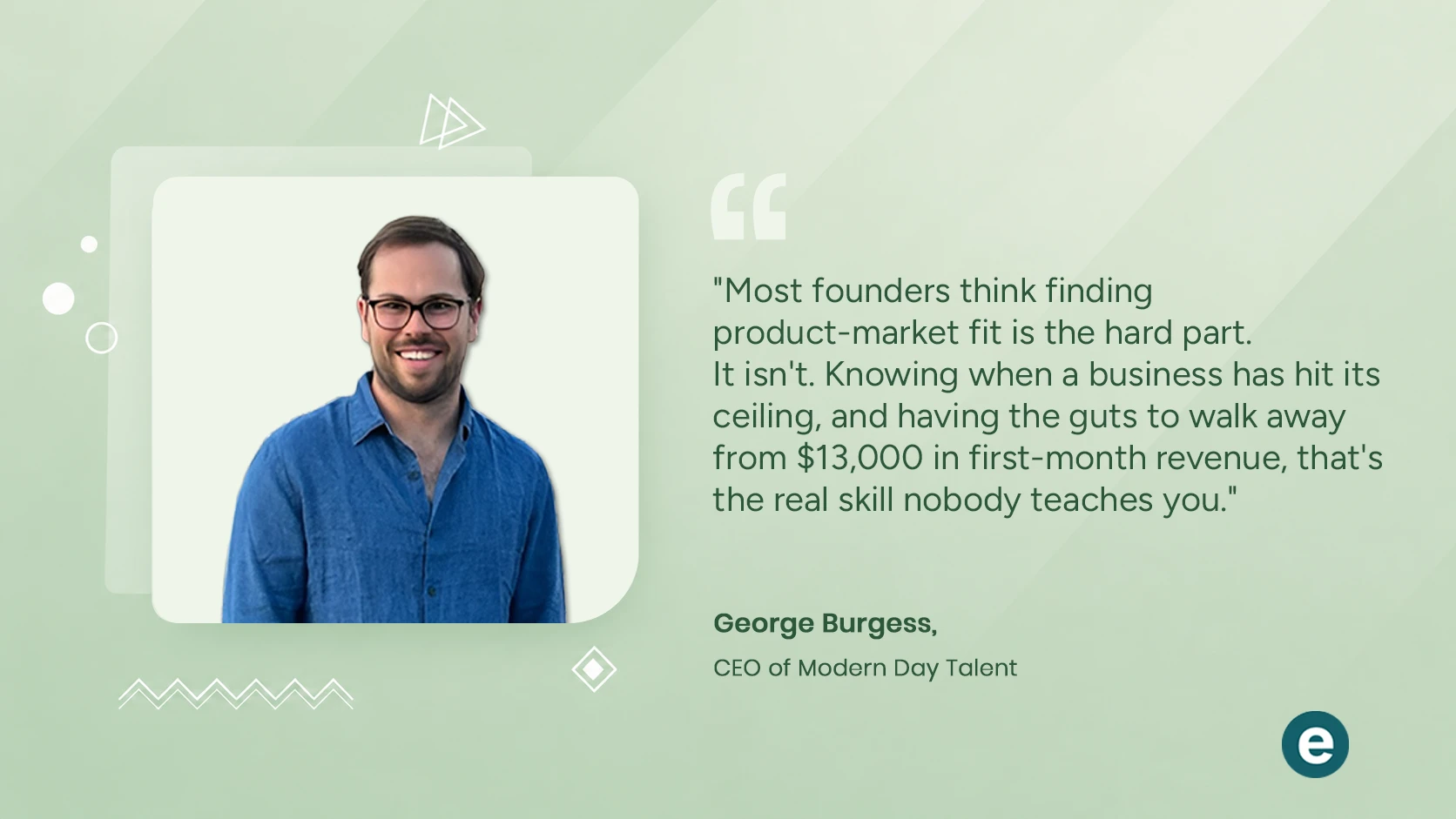
About George Burgess
George Burgess is a London-based serial entrepreneur, angel investor, and CEO of Modern Day Talent, an offshore staffing agency helping fast-growing companies build remote teams in South Africa. His entrepreneurial instincts surfaced early; he was selling storybooks outside his house at age seven and had his first viral product idea in school.
At 17, he founded Gojimo, a mobile exam-prep app that went on to reach 45% of UK secondary school students and was eventually sold to a major UK media group (Telegraph Media Group). He dropped out of Stanford University to go full-time on Gojimo, raising external capital and scaling it into the UK’s largest mobile learning platform.
After the Gojimo exit, George went on to co-found a dating app (The Intro App), a wellness retreat marketplace (Basubu), and, in 2023, Modern Day Talent, selling each venture at the right moment rather than holding past its peak.
He was named to Forbes’ 30 Under 30 Europe: Technology list in 2016. Today, George is as well known for his exit discipline as he is for his growth instincts, a rare founder who has compounded judgment across four distinct companies and categories.
Most Founders Build One Company. George Burgess Built Four Then Sold Every One.
Most founders assume the hardest part of building a startup is finding product-market fit. It isn’t. Knowing when to stop and having the discipline to act on that knowledge is often harder than anything that comes before it.
Before launching Modern Day Talent, George Burgess had already built, scaled, and exited three companies across three different categories. His career moved through edtech, social apps, and wellness marketplaces, each time absorbing a sharp lesson about timing, capital, and the real cost of staying too long in the wrong room.
That experience created a rare advantage. Instead of treating each new venture as an independent bet, George brought compound judgment to every decision. He wasn’t just building companies. He was refining a framework, one exit at a time.
The result became Modern Day Talent, an offshore staffing agency connecting businesses with remote talent in South Africa, built on hard-won lessons about what makes a business worth building in the first place.
Key Takeaways
- George timed his first viral growth wave by moving onto Instagram video ads before advertisers caught on. Distribution timing, not product quality, created the initial spike.
- He ran three businesses simultaneously in 2023 and shut down two within six months, using parallel experimentation to find genuine demand without betting years on untested assumptions.
- Basubu generated $13,000 in its first month but George sold it anyway, because recognizing a ceiling early is as important as recognizing an opportunity.
- Venture capital pressure misaligns most founders with their actual business potential. Modern Day Talent was profitable immediately and needed no outside capital.
- Hiring discipline, slow in and fast out, protected the culture and economics of every business George built.
The Interview
Q: You have built and sold four companies. Your first, Gojimo, gained traction with over 45% of UK secondary school students using the app. How did you achieve such widespread adoption early on?
George Burgess: I think the success of Gojimo was partly due to timing. When we were figuring out our user acquisition strategy, Instagram had just released video ads, which were very new at the time.
This new format wasn’t widely adopted by advertisers yet because creating good video content was still costly and time-consuming.
Instagram had a lot of unused ad inventory, so the cost for video ads was much lower than other formats. We jumped on that opportunity, and it allowed us to acquire users affordably. Another key factor was product-market fit. Students genuinely loved the product. We knew if we could get a significant number of students in each grade, they would spread the word and share it with their friends.
Q: You eventually sold Gojimo to a UK-based media group and worked there post-acquisition. How did it feel transitioning from being a founder and CEO to working in a corporate setting?
George: It was different. Suddenly, I had a proper job with someone to report to, which was a huge change. In some ways, it was refreshing. I had spent six or seven years building Gojimo by myself, making all the decisions alone, so joining a large organization with 1,200 people was a welcome shift. There were senior management teams and smart people to collaborate with, which I initially enjoyed.
But over time, I found the pace slower, especially in a well-established organization like the Telegraph. There was less willingness to take risks, which can be frustrating for a founder. After about two years, I realized I needed to return to the startup world.
Q: After the dating app and Basubu, you launched three businesses simultaneously in 2023. How did you decide which one to go all-in on?
George: When starting multiple businesses at once, you look for a pull factor, basically product-market fit. With Modern Day Talent, I started seeing people approach me, not just those I had marketed to directly. That’s when you know there’s demand. We began to place staff for clients, and they were happy, which made it a no-brainer to go all-in on the business.
The business model was also appealing. Unlike my TikTok agency, which required constant content creation and management, once we placed someone with a client in the staffing agency, it became monthly recurring revenue with minimal extra work. After six months, Modern Day Talent was clearly the winner. It was growing the fastest, already profitable, and had great potential. So, I shut down the other two and went full-time.
Q: Basubu generated $13,000 in its first month. That sounds like success. So why did you sell it?
George: We could tell that this model would only lead to a medium-sized business, not the massive returns venture capital investors expect. The real growth was going to come from SEO. We were competing with others for top spots on Google, and there weren’t many other levers to pull.
Every founder has an opportunity cost. Spending five years on this business means I’m not spending five years on something else with more potential. In both cases, with the wellness retreats and the dating business, we decided to move on because the upside was too limited compared to the opportunity cost.
Q: You mentioned being proud of knowing when to exit. What does that decision actually feel like from the inside?
George: It’s definitely not an exact moment. It’s more of a gradual realization. As you go deeper into a business, you learn things that make you reassess. Early in my career, I wouldn’t have had the confidence to admit defeat. I would have kept fighting for a project that wasn’t working.
Most founders wouldn’t admit defeat, especially if they had venture capital behind them. But we realized it wasn’t the right fit for us or the market, and that maturity allowed us to pivot and move forward. Knowing when to push forward and when to pivot is crucial, and it’s a skill you develop over time, not something you’re born with.
Q: Your first three startups were VC-backed, while Modern Day Talent was bootstrapped. Should first-time founders pursue venture capital or bootstrap?
George: VC funding has become mainstream due to how often the media discusses it, but it doesn’t make sense for most businesses. Venture capitalists are looking for companies that can provide massive returns, typically aiming for a 100x outcome. Most businesses won’t achieve that.
The reality is that most businesses don’t need venture capital. In the case of Modern Day Talent, I was fortunate. It didn’t require much upfront capital, so we were profitable from day one. But that’s rare.
Most founders need to find creative ways to finance their businesses. If you don’t fit the VC profile, don’t force it. Bootstrapping keeps your incentives clean and your decisions yours.
Q: If you could change one thing from your entrepreneurial journey, what would that be?
George: In my earlier ventures, I didn’t invest enough time in becoming a better leader. I was just figuring things out as I went along. As CEO of a growing company, I had 16 or 20 employees, but I never stepped back to think about how I could lead more effectively.
Now, I spend a lot of time focusing on leadership and company values. In Gojimo, my first business, we didn’t talk about values for six or seven years. I thought it was a wishy-washy concept that didn’t matter. But now, in Modern Day Talent, we have clear values, and it’s a game-changer. Values guide hiring decisions, performance reviews, and everyday choices, helping the entire team work from the same framework.
Q: What are the three most important pieces of advice you would give to someone just starting out?
George: Get started. The first step is often the hardest, but it’s critical. I see so many aspiring entrepreneurs who talk about ideas but never take action. Start by putting up a website, trying an ad, or selling your product. In Modern Day Talent, my first customer came from finding a virtual assistant for a friend. That was customer one, and we built from there.
Understand how hard it is. Building a business is tough, and it will affect every aspect of your life. If you don’t enjoy the process, it’s not worth it. A lot of people think being a founder is a path to wealth, but it’s incredibly risky, and the odds of massive success are low. If you don’t love the grind, you won’t last.
Hire slow, fire fast and actually mean it. You’ll know in your gut when someone isn’t working out. As a first-time founder, you might hesitate to let people go, hoping they’ll improve. But if you feel something isn’t right, trust your gut and act quickly. Keeping the wrong person on board impacts your entire team, and making tough decisions early will serve you better in the long run.
Lessons for Founders: What Four Exits Actually Teach You
Distribution timing beats product quality in the early days. Gojimo scaled because they caught on to Instagram video ads before advertisers did. Watch for new channels where inventory is cheap and attention is real. Move before the crowd.
Run parallel experiments, then ruthlessly cut. George started three businesses at once and gave each six months. This sounds scattered. It’s actually efficient. You’re not betting years on an untested thesis. You’re buying data cheaply across multiple bets, then going all-in on the one that pulls.
Venture capital is not a default. It’s a specific tool. “VC funding has become mainstream due to how often the media discusses it, but it doesn’t make sense for most businesses,” George said. VCs need 100x outcomes. If your business is building toward something profitable and medium-sized, raising VC money misaligns your incentives from day one.
Hire slow, fire fast and actually mean it. “You’ll know in your gut when someone isn’t working out.” Keeping the wrong person damages the whole team. The hesitation costs more than the decision.
Opportunity cost is a real expense. Five years inside a business that can’t scale is five years you’re not spending on one that can. Calculate that number before you decide to stay.
If you want to go deeper on founder stories like George’s exit decisions, hiring frameworks, and growth strategy from people who’ve actually done it, read more founder stories at eFounder.club.