
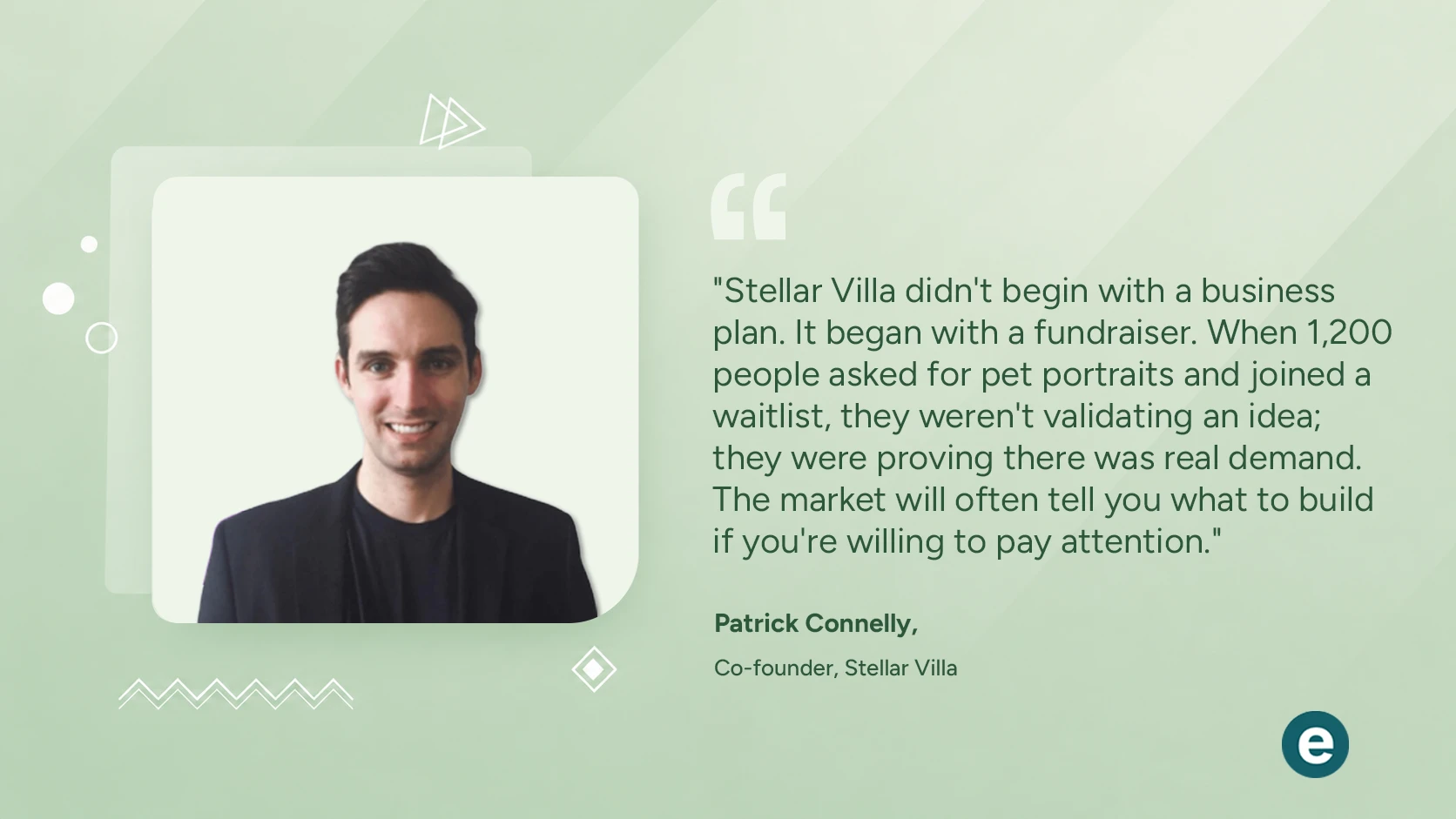
The founding story of Stellar Villa does not fit the standard entrepreneur narrative. Laura did not set out to build a pet portrait business. She set out to support an animal shelter during a moment of particular need.
The fundraiser worked beyond any reasonable expectation. Patrick, who has built several seven-figure eCommerce businesses, knew the difference between a waitlist that reflects curiosity and one that reflects genuine willingness to pay. Stellar Villa was the latter.
Patrick’s decade-plus in eCommerce gave Stellar Villa an operational foundation most new brands spend years building. The brand could focus on product and customer experience rather than discovering basic operational truths the hard way. Press coverage in Forbes, Marie Claire, and Fast Company followed because the product earned it.
About Patrick and Laura Connelly
Patrick and Laura Connelly are the co-founders of Stellar Villa, a pet portrait brand that grew from a pandemic fundraiser into a seven-figure business. Laura started by illustrating pet portraits to raise money for an animal shelter during COVID-19.
The fundraiser produced 1,200 illustrations and a waitlist. Patrick, with over a decade in eCommerce and multiple seven-figure businesses behind him, recognized what the waitlist represented: demonstrated demand, not potential demand.
Stellar Villa has since been featured in Forbes, Marie Claire, and Fast Company. The couple uses SCORE, the SBA-affiliated free mentorship organization, for business guidance, and P
Key Takeaways
- A pandemic fundraiser producing 1,200 pet portraits and a waitlist revealed genuine demonstrated demand before the brand formally launched.
- Patrick’s decade in eCommerce across multiple seven-figure businesses gave Stellar Villa operational foundations most new brands spend years developing.
- Forbes, Marie Claire, and Fast Company coverage reflects a product that earned press through quality rather than paid for it through PR spend.
- SCORE mentorship provided experienced guidance at no cost, demonstrating that advisory quality is not correlated with advisory price.
- Co-founder diversity of thinking, creative, and operational instincts working together, produces better outcomes than homogeneous founding teams.
Laura started Stellar Villa as a fundraiser. At what point did you recognize this as a business?
When I saw the waitlist. A fundraiser that generates 1,200 illustrations and a backlog of people who want more is not a charitable moment. It is demonstrated demand. The question I asked was whether people would pay enough for this to make it a real business. The answer was yes. That answer was already in the waitlist. We just had to build around it.
You have built multiple seven-figure eCommerce businesses before Stellar Villa. What did that experience change about how you built this one?
It changed the speed of critical decisions. I had already made most of the foundational mistakes in earlier businesses. With Stellar Villa, I knew which decisions were reversible and which were not, which operational choices would compound into problems later, and which early investments would pay off disproportionately. That pattern recognition is worth more than any single tactic.
You use SCORE rather than paid advisors for business mentorship. Why that choice?
Because the quality of guidance is not correlated with its cost. SCORE mentors are typically executives with decades of operating experience who have made the category of mistakes early-stage founders are about to make. The guidance is specific, honest, and current. Paid advisors can deliver the same thing, but free is not a signal of lower quality when the credential behind it is genuine.
Stellar Villa has been covered in Forbes, Marie Claire, and Fast Company. What drove that press coverage?
The product. Publications that cover lifestyle and culture are not looking for interesting founders. They are looking for interesting products with genuine stories. A pet portrait business that started as a pandemic fundraiser and grew into a seven-figure brand has a real story. The press followed the product quality and the origin, not a PR campaign.
You have spoken about diversity of thinking as a structural advantage in your founding partnership. What does that look like in practice?
Laura approaches the business from a creative and customer experience perspective. I approach it from an operational and growth perspective. When we disagree, it is usually because we are optimizing for different things, and the resolution almost always produces a better outcome than either of us would have reached alone. Diversity is important and when people who think differently work together, the end result is better ideas and better outcomes.
Lessons for Founders
- Waitlists created by genuine demand are more valuable than market research projections: they reflect actual willingness to pay rather than stated intent.
- Prior operating experience accelerates critical decision-making by reducing the category of mistakes a founder has not yet made.
- Advisory quality is not correlated with advisory cost: experienced mentors operating through organizations like SCORE deliver genuine value at no charge.
- Creative and operational co-founder pairings produce better decisions than homogeneous founding teams because disagreement surfaces the full problem.
For more founder stories and growth strategies from operators who have built from the ground up, read more at eFounder.club.