
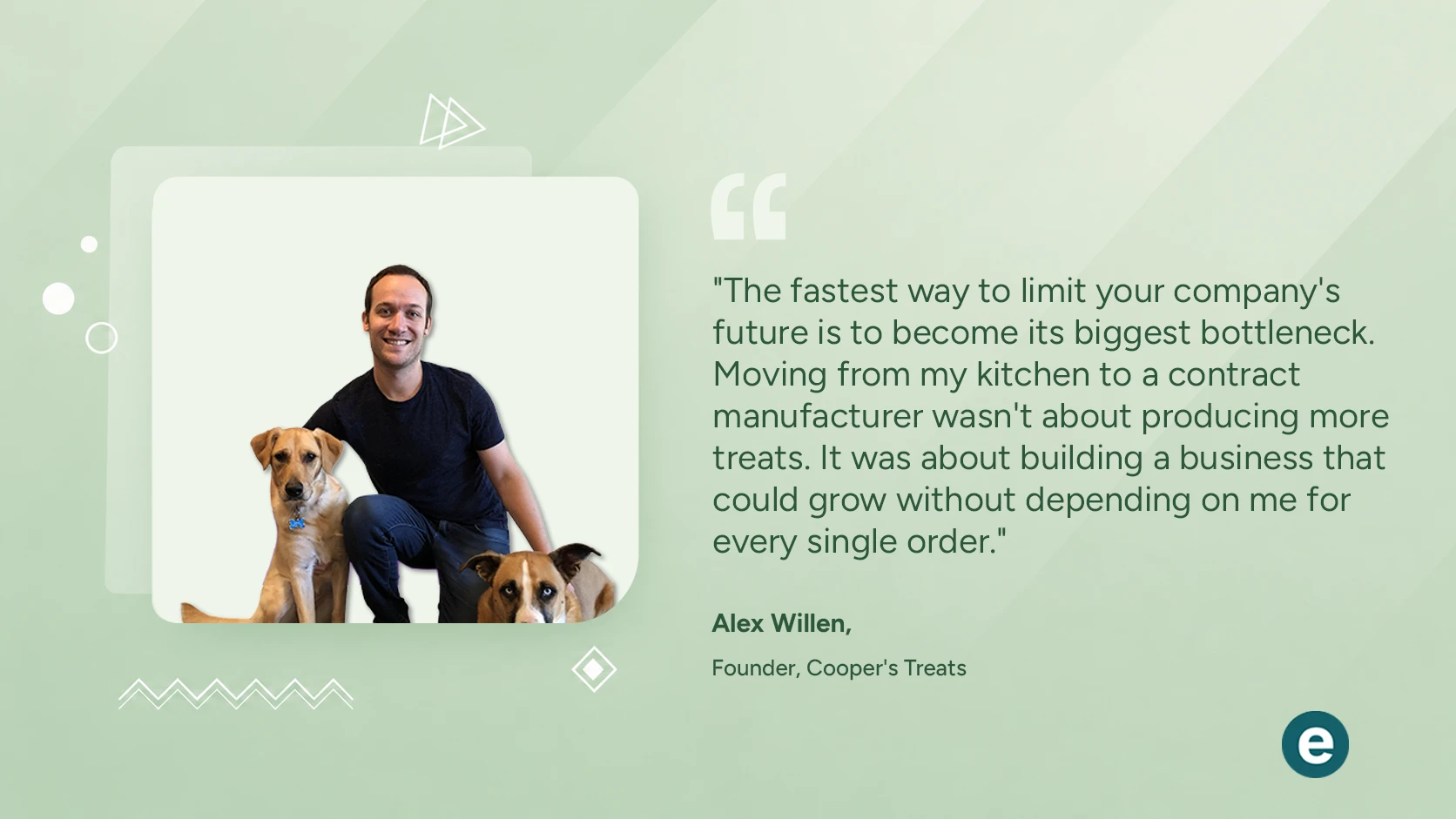
About Alex Willen
Most pet brand founders come from food science, veterinary nutrition, or consumer packaged goods. Alex Willen came from enterprise software. After spending a decade as a product manager at Silicon Valley companies like Box and Talkdesk, he moved to San Diego with a concrete plan to open a dog boarding facility.
When COVID-19 destroyed that plan just days before construction was set to begin, Alex did not wait for the market to recover. Instead, he looked at his dog Cooper, read the ingredient label on a freeze-dried meat treat, and realized he could no longer stomach feeding his pet synthetic stabilizers. He launched Cooper’s Treats out of his own kitchen and turned a personal frustration into a growing direct-to-consumer brand.
Building From Necessity
Many founders discover their business by accident. Alex discovered his by sheer necessity. The pandemic made his dog boarding business functionally impossible to open. Most people in that position would have spent months reassessing their life choices. Alex simply looked at the assets he already had.
He knew that the pet industry does not slow down for recessions. He knew that pet ownership was hitting an all-time high as people sought companionship during isolation. More importantly, he recognized that this massive influx of new dog owners did not want generic kibble full of unpronounceable chemical additives. They wanted products they could actually verify. Alex saw that opening because he was living entirely inside it.
Key Takeaways
- Alex abandoned his dog boarding business plan immediately when COVID-19 hit and pivoted to building a DTC brand based on personal frustration.
- The product iteration process required solving a complex two-customer problem. Both the dog eating the treat and the human buying it had to approve the formula.
- He achieved product-market fit by strictly using whole, recognizable ingredients like real meat and whole wheat flour instead of chemical stabilizers.
- Operational scaling was treated as a primary business objective. Moving from kitchen production to a professional contract manufacturer and 3PL happened within the first year.
- A core mission was woven directly into the business model from day one by partnering with animal rescues and donating a portion of every sale.
The Interview
Q: You spent a decade in Silicon Valley building enterprise software. What made you decide to leave that world and enter the pet industry?
Alex Willen: I wanted to build something I genuinely cared about. My original plan was to open a dog boarding facility here in San Diego. I had the lease signed, the permits secured, and the contractor completely ready to go. Then COVID-19 arrived in March 2020 and made group animal care facilities impossible to open. The boarding business vanished in a week, but my underlying insight about the pet industry was still valid. People increasingly treat their dogs as family members with real dietary standards.
Q: Most consumer brands start with a massive market analysis. Cooper’s Treats started because your dog refused a snack during a heatwave. How did that moment shape the company?
Alex: Cooper refused to eat his regular treats, so I improvised by blending the meat into powder, mixing it with water, and freezing it. He absolutely loved it. But when I actually read the ingredient label on the original treat bag, I was shocked. It contained things like carboxymethylcellulose and thiamin mononitrate. I decided right then that if I could not pronounce an ingredient, it had no business being in my dog’s bowl. That personal frustration became my entire product brief.
Q: Pet products have a unique dynamic where the buyer and the user are completely different species. How did you design a product that works for both?
Alex: You really have to solve a two-customer problem. The dog obviously has to love the taste, but the human has to trust the ingredient label and actually tolerate the smell of the product in their kitchen. A treat that dogs love but owners find visually repellent simply will not get a repeat purchase. I spent weeks iterating on ingredients like egg powder and whole wheat flour until both sides of that equation worked perfectly.
Q: You moved from making treats in your kitchen to using a contract manufacturer and a 3PL very quickly. Why was that such a priority for you?
Alex: Getting trapped in self-fulfillment is exactly where most small food brands either stall out or die. If you only sell what you can personally produce and ship from your kitchen, you cap your growth immediately. I treated operational graduation as a mandatory milestone for year one rather than an eventual aspiration. You have to remove yourself as the primary bottleneck if you ever want the business to scale.
Q: Cooper’s Treats donates a portion of every sale to rescue dogs. Do you view that as a marketing strategy or a core part of the business model?
Alex: It is absolutely a core part of the business model. Both of my dogs are rescues, so that mission is deeply personal. But from a business perspective, a customer who buys your product purely for the clean ingredient list might switch if a competitor launches something cleaner. A customer who buys from you because your brand actively shares their values about animal welfare is much harder to displace. The mission creates the community before the community creates the revenue.
Q: The pet industry is increasingly dominated by massive corporate conglomerates. How does a bootstrapped brand survive against that level of competition?
Alex: You survive by serving the exact segment that mass-market retail completely ignores. The pet owners I build for are the same consumers who scrutinize the nutrition labels on their own food. They demand verifiable supply chains and whole ingredients. Corporate brands cannot easily pivot to those standards because their entire margin structure relies on cheap synthetic fillers. If you build exactly what the conscious consumer demands, you do not need to compete on corporate shelf space.
Lessons for Founders
- Pivot with absolute speed. When the market closes a door, do not spend months processing the loss. Speed of execution matters far more than the elegance of the pivot itself.
- Solve the two-customer problem. In categories where the buyer is not the end user, your product must perfectly satisfy the emotional and practical needs of both parties to generate retention.
- Operational scaling is a mandatory milestone. Do not get trapped in self-fulfillment. Moving to a professional manufacturer and 3PL should be a year-one objective rather than a distant dream.
- Mission drives retention. Customers will eventually abandon a product feature, but they will fiercely protect a brand that actively funds a mission they deeply care about.
If you want to read more about founders who built real companies from unexpected pivots, explore more stories at eFounder.club.