
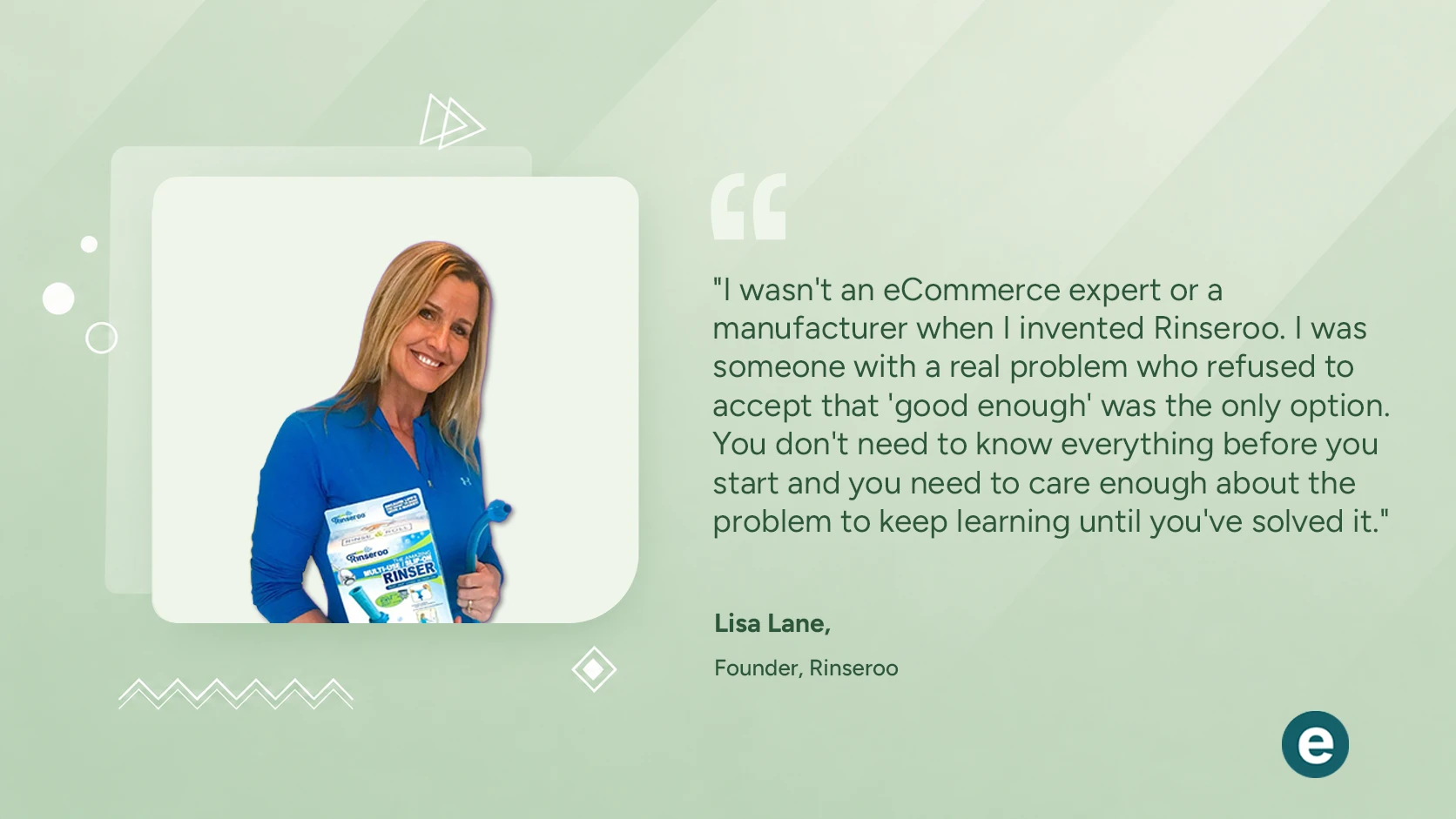
The founding idea for Rinseroo did not come from a gap analysis or a market research report. It came from a practical problem that had no good existing solution: four dogs, a large tub, and the only available option being a cup of water. Lisa recognized the problem as specific, universal, and underserved. Her pharmaceutical sales career had taught her persistence, rapid value communication to skeptical professionals, and tolerance for rejection. All three transferred directly to building a product company from scratch.
Her advice to first-time founders is concrete: do not resell existing products. Build something that is slightly better, something you can protect, something with a genuine differentiator. Rinseroo is patented. That protection was not incidental. It was a founding priority.
About Lisa Lane
Lisa Lane is the founder of Rinseroo, a patented slip-on shower attachment hose that makes rinsing and cleaning significantly easier without requiring any installation. She arrived at the idea through a messy bathroom at a Jersey Shore beach house with four dogs, a large tub, and no practical way to rinse any of them efficiently. She was a pharmaceutical sales representative with no e-commerce background and no manufacturing contacts before she built it.
She solved both gaps with a single resource: the Mom Inventor’s Handbook, which she read cover to cover and treated as her founding curriculum. Her grandfather, always creating solutions to everyday problems, modeled the inventor’s disposition from her childhood. That disposition was in her before Rinseroo gave it a specific direction.
Key Takeaways
- Rinseroo was invented to solve a specific, observed problem with no good existing solution: bathing dogs and rinsing large tubs without installation requirements.
- Lisa is self-educated entirely through the Mom Inventor’s Handbook, demonstrating that focused single-source learning can replace formal business training.
- Pharmaceutical sales experience built persistence, rapid value communication, and rejection tolerance that transferred directly to founding a product company.
- A grandfather who modeled the inventor’s disposition from her childhood gave Lisa a problem-solving orientation she brought to Rinseroo before she had the specific idea.
- Rinseroo is patented, reflecting Lisa’s founding conviction that first-time founders should build something protectable rather than reselling existing products.
You were a pharmaceutical sales rep with no eCommerce background when you decided to build Rinseroo. What gave you the confidence to start?
The problem was real and specific and I could not find anything that solved it well. Confidence came from the problem, not from prior experience in the category. Pharmaceutical sales taught me that you do not need to have invented a drug to sell it effectively. You need to understand the problem it solves and be able to communicate that clearly. The same logic applies to building a product. I understood the problem. The rest I was going to figure out.
You used the Mom Inventor’s Handbook as your primary educational resource. How comprehensive was that single-book approach?
Comprehensive enough to get me to a patent and a product. The book answered questions I did not know to ask: whether a product is worth selling, whether there is genuine mass market demand, how to approach manufacturing, and how to think about intellectual property. I describe it as my bible because it functioned that way. One authoritative source, read thoroughly and applied specifically, replaced what I would have spent years learning by trial and error or in a formal program.
Rinseroo is patented. How early in the process did intellectual property protection become a priority?
From the beginning. My advice to any first-time founder is to build something you can protect. Reselling existing products is a race to the bottom because anyone can do it. A patent gives you a window of protection that allows you to establish the brand before competitors can replicate the product exactly. The patent was not something I added after the product was built. It was part of the founding logic.
Your grandfather modeled the inventor’s disposition for you. How much of what you built with Rinseroo came from him?
More than I recognized at the time. He was always creating solutions to everyday problems, not because he was trying to build a business, but because that is how he approached the world. I absorbed that orientation without naming it. When I encountered the bathtub problem at the beach house and my first instinct was to think about what the right solution would look like, that was his influence showing up. Rinseroo was specific to me, but the disposition that made me see it as a problem worth solving was his.
What would you tell someone who has an idea but has not acted on it?
Building something of your own and selling it is easier than it ever was. The world is your oyster, all you need to do is know what you are good at and have the courage to go after it unabashedly. The gap between having an idea and building something from it is not intelligence or creativity. It is action. Most people who have good ideas do not act on them. That is the only real differentiator between founders and everyone else.
Lessons for Founders
- Focused single-source learning from an authoritative resource can replace years of formal training when applied thoroughly and specifically.
- Build something protectable rather than reselling existing products: a patent creates a window of competitive protection that allows brand establishment before exact replication.
- Skills from unrelated careers, pharmaceutical sales persistence and value communication in Lisa’s case, transfer directly to founding product companies.
- The inventor’s disposition, the instinct to see everyday problems as worth solving, is a foundational founder trait that can be cultivated from role models before it is applied to a specific idea.
For more founder stories and growth strategies from operators who have built from the ground up, read more at eFounder.club.