
Ginger ale as a category is largely fictional as a digestive health intervention. The products labeled as ginger ale contain trace amounts of ginger flavoring alongside substantial quantities of sugar. They were not formulated to address digestive discomfort. They were formulated to taste pleasant and sell at volume.
Miles formulated Soov from the opposite direction: real ginger juice at meaningful concentration, ingredients with documented digestive benefit, and a sugar level that did not create secondary problems. The truck accident that destroyed his contract manufacturer’s equipment was an existential event. A brand with weak underlying demand would not survive. Soov survived because customers genuinely needed it.
About Miles Gotcher
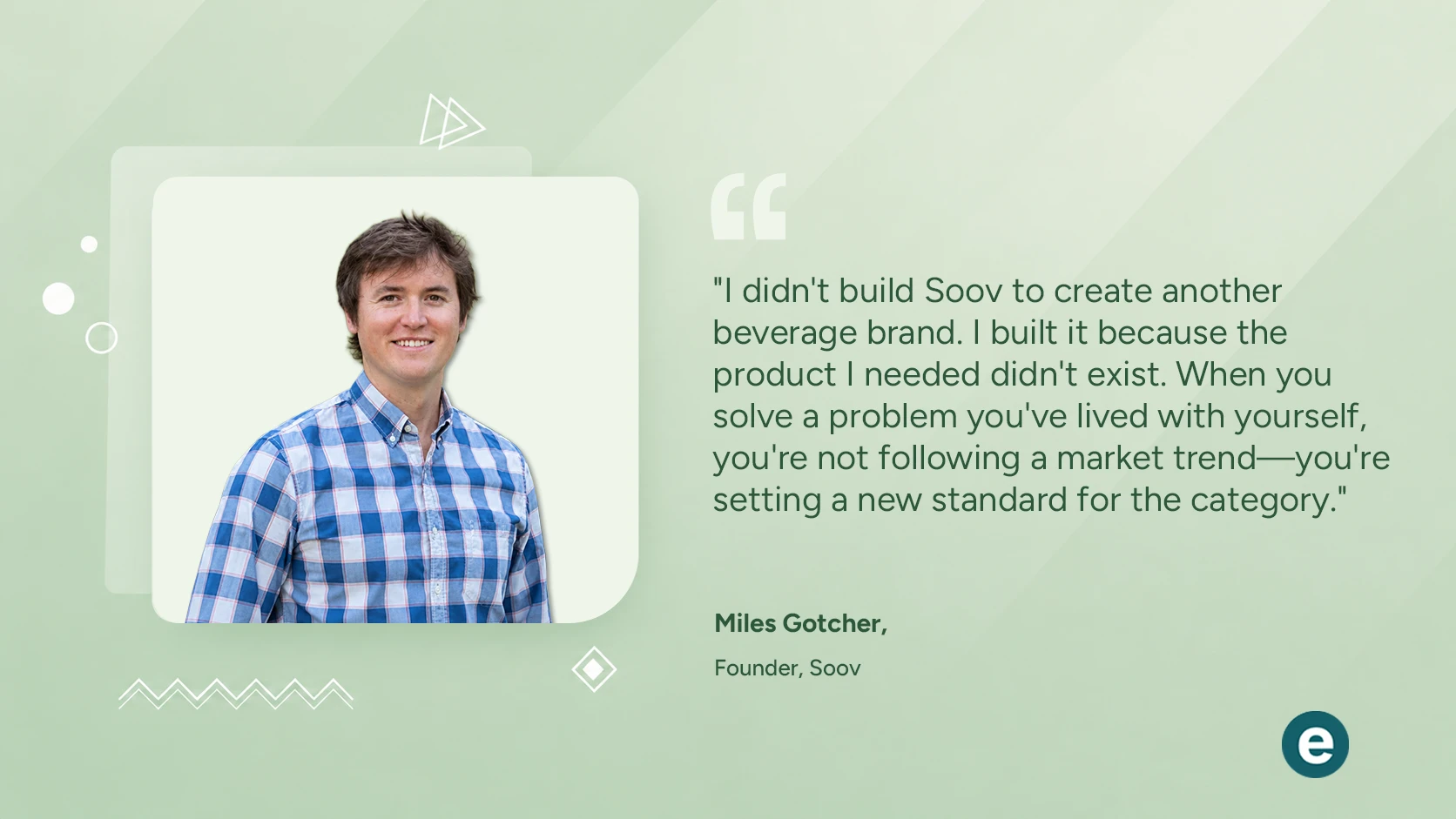
Miles Gotcher is the founder of Soov, a functional digestive drink built on real ginger juice and distributed across 30 states. He built it because the products available to the 45 million Americans living with IBS were, at best, dressed-up sugar water. Miles had IBS. The home remedy he developed to manage it became the product.
Soov contains 80% less sugar than conventional ginger ale and 31% real juice content. A truck accident destroyed equipment at his contract manufacturer during early scaling. He rebuilt. The brand now ships to 30 states.
Key Takeaways
- Miles built Soov to address his own IBS, producing a formulation grounded in personal efficacy testing rather than category convention.
- Soov contains 80% less sugar than conventional ginger ale and 31% real juice, representing a genuine reformulation rather than incremental improvement.
- A manufacturing crisis caused by a truck accident tested the brand’s demand resilience and confirmed genuine customer need.
- 30-state distribution was achieved without a major retail partnership, through consistent rebuild and organic expansion.
- One in seven Americans has IBS; 60-75% experience occasional digestive issues, providing a large addressable population underserved by existing products.
You had IBS and built a drink brand to address it. What was wrong with what was already available?
The available options were not designed for what I was experiencing. Ginger ale has the word ginger in the name and almost no ginger in the formula. What it has is sugar, which is not what a digestive system under stress needs. I built Soov because I needed it and it did not exist.
Your contract manufacturer’s equipment was destroyed in a truck accident during early scaling. How did you respond?
The first question was whether the demand was real enough to justify finding another path. It was. Customers who had found Soov were using it specifically because it worked for something they dealt with regularly. That demand gave me the confidence to spend the time finding new manufacturing capacity and rebuilding.
The addressable market for digestive health beverages is large. How do you reach people who do not yet know Soov exists?
Most people with IBS or digestive discomfort have accepted they will manage it with whatever is available, because the available options are all they know. Reaching them requires demonstrating that something meaningfully different exists. We have to create awareness before we can create preference.
What does a 30-state distribution look like operationally for a small brand?
A lot of individual decisions about prioritization and logistics made carefully, not a single retail deal that unlocked everything. We expanded state by state based on where demand was building and where we could serve customers well. That is slower than a major retail partnership but more durable because each market was earned rather than assigned.
What would you tell a founder entering the functional beverage category?
Know whether you are reformulating a category or competing within it. Those are very different businesses. If you are genuinely reformulating, your product needs to actually do what existing products do not, and you need to explain that difference in a way that is specific enough to be verifiable. If your label supports your claim, lead with the label.
Lessons for Founders
- Personal need-driven formulation produces products that address genuine gaps rather than incremental variations on existing solutions.
- Manufacturing crises reveal demand resilience: the rebuild decision exposes whether customers need the product or merely tried it.
- Incremental geographic expansion builds more durable distribution than single channel events that assign presence without earning it.
- Category reformulation requires demonstrating difference specifically and verifiably, not claiming it rhetorically.
For more founder stories and growth strategies from operators who have built from the ground up, read more at eFounder.club.