
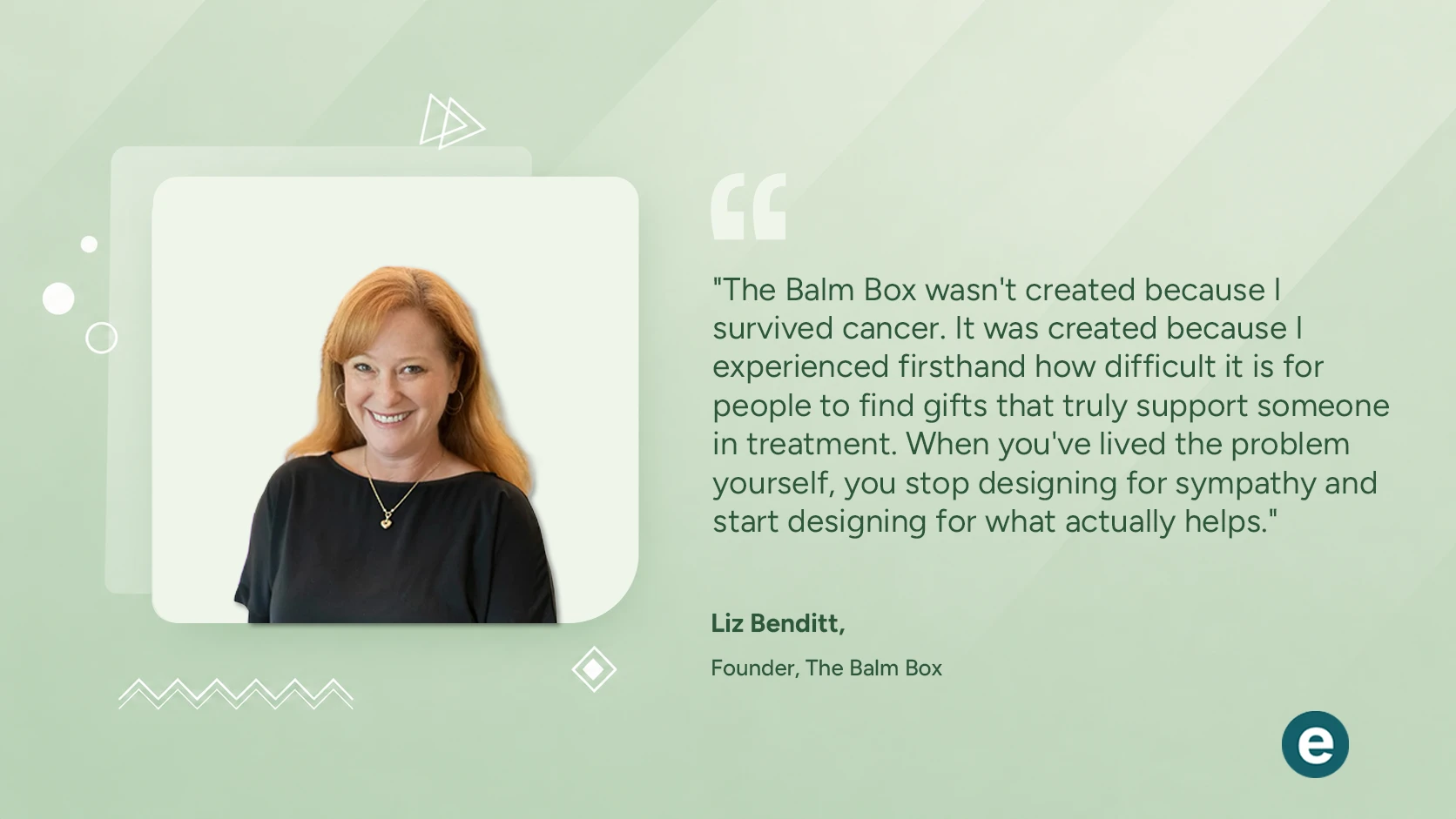
Liz moved to Kansas City in 2000 to be closer to her mother, who had been diagnosed with breast cancer. That decision, to reorganize her geography around family health needs, foreshadowed the logic behind The Balm Box. What the market offered cancer patients was symbolism: branded merchandise, awareness colors, and inspirational messages. Those gestures mean something. They do not replace functional support.
When Liz completed her breast cancer treatments, her friends threw her a finish line party. She describes it as, next to her wedding, her favorite event of her life. That phrase, the finish line, became the emotional anchor of how she talks about The Balm Box’s mission. The brand exists to support people on their way to their own finish lines, with products that serve the actual physical realities of treatment rather than its symbolism.
About Liz Benditt
Liz Benditt is the founder of The Balm Box, a curated gift brand for cancer patients, which she built after being diagnosed with four different cancers between 2009 and 2017: melanoma, thyroid cancer, basal cell carcinoma, and breast cancer. She underwent surgeries, treatments, and the particular experience of receiving gifts that meant well but missed what she actually needed.
Before The Balm Box, Liz built an executive marketing career spanning Hallmark Cards, Bluetooth, and Lyric Opera of Kansas City. She surveyed over 500 patients and gift buyers before launch. What the research confirmed, her personal experience had already established: there is a significant and consistent gap between what cancer patients need and what the people who love them are able to find and give.
Key Takeaways
- Liz was diagnosed with four different cancers between 2009 and 2017, giving her direct experience of the gap between what patients need and what conventional gifts provide.
- 500 patient and gift buyer surveys before launch confirmed what personal experience had already established: a significant, consistent gap in cancer patient gifting.
- An executive marketing career at Hallmark Cards, Bluetooth, and Lyric Opera of Kansas City gave Liz the commercial discipline to build a brand rather than just a product.
- The finish line party after breast cancer treatment became the emotional anchor of The Balm Box’s mission and the brand’s language for what it supports.
- A customer note describing beautiful packaging, functional products, and the particular psychological effect of feeling cared for confirmed the product’s actual value to patients.
You were diagnosed with four cancers over eight years. When did that experience become the founding logic for The Balm Box?
During breast cancer treatment in 2017. By then I had been through enough treatment cycles to have a precise understanding of what patients actually need and what the gifting market offers instead. I kept receiving well-intentioned things that were genuinely unhelpful for what I was physically experiencing.
My experience as a cancer patient led me to walk away from my marketing career to build the solution. The mission was not abstract. I was the person the product was built for.
You surveyed over 500 patients and gift buyers before launching. What did the research confirm that your personal experience had already told you?
The gap is consistent and significant. Gift buyers want to do something meaningful for the person they love who is going through treatment, and they cannot find a credible option that feels intentional rather than generic.
Patients need products that serve the physical realities of their specific treatment, not awareness merchandise. The research confirmed both sides of that equation are underserved and that the gap is not specific to my experience or to a particular type of cancer.
The finish line party your friends threw after your breast cancer treatment became important to the brand. How does that translate into what The Balm Box does?
The finish line is the emotional frame. Every person undergoing cancer treatment is on their way to their own finish line, even if the distance and route are uncertain. The Balm Box exists to support people on that journey with products that serve the actual experience rather than its symbolism.
The party was the most vivid confirmation I have had that the moment of completion deserves recognition and support that is specific to what the person went through to get there.
A customer wrote to The Balm Box after receiving a box before radiation therapy. What did that note say and why did it matter?
The note described beautiful packaging, products that served the physical realities of treatment, and the particular psychological effect of feeling genuinely cared for rather than generically remembered. That last element is what the brand is designed to produce. A patient going through radiation treatment knows the difference between a gift selected with knowledge of what she is experiencing and one selected because it was the available option. That customer’s note described the difference specifically. It confirmed that The Balm Box was doing what it was built to do.
Your marketing career at Hallmark Cards gave you a specific understanding of the gifting category. How did that shape how you built The Balm Box?
It gave me a commercial framework for what makes a gift brand credible and what makes gifting decisions work at scale. Hallmark operates at a level where you understand how people think about giving, what makes a gift feel meaningful versus obligatory, and how to curate for an occasion in a way that serves the giver and the recipient simultaneously.
Building The Balm Box for a specific and emotionally significant occasion, cancer treatment, required exactly that kind of category understanding applied to a population with very specific functional needs.
Lessons for Founders
- Direct personal experience of the problem a product solves produces founding conviction that market research can confirm but not replace.
- Surveying 500 users before launch is not validation theater when the founder already knows from experience what the gap is: it is evidence collection that converts personal conviction into commercial credibility.
- Emotional anchors from personal experience, the finish line in Liz’s case, create brand language that is specific, resonant, and owned by the founder in a way that manufactured brand concepts are not.
- Category expertise from an adjacent commercial field, gifting at Hallmark in Liz’s case, provides a commercial framework that direct industry experience does not always supply.
For more founder stories and growth strategies from operators who have built from the ground up, read more at eFounder.club.