
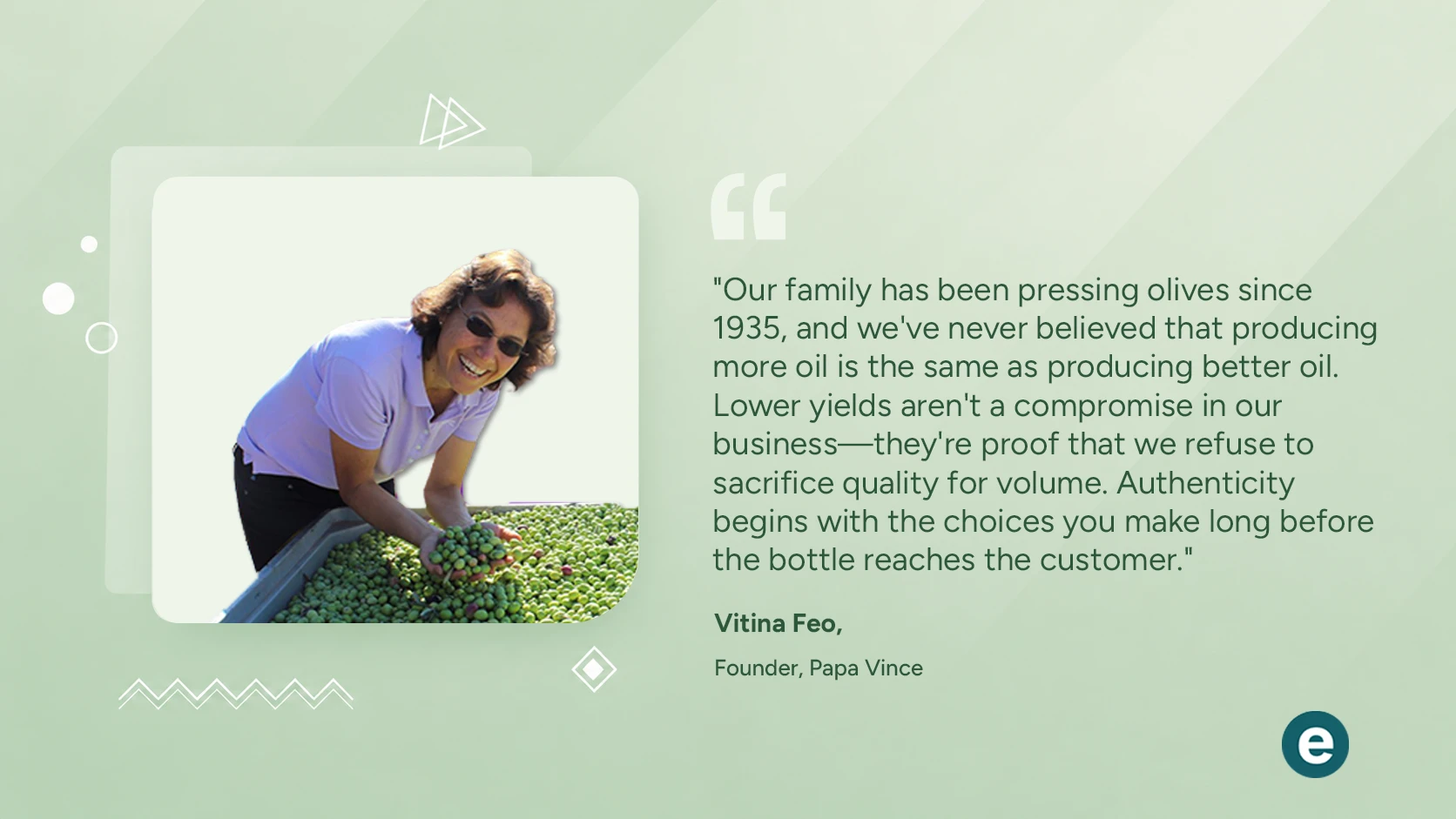
Most olive oil brands sell a story about the Mediterranean. Papa Vince sells the real thing. The production shortcuts that maximize yield also compromise what makes premium extra virgin olive oil worth distinguishing from a commodity product. Vitina’s engineering background gave her the systematic discipline to document and defend that distinction at every step of the supply chain.
Papa Vince offers annual tours of Sicily for seven to eight customers per cohort. That scale is deliberate. Customers who visit the estate, meet the family, and watch the press operate do not need to be convinced of the product’s authenticity. They have experienced it. That converts a transaction into a relationship.
About Vitina Feo
Vitina Feo is the founder of Papa Vince, a Sicilian olive oil brand built on a family press that has operated since 1935. She came to the business not through culinary school or the food industry but through computer science engineering and a family heritage that gave her the product before she had the business.
Papa Vince only presses the freshest green olives at peak polyphenol content, producing an oil yield of 13% to 18%, lower than the industry standard. That lower yield means Papa Vince produces less oil per batch than competitors who press further. It also means the oil retains what makes premium extra virgin olive oil worth the price.
Key Takeaways
- Papa Vince presses only the freshest green olives at peak polyphenol content, producing a 13-18% yield lower than the industry standard to protect quality.
- Vitina’s computer science engineering background gave her a systematic operational discipline she applied directly to supply chain management.
- The brand moved from farmers’ markets to Amazon without losing what made the product special, a transition most premium food brands struggle to make.
- Annual Sicily tours are limited to 7-8 customers, converting transactions into long-term relationships through direct experience of the production process.
- The 90-year family press is not a marketing story. It is the actual production infrastructure on which the brand is built.
You are a computer science engineer who built a food brand. What did that background actually give you?
Systematic thinking. Engineering trains you to understand systems, to trace cause and effect through a process, and to identify where the process breaks down. When I looked at olive oil production, I applied the same lens. What most companies do not understand is just that: the shortcuts that maximize yield are the same shortcuts that compromise what makes the oil worth buying. My engineering background made that connection obvious in a way it might not have been if I had come from the food industry.
Papa Vince produces a lower oil yield than the industry standard. That costs you margin. How do you justify that decision commercially?
By not competing on price. If you produce the same oil at the same yield for the same customer as commodity olive oil brands, you are in a race you cannot win. Papa Vince is not competing in that race. We are producing something genuinely different for a customer who can tell the difference and is willing to pay for it. The lower yield is the product. It is not a cost to be minimized.
You went from farmers’ markets to Amazon. Most premium food brands find that transition difficult. What made it work for Papa Vince?
The product. When your differentiation is real, specific, and demonstrable, it travels across channels better than differentiation that relies on in-person experience or ambient brand signals. At a farmers’ market, customers can taste it. On Amazon, the reviews carry that function. If the product genuinely does what you say it does, customers will describe that in ways that replace the tasting table.
The annual Sicily tours are capped at seven to eight people. Why keep that so small?
Because the experience only works at that scale. Seven customers can meet my family, walk the estate, watch the press operate, and understand where the oil actually comes from. Seven hundred cannot. Keeping the tours small means they remain what they are supposed to be: a conversion of a product relationship into a human one. That is worth more than the revenue from running larger tours.
What do you think the premium olive oil category consistently gets wrong?
The story is often bigger than the product. Many brands have found that consumers respond to Italian heritage and Mediterranean imagery and authentic-sounding family names. What fewer brands have done is match that story to a production standard that actually delivers. Papa Vince starts from the production and lets the story follow. That sequence produces a different product.
Lessons for Founders
- Lower yield as a deliberate product decision reframes margin compression as a quality signal rather than an operational problem.
- Engineering disciplines applied to food production supply chains produce systematic quality controls that culinary backgrounds rarely generate.
- Premium product differentiation that is real and specific travels across distribution channels without losing its credibility.
- Small-scale customer experiences that deliver genuine connection are worth more commercially than scaled events that dilute the relationship.
For more founder stories and growth strategies from operators who have built from the ground up, read more at eFounder.club.