
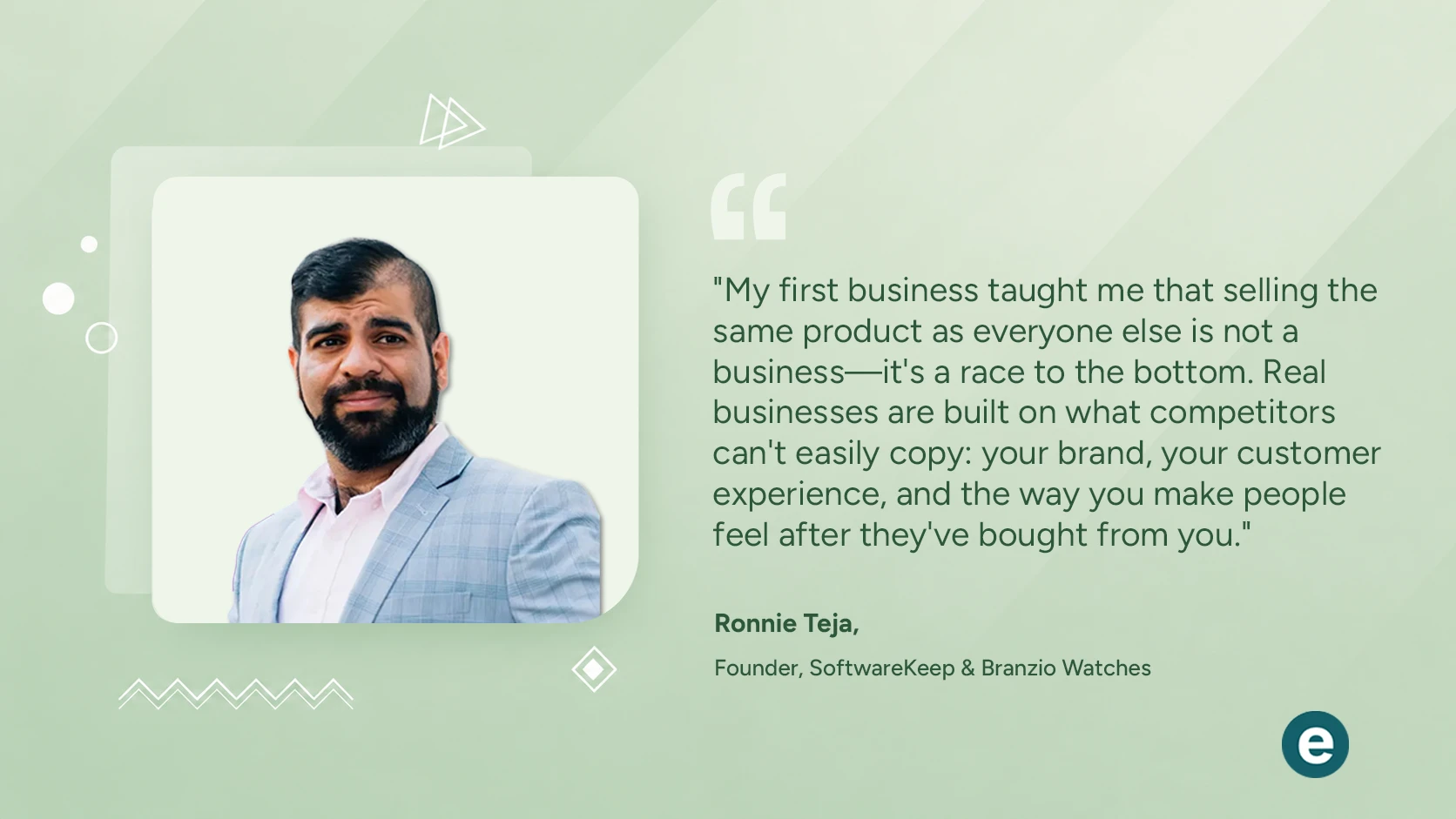
Ronnie’s trajectory from first-generation immigrant to multi-brand founder follows a pattern that researchers have documented consistently: immigrant founders are statistically overrepresented in high-growth company formation. The reasons are structural. Immigration requires navigating unfamiliar systems without the default support networks locals assume. That experience builds a specific kind of problem-solving resilience.
The dropshipping phase did not work. Ronnie does not obscure this. What he took from that failure was a clearer understanding of what makes a business defensible: brand, differentiation, and customer experience. Branzio Watches was built on all three. When a clone appeared on Kickstarter six months into development, Ronnie continued. The clone validated the concept.
About Ronnie Teja
Ronnie Teja is the founder of SoftwareKeep and Branzio Watches, two brands built by a first-generation Canadian immigrant who arrived in 2007 with an advertising background and no entrepreneurship roadmap. He moved through advertising, Best Buy, and HSBC before deciding to build his own business, a sequence that produced both corporate operational discipline and a clear picture of what he did not want.
His path included a failed dropshipping attempt, a watch brand clone discovered on Kickstarter six months into development, and an eventual operating thesis: software retail should feel like a premium service, and if competitors imitate you, that is confirmation rather than threat.
Key Takeaways
- First-generation immigrant experience built the problem-solving resilience and systems navigation skill that Ronnie applied directly to building businesses.
- A failed dropshipping attempt clarified what makes a business defensible: brand, differentiation, and customer experience rather than margin and volume.
- A Kickstarter clone of Branzio Watch six months into development was interpreted as concept validation rather than competitive threat.
- SoftwareKeep is built on the premise that software retail should feel like a premium service, differentiating on experience in a commodity category.
- A college roommate as trusted peer support provided the personal foundation that structured business support cannot replicate.
You arrived in Canada as a first-generation immigrant and built two brands. What did that experience of immigration give you as a founder?
The experience of navigating systems that were not built for you without the networks that locals assume. When you arrive without a roadmap, you develop a specific kind of resourcefulness. You learn to figure things out without asking for permission or waiting for the support structure to appear. That disposition transfers directly to early-stage company building, which is also fundamentally an experience of navigating without a roadmap.
Your dropshipping attempt failed. What did you learn from it that shaped what came next?
That a business without differentiation is not really a business. It is a margin arbitrage exercise that works until someone undercuts you. Dropshipping taught me that defensibility requires brand, customer experience, and something a competitor cannot simply replicate by listing the same product at a lower price. Branzio and SoftwareKeep were both built specifically to have that kind of differentiation.
You discovered a clone of Branzio on Kickstarter six months into development. How did you respond?
I kept building. A clone means your product was worth copying, which is confirmation that you built something real. The alternative interpretation, that the clone invalidates the opportunity, gets the logic backwards.
If your concept is worth imitating before you even launch, that is a signal about the concept, not a reason to abandon it. We view imitation as welcome. If our competitors imitate us, we gladly welcome them.
SoftwareKeep operates in a commodity category. Software itself has no differentiation. How do you build a defensible business around it?
Through the experience around the software, not the software itself. A software key is a commodity. The support, the guidance, the relationship a customer builds with a retailer who treats them as more than an order number, that is not a commodity.
SoftwareKeep is built on the premise that the purchase experience is the product. That is something a race-to-the-bottom competitor cannot replicate without changing their fundamental operating model.
What role did your personal support network play in getting through the early failures?
My college roommate was a key part of getting through the difficult early stages. There are parts of building a business that structured support cannot reach: the personal doubt, the moments where you are not sure the next decision is right, the nights when nothing is working. Having someone who knew me before the business, who understood what I was trying to do and believed in it, was different from any advisor or mentor relationship. That kind of peer trust is not replaceable.
Lessons for Founders
- Defensibility in a business requires brand, differentiation, and customer experience rather than margin and volume advantages that any competitor can match.
- Treating product clones as concept validation rather than competitive threat reframes imitation as a market signal about the quality of your idea.
- Experience-layer differentiation in commodity categories is more durable than product-layer differentiation because it requires a fundamental operating model change to replicate.
- Trusted personal peer support provides a form of resilience during early-stage building that structured advisory relationships cannot substitute.
For more founder stories and growth strategies from operators who have built from the ground up, read more at eFounder.club.