
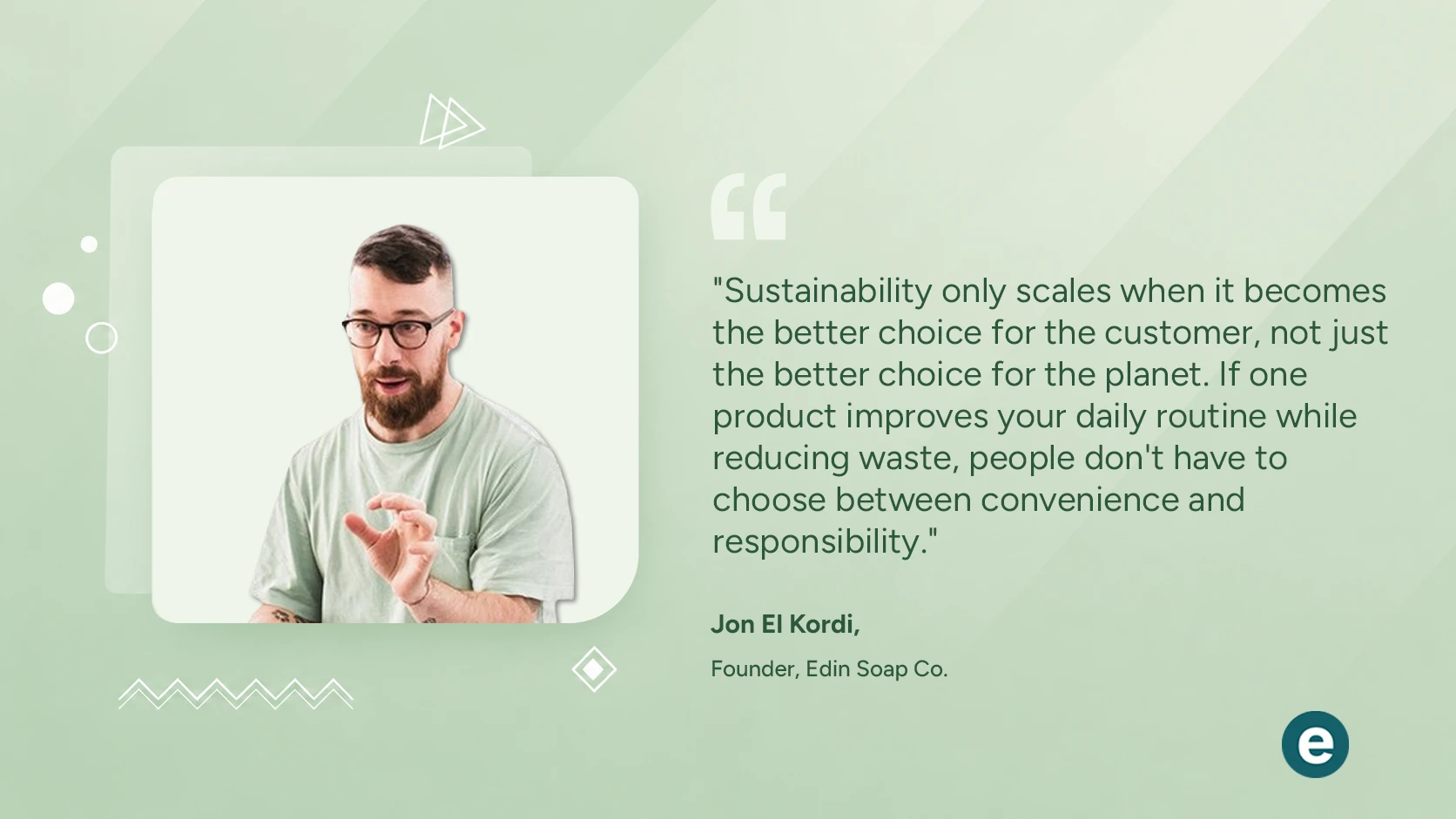
About Jon El Kordi
Most soap brands sell cleanliness. Jon El Kordi decided to sell responsibility. Before launching Edin Soap Co., Jon spent years helping other businesses solve complex growth problems. His career moved through market research, healthcare advertising, and eventually performance marketing, where he helped brands develop customer acquisition strategies and positioning frameworks.
Instead of starting with a product and figuring out marketing later, Jon and his fiancée, Rachel, started with a clear understanding of how successful consumer brands earn attention and trust. The result is Edin Soap Co., a sustainable personal care brand built around the idea that everyday products should benefit both the user and the environment.
Brand Identity Before Product: How Jon El Kordi Built a Personal Care Brand?
Many founders assume product development is the hardest part of building a consumer brand. It is not. Getting customers to trust an unknown product is often much harder. Years spent working with businesses ranging from startups to Fortune 500 companies taught Jon that consumers judge before they evaluate.
A strong visual identity creates credibility long before someone reads a product description, studies the ingredients, or compares prices. That crucial insight shaped Edin’s launch strategy. Rather than rushing products into the market, the founders invested heavily in defining the brand personality, visual language, photography, and typography. Customers rarely compare every option rationally. They make emotional decisions first and logical decisions second, and Edin was designed specifically for that sequence.
Key Takeaways
- Jon spent more time building brand identity than manufacturing the initial product because trust is often a visual decision before it becomes a purchasing decision.
- Edin Soap was built on lessons gathered from years of helping other brands scale through performance marketing and customer acquisition.
- The company completely abandoned its overseas expansion plans during the pandemic and successfully refocused on the U.S. market.
- Sustainability became a functional product strategy rather than a marketing slogan by replacing plastic packaged body wash with cold processed soap bars.
- Building a business with a life partner created operational advantages by combining Rachel’s creative vision with Jon’s analytical expertise.
The Interview
Q: You spent years working in performance marketing and healthcare advertising. How did that background help you launch a sustainable soap company?
Jon El Kordi: Working with startups and Fortune 500 companies taught me exactly what fails and what succeeds. I learned that getting customers to trust an unknown product is often much harder than actually creating the product itself. We did not start with a soap recipe and try to figure out marketing later. We started with a clear understanding of how successful consumer brands earn attention and trust, then we built the physical product to match that framework.
Q: You spent an unusual amount of time developing your visual identity before launching. Why prioritize design over getting to market quickly?
Jon: Consumers judge before they evaluate. A strong visual identity creates instant credibility before someone ever reads a product description or compares prices. Customers rarely compare every option rationally. They make emotional decisions first and logical decisions second. The time we spent developing our visual language, photography, and typography became one of our absolute strongest assets because it built trust instantly.
Q: You refer to your soap bars as “Ingots of Wellness.” What drove that specific positioning?
Jon: Historically, an ingot represents a block of refined precious material like gold or silver. I wanted customers to think about soap completely differently. It should not be treated as a cheap, disposable commodity. What people place on their skin deserves the exact same attention they give to what they eat. We want to redefine consumer expectations around everyday wellness products, which creates immediate separation in a category crowded with identical claims.
Q: The market is incredibly crowded with greenwashing. How do you make your sustainability claims resonate with skeptical consumers?
Jon: People rarely change their habits just because they want to save the planet. They change habits because the alternative is actually better for them personally. We position sustainability and personal wellness as the exact same decision. Replacing one plastic body wash bottle with our cold processed soap bar means healthier ingredients for your body and less plastic for the environment. One action serves both goals.
Q: You built this company with your fiancée Rachel. What is the reality of running a startup with your life partner?
Jon: It creates an incredible dynamic that most startups spend years trying to manufacture through hiring. Absolute trust, open communication, and shared incentives already existed from day one. Rachel brings immense creativity and a thoughtful approach that influences our entire visual identity and customer experience. I bring the growth and analytical expertise. It creates perfect operational balance.
Q: Your original vision included international growth, but you pivoted completely during the pandemic. What did that disruption teach you about strategy?
Jon: We had massive plans for overseas operations, but the world shifted. Rather than forcing our existing plan to survive, we made the difficult decision to redirect entirely toward the U.S. market. That disruption actually triggered a complete rebrand and a new direction. Many founders treat pivots as failures, but they are actually signs of good judgment. The businesses that survive major disruptions are the most adaptable ones, not the most stubborn ones.
Lessons for Founders
- Invest in brand identity early. Trust is created through design and visual consistency long before a customer ever tries your physical product.
- Build around skills you already understand. Leverage your past career experience instead of trying to learn massive new skills like marketing from scratch after launching.
- Align sustainability with personal benefit. Consumers adopt better environmental habits much faster when those habits directly improve their own daily lives.
- Adapt faster than circumstances change. When external disruptions destroy your original roadmap, pivot immediately. Stubbornness kills more companies than market shifts do.
If you know a founder with practical lessons worth sharing, nominate them for a future feature at eFounder.club.